Clear Sky Science · en
Mechanical gating of tendon fibrogenic transcription in systemic sclerosis
Why tendon stiffness matters in a whole‑body disease
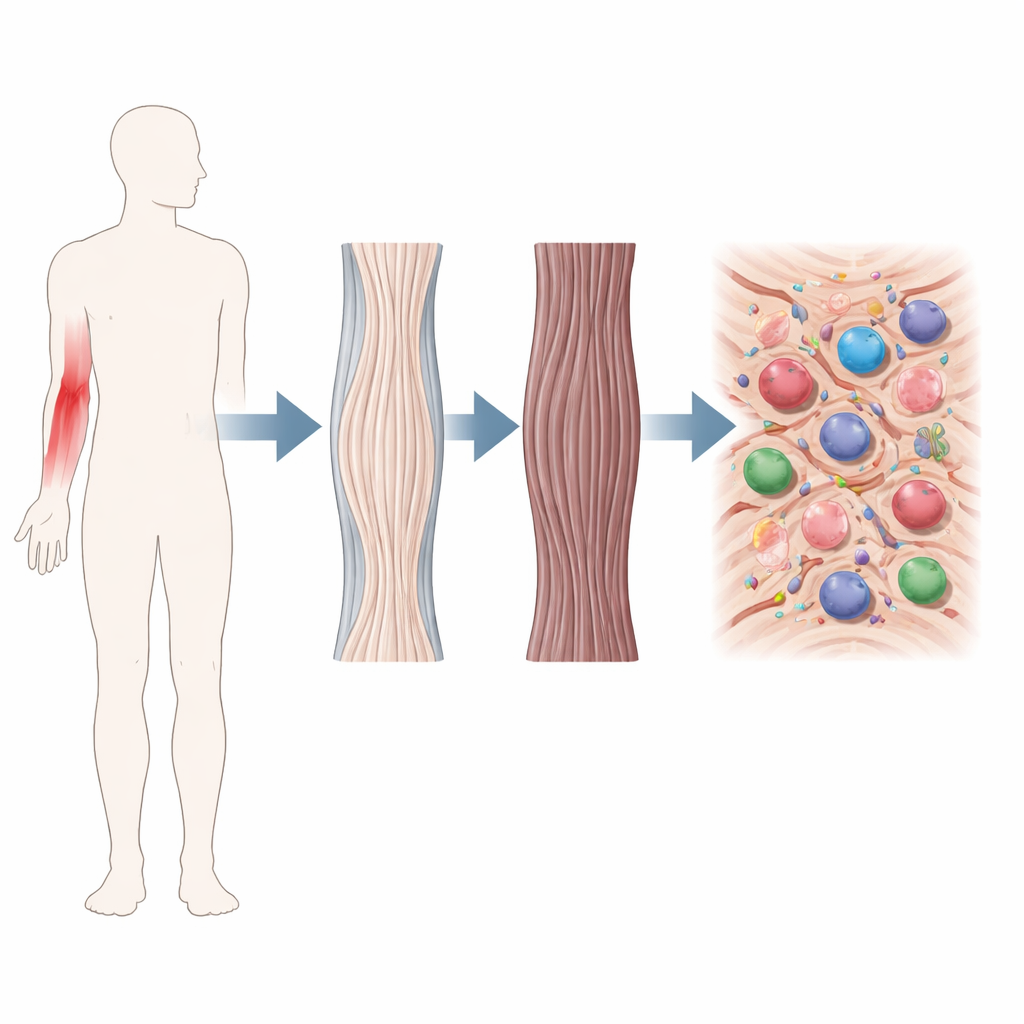
Systemic sclerosis is an autoimmune disease best known for hardening the skin and damaging internal organs, but it also quietly alters tendons—the tough cords that connect muscle to bone. When tendons become abnormally stiff, everyday movements can become painful and joints may gradually lose mobility. This study explores how changes in the physical stiffness and tension of tendon tissue can, by themselves, push cells toward scarring behavior, and how signals from the immune system can further amplify this process. Understanding this mechanical–biological conversation could open new ways to slow or prevent disabling fibrosis in systemic sclerosis and related conditions.
Building a miniature tendon in the lab
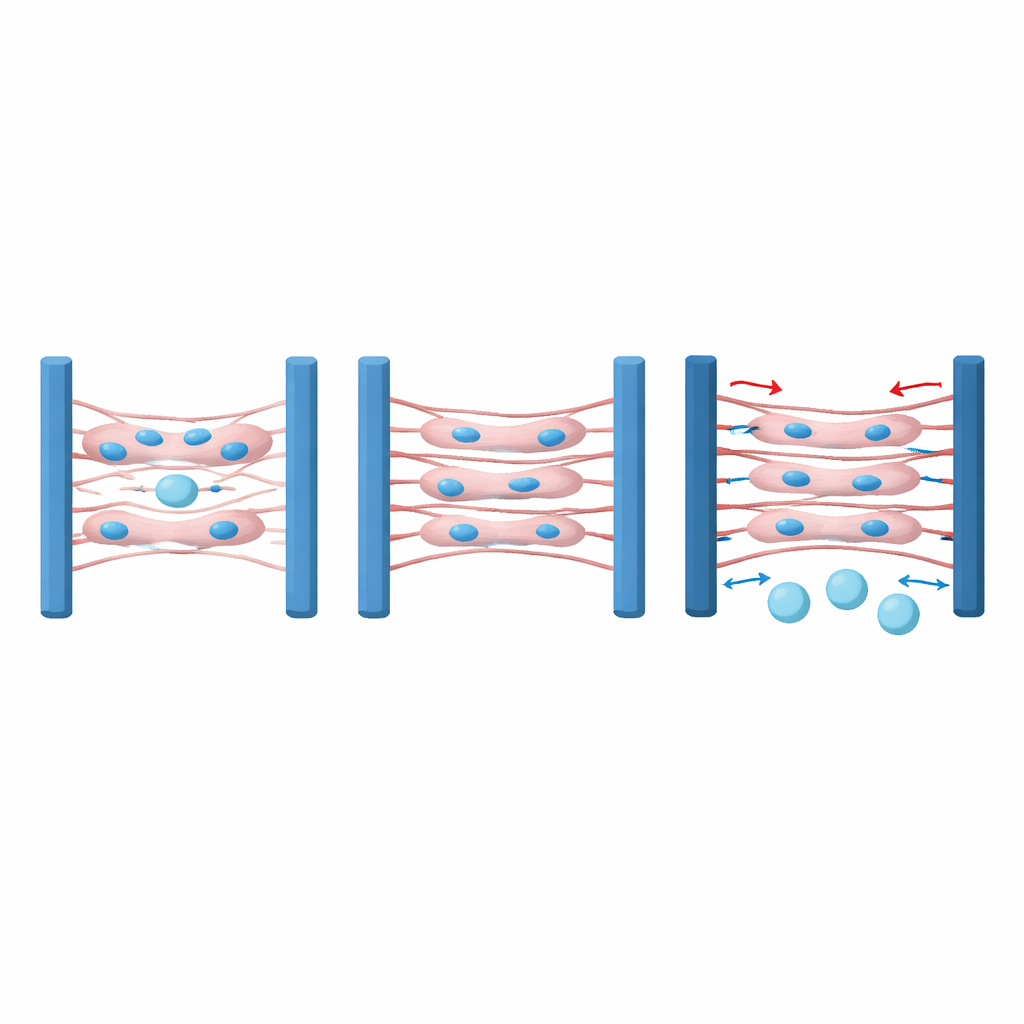
The researchers first created a simple but powerful lab model that mimics how real tendons are constantly under tension. They engineered a two‑plate device in which living tendon cells are embedded in a collagen gel stretched between tiny vertical posts. By making the underlying silicone support soft or rigid, they could keep the collagen composition the same while changing how much resistance the cells feel when they pull on their surroundings. As the cells contracted, the posts bent slightly; this deflection could be measured to calculate the forces the cells exerted, giving a live readout of tissue tension without disturbing the construct.
How tension turns quiet cells into scar‑forming cells
Using this system, the team showed that tendon cells under higher tension become more contractile and adopt features of myofibroblasts—the specialized cells that drive scarring. Adding the well‑known fibrotic messenger TGF‑β1 boosted both the pulling forces and the appearance of stress fibers inside cells, confirming that the model reproduces classic fibrotic behavior. Surprisingly, when the surrounding matrix was made mechanically rigid, tendon cells increased their contractility and myofibroblast markers but actually reduced the activity of key collagen genes. In other words, a stiffer environment pushed them toward a scar‑like, highly tensed state while simultaneously dialing down the instructions to make fresh collagen, suggesting that chronic stiffness may lock tendons into a rigid, low‑turnover state rather than simply causing overproduction of matrix.
Patient and mouse tendons reveal a stiffness–gene mismatch
To see whether this counterintuitive pattern also appears in living tissue, the researchers examined tendons from a rare systemic sclerosis autopsy and from a transgenic mouse model that develops multi‑organ fibrosis. In both cases, tendons were mechanically stiffer and showed biochemical signs of increased collagen crosslinking, even though total collagen content was not dramatically higher. Gene profiling of the fibrotic mouse tendons revealed reduced expression of many collagen genes alongside strong signatures of inflammation and activated macrophages, a type of immune cell. Computational analysis of the RNA data indicated that immune and nerve‑related cell populations were enriched in diseased tendons, and similar signaling themes were shared with fibrotic lungs and with human frozen shoulder tissue, pointing to a common inflammatory–matrix program across different fibrotic disorders.
When immune cells override mechanical brakes
The team then asked how immune cells interact with stiff matrices to shape tendon cell behavior. They co‑cultured tendon fibroblasts with bone‑marrow‑derived macrophages inside the tension‑controlled constructs. Alone, wild‑type tendon cells on rigid supports tended to reduce collagen gene activity. But when macrophages were added, collagen and crosslinking genes were re‑energized, especially under high tension, and the combined tissues generated much larger pulling forces. Macrophages from fibrotic mice were particularly potent, driving normal tendon cells to behave almost like diseased fibroblasts. These experiments show that while matrix stiffness can suppress some aspects of collagen transcription, inflammatory cues from macrophages can override this “mechanical checkpoint” and reignite fibrotic remodeling.
What this means for people living with fibrosis
Taken together, the work paints a picture of tendon fibrosis in systemic sclerosis as a self‑reinforcing loop: early changes in matrix crosslinking increase tissue stiffness and tension; this altered mechanical state reprograms tendon cells and attracts or activates immune cells; in turn, immune‑derived signals push stromal cells to generate stronger forces and more crosslinked matrix, even as core collagen genes fall quiet. By providing a reductionist, easy‑to‑build platform that cleanly separates mechanical tension from other matrix properties, the study offers a new way to dissect these intertwined processes. In the long run, therapies that soften excessively stiff matrices, block key crosslinking enzymes, or interrupt the dialog between tendon fibroblasts and macrophages could help preserve mobility and reduce pain in people with systemic sclerosis and other fibrotic diseases.
Citation: Hussien, A.A., Knell, R., Wunderli, S.L. et al. Mechanical gating of tendon fibrogenic transcription in systemic sclerosis. Nat Commun 17, 3893 (2026). https://doi.org/10.1038/s41467-026-70395-2
Keywords: tendon fibrosis, systemic sclerosis, mechanobiology, extracellular matrix, macrophage interactions