Clear Sky Science · en
Integrated photonic ultrawideband real-time spectrum sensing for 6G wireless networks
Why the Airwaves of Tomorrow Need New Tools
Our phones, cars, and even household gadgets are racing toward a future where wireless networks not only communicate, but also sense the world around them. The upcoming 6G era aims to merge radar-like sensing with ultra-fast data links over the same invisible airwaves. That promise comes with a problem: the radio spectrum is becoming crowded, and today’s electronics struggle to watch over these busy frequencies quickly enough and across a wide enough range. This article presents a new kind of chip, based on light rather than just electricity, that can keep track of huge swaths of the spectrum in real time—paving the way for smarter and more efficient 6G networks.
From Fixed Lanes to Dynamic Traffic
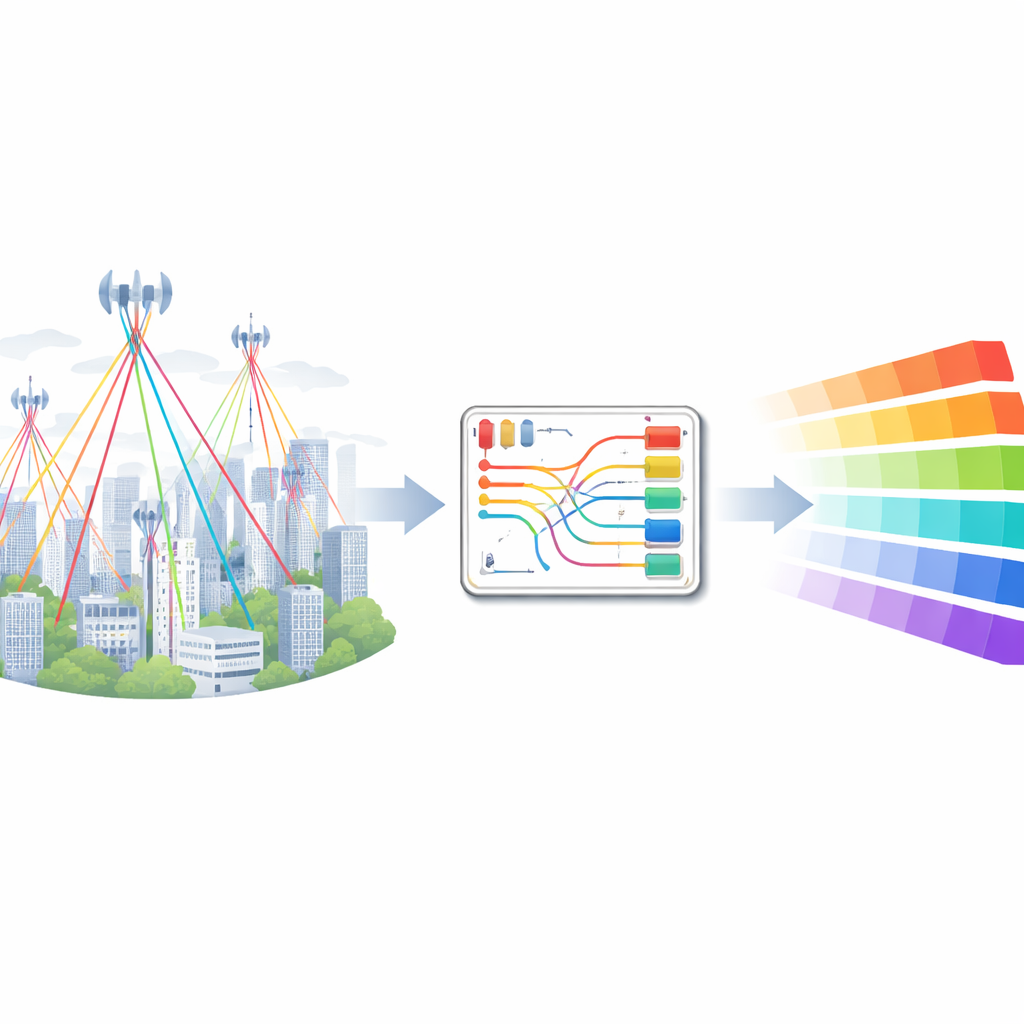
For decades, regulators have treated the radio spectrum like a highway with fixed lanes: some bands reserved for mobile phones, others for radar, Wi‑Fi, or satellite. As sensing and communication functions begin to share the same bands in 6G systems, that rigid model breaks down. Radar and data links must coexist and even adapt on the fly, slipping into unused “white spaces” without causing interference. This vision, known as dynamic spectrum access, depends on the ability to constantly monitor which frequencies are busy and which are free. That is the role of real-time spectrum sensing—essentially a high-speed, continuous health check of the surrounding electromagnetic environment.
Why Conventional Electronics Fall Short
Conventional spectrum analyzers and electronic sensors can scan tens of gigahertz, but they hit hard limits in three areas: bandwidth, delay, and size. Electronic circuits struggle to directly handle the very high frequencies expected in 6G, which extend from ordinary microwave bands through millimeter waves and into the sub-terahertz range. Photonic approaches, which use light in optical fibers, can stretch the bandwidth further, but traditional versions rely on long coils of fiber that add microseconds of delay and bulky hardware—not ideal for compact base stations that must react in nanoseconds. Previous integrated photonic attempts on silicon chips reduced size, yet were too slow to track fast-changing signals and were limited in frequency range.
A Light-Based Chip That Reads the Spectrum in Real Time
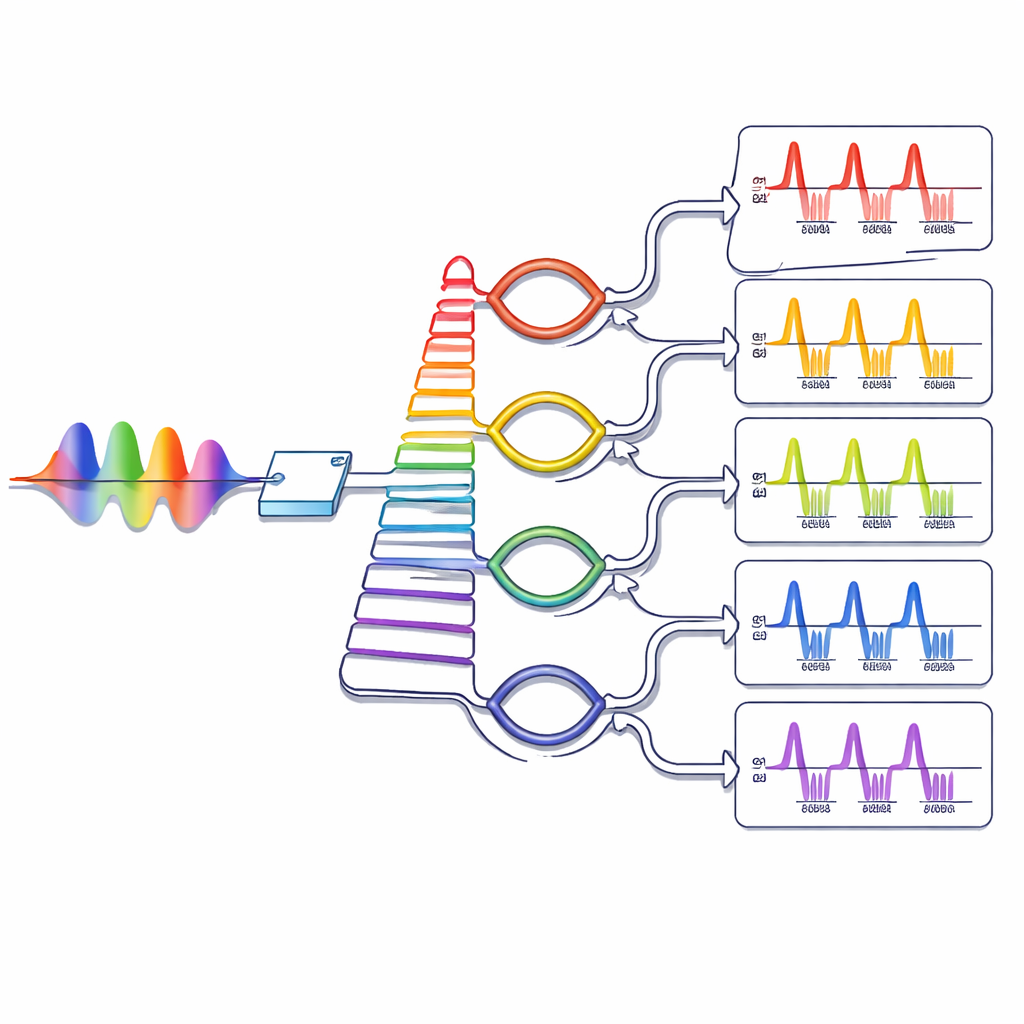
The researchers tackle this by building a compact real-time spectrum sensor on a thin-film lithium niobate chip. Incoming radio signals are first imprinted onto a continuous laser beam by an optical modulator, converting complex wireless activity into patterns riding on light. Inside the chip, a device called an electro-optic comb creates a series of evenly spaced optical reference lines—like a ruler in the frequency domain. These references and the signal then enter a bank of tiny optical rings, each tuned to watch a specific slice of the spectrum. By rapidly sweeping the rings’ resonance across their assigned ranges, the chip translates frequency information into precise timing of pulses at the output. Low-speed electronics need only measure when these pulses arrive to reconstruct which radio frequencies were present, and how they changed over time.
Reaching from Microwaves to Sub-Terahertz
Because lithium niobate supports extremely fast and efficient modulation, the chip achieves an effective analysis bandwidth of 57.5 gigahertz in its current configuration, and can measure tones up to 120 gigahertz—well into the sub-terahertz region targeted for future 6G links. The time it takes from a signal entering the chip to its spectrum being available at the output is under 110 billionths of a second, with a temporal “snapshot” every 100 nanoseconds. Within each snapshot, the system distinguishes frequencies spaced as closely as 350 megahertz using high-quality optical rings. The authors also show that multiple channels can run in parallel, stitching together several spectral slices without gaps, and that the concept scales to even broader coverage with more rings and detectors.
Showing It in Action with Shared Radar and Communication
To move beyond lab benchmarks, the team builds a small demonstration of an integrated sensing-and-communication scenario. A communication transmitter sends data using hopping carriers in a 20–26 gigahertz band, while a radar system must measure the distance to a reflector in the same band. The radar is equipped with the photonic spectrum-sensing chip, which continuously maps how the communication signal occupies the spectrum over time. A simple allocation algorithm then chooses, in each microsecond time slot, the quietest slice of frequencies for the radar to use. When the radar adapts this way, its echo signals have a much cleaner separation between the target and interference, yielding up to an 8.8-decibel improvement in signal quality compared with a fixed, non-adaptive allocation. Simulated two-dimensional radar images under the same conditions also appear far clearer when guided by the chip’s dynamic view of the spectrum.
What This Means for Everyday Wireless
For non-specialists, the central message is that this light-based chip acts like an ultrafast, wide-angle monitor for the crowded airwaves of tomorrow. By compressing a broad microwave-to-sub-terahertz view into compact hardware with extremely low delay, it allows radios and radars to react almost instantly to who is using which frequencies. This, in turn, opens the door to 6G base stations that can flexibly share scarce spectrum between high-speed data and precise sensing, without needing bulky equipment or exotic electronics. Although further integration and scaling are needed before commercial deployment, the work charts a realistic path toward smarter, more efficient, and more responsive wireless networks that can support both our conversations and our machines’ awareness of the world.
Citation: Tao, Y., Feng, H., Fang, Y. et al. Integrated photonic ultrawideband real-time spectrum sensing for 6G wireless networks. Nat Commun 17, 3666 (2026). https://doi.org/10.1038/s41467-026-70389-0
Keywords: 6G spectrum sensing, integrated photonics, dynamic spectrum access, lithium niobate chip, integrated sensing and communication