Clear Sky Science · en
Both genome instability and replicative senescence stem from the shortest telomere in telomerase-negative cells
Why tiny chromosome caps matter for aging and cancer
Every time our cells divide, the protective caps at the ends of chromosomes, called telomeres, grow a bit shorter. When telomeres become too short, cells stop dividing, which helps prevent tumors but is also tied to aging. This study in baker’s yeast asks a simple but powerful question: is it just one very short telomere that brings a cell to a halt, and is that same fragile spot also where dangerous DNA reshuffling begins?
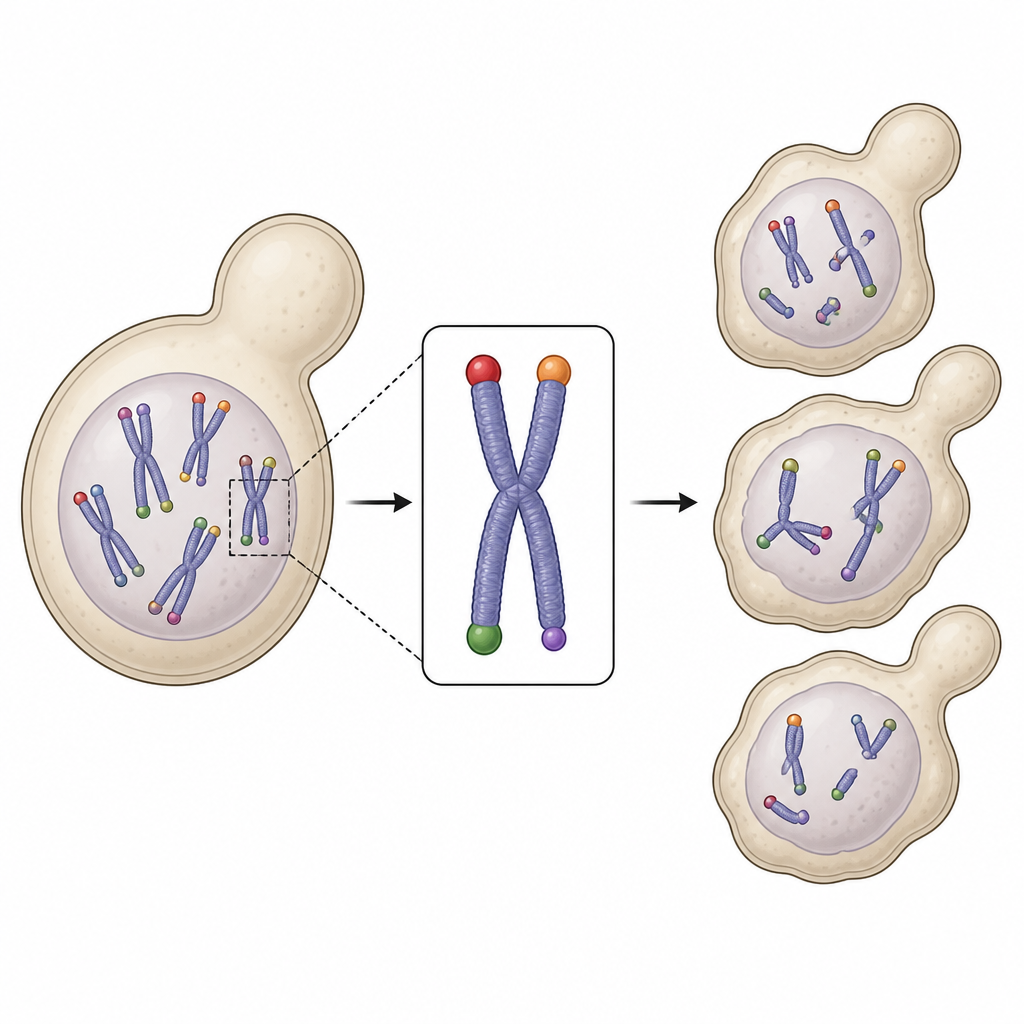
A new way to make perfectly short chromosome ends
To tackle this, the researchers built a genetic tool they call FinalCut in yeast. It uses a programmable DNA-cutting enzyme to trim exactly one chosen chromosome end down to a precise length, while leaving all other ends untouched. They can also switch the cell’s natural telomere-lengthening enzyme, telomerase, on or off. This lets them watch how a single controlled short telomere behaves over time, something that is usually hidden in the natural jumble of chromosome ends of many different lengths.
Watching the last steps before cells stop dividing
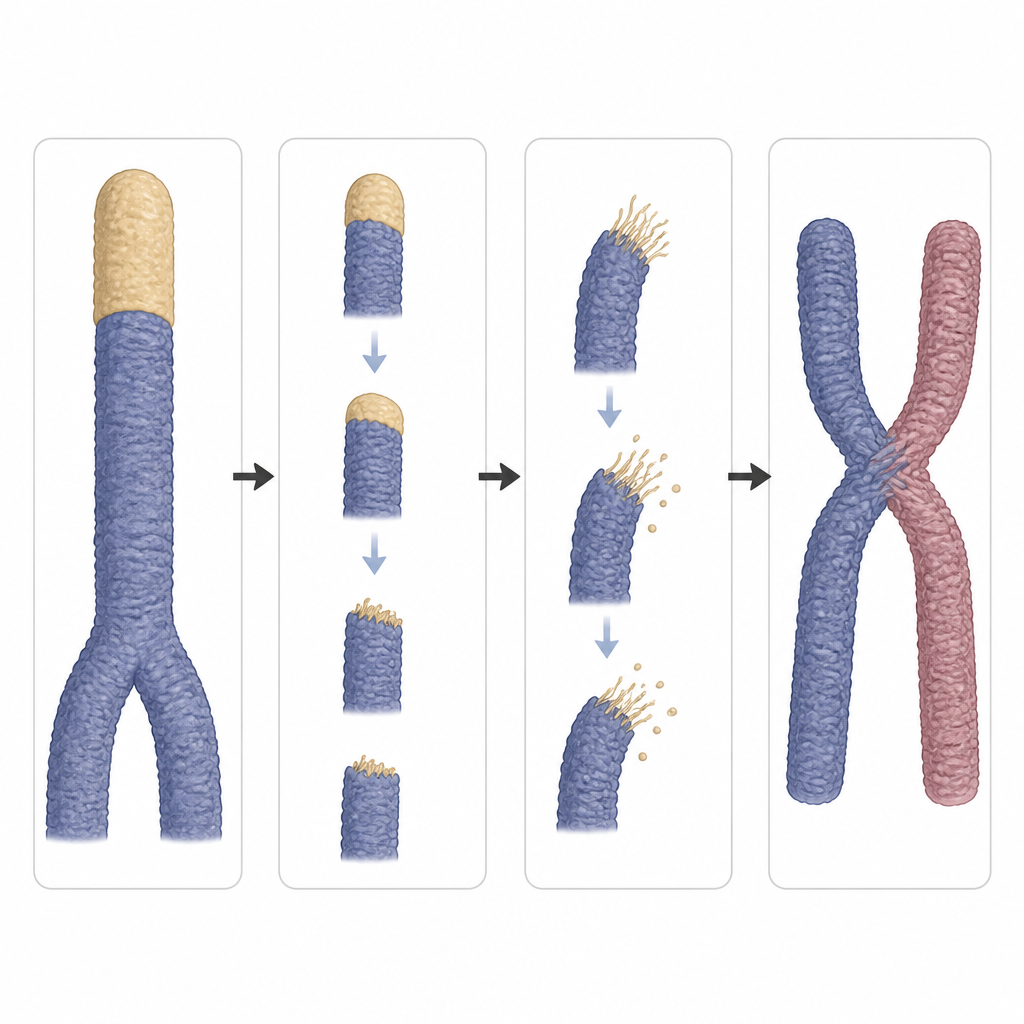
Using FinalCut together with single-molecule DNA sequencing, the team followed how the engineered short telomere shrank with each cell division. They saw that telomeres lose only a few DNA “letters” each round, but once the engineered tip reached roughly 30 to 40 DNA building blocks in length, its behavior changed dramatically. Instead of being maintained, that chromosome end began to erode inward. At the same time, single-cell tracking in tiny microfluidic chambers showed that the yeast lineages divided normally for a number of generations set by the starting length of this one telomere, then suddenly entered a phase of very long, stressed cell cycles and ultimately died. Mathematical modeling that incorporated these data pointed to a sharp threshold: when the shortest telomere falls below a critical size, it reliably flips the cell into permanent arrest.
Where genome chaos really begins
The authors then asked where serious DNA damage arises when telomeres are short. They installed genetic “reporter” segments near the engineered telomere and, separately, near a distant chromosome end. When telomerase was shut off and the engineered tip was allowed to shrink, mutation rates near that shortest telomere shot up, while distant regions stayed relatively quiet. Most of these changes were not simple typos in the DNA code but large-scale rearrangements in which a chunk of the chromosome near the fragile telomere became fused to a different chromosome arm.
A stepwise path from worn caps to risky rearrangements
Genome-wide DNA sequencing of mutant yeast confirmed a clear pattern. The damaged chromosome ends tended to latch onto other chromosome ends that shared similar nearby sequences, creating one-way fusions known as non-reciprocal translocations. These events depended on a specific DNA-copying factor, Pol32, which is required for a repair process that can copy long stretches of DNA from a template. In effect, once the shortest telomere slipped below the protection threshold, the end was chewed back, exposing matching sequences that then hijacked this repair pathway to rebuild a new, longer chromosome tip from elsewhere in the genome.
What this means for aging cells and tumors
Putting all of the evidence together, the study shows that, in telomerase-free yeast cells, a single shortest telomere both determines when a cell stops dividing and marks the hotspot where dangerous DNA reshuffling begins. As the cell ages and that one telomere crosses a critical minimal length, it triggers a DNA damage alarm that halts growth while also making local rearrangements more likely, sometimes rebuilding the broken tip and letting the cell temporarily escape arrest. Because telomere biology and repair pathways are deeply conserved, these results offer a concrete picture of how one especially short chromosome end in human cells could at once enforce a limit on cell divisions and, under the same conditions, spark genomic changes that contribute to cancer.
Citation: Berardi, P., Martinez-Fernandez, V., Rat, A. et al. Both genome instability and replicative senescence stem from the shortest telomere in telomerase-negative cells. Nat Commun 17, 4271 (2026). https://doi.org/10.1038/s41467-026-70352-z
Keywords: telomeres, cellular senescence, genome instability, telomerase, yeast model