Clear Sky Science · en
Desegregation of neuronal predictive processing
How the Brain Bets on the Future
Every moment, your brain quietly guesses what will happen next—how your hand will feel when it touches a doorknob, what sound your footsteps should make, or which word is likely to come in a sentence. When the guess is wrong, the surprise helps you learn. This study asks a deep question about that process: are there special kinds of brain cells that only predict, and others that only signal surprise, or are these jobs spread around more democratically? Using mathematical models and real recordings from mouse brains, the authors show that prediction and surprise are far more intertwined than previously thought.
Brains as Forecast Machines
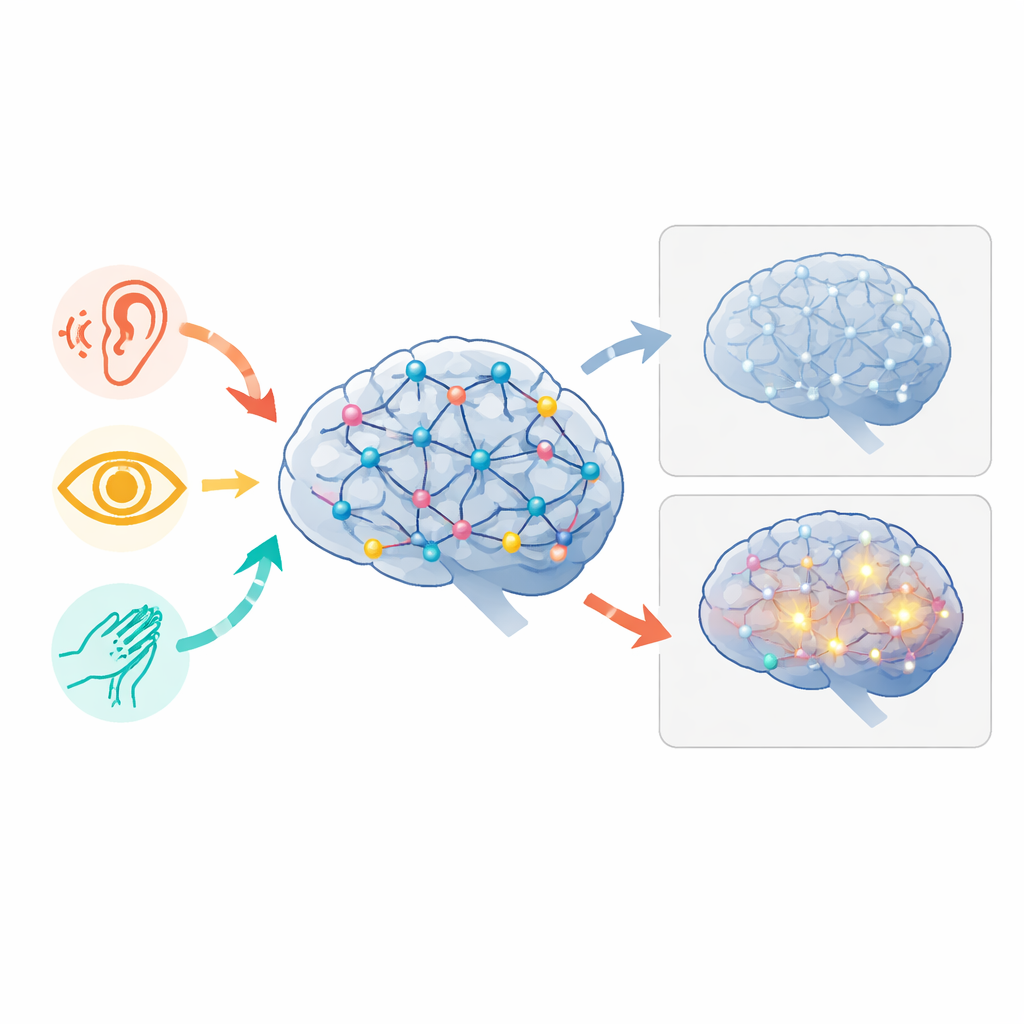
Neuroscientists increasingly view the brain as a forecasting machine that constantly compares what it expects with what actually comes in through the senses. When the world behaves as expected, activity in many sensory areas is dampened; when an unexpected event occurs, certain cells respond more strongly, producing what researchers call a “prediction error.” Earlier theories proposed neat wiring diagrams where one group of neurons represented the incoming sights and sounds, while a separate group computed the errors. But most experiments had only tested very simple situations, such as one sound predicting one movement, which is a far cry from the tangled, many-to-many associations that dominate natural behavior.
Simulating a Busy Sensory World
To explore more realistic situations, the authors built a large computer model of a brain circuit that receives many different sensory and motor signals at once. The model learns, through repeated exposure, which combinations of events tend to go together—much like an animal learning that a particular movement usually produces a particular sound. Crucially, the model was designed to create internal predictions while also keeping its overall activity economical, reflecting the brain’s need to use energy efficiently. As learning progressed, the simulated neurons came to suppress their responses when an expected pairing occurred and to respond more strongly when a predicted partner was missing, mirroring what has been seen in mouse experiments.
Surprise Is Everywhere, Not in a Single Box
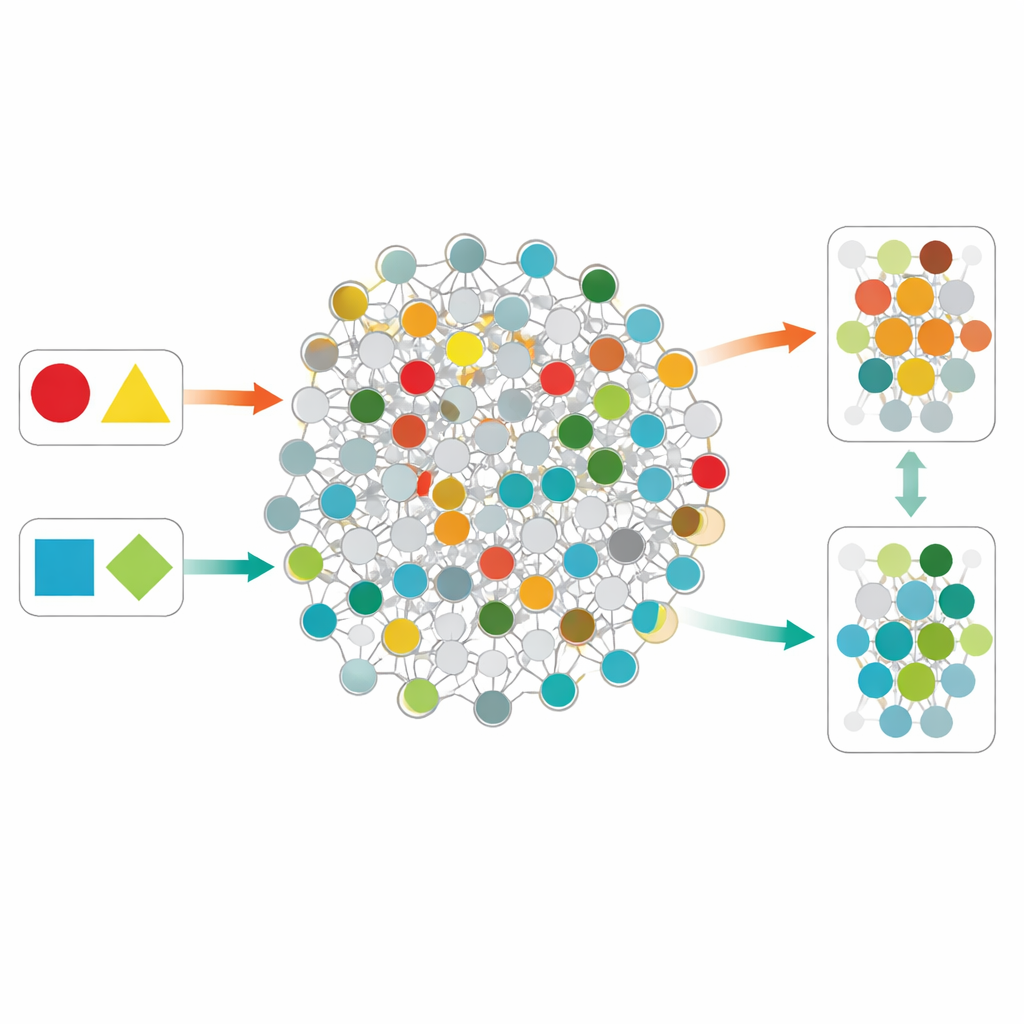
When the researchers examined the model’s “neurons” in detail, they discovered that cells did not sort cleanly into prediction cells and error cells. A neuron that signaled a mismatch for one pair of events might behave like a straightforward sensory reporter for another pair. As the model learned more and more distinct pairings, this mixing became even more common, and purely “error-only” neurons became rare. The authors then turned to recordings from mouse auditory cortex, where animals expected a specific tone after pressing a lever but were sometimes presented with altered sounds. The pattern of responses across many neurons showed the same kind of mixing predicted by the model, arguing against a tidy separation of prediction and error roles in real brains.
Balancing Excitation, Inhibition, and Complexity
The study also probes how the balance of excitement and suppression within brain circuits shapes prediction. The model separates each neuron’s input into two parts: direct sensory drive and internal feedback from other neurons that carry predictions. When these two influences nearly cancel, the system becomes “balanced,” and small mismatches stand out more clearly. The authors find that there is an optimal, not-too-tight level of this balance. As the number of different learned associations grows, the best-performing circuits actually become more loosely balanced, which helps avoid interference between many overlapping predictions. Extending the model to include distinct excitatory and inhibitory cells—and to stacked layers resembling cortical depth—the authors show that prediction-related signals are distributed across cell types and layers rather than stored in one special locus.
Why This Matters for Understanding Thought
In everyday life, we juggle countless expectations about sounds, sights, and movements all at once. This work suggests that the brain supports such rich prediction by spreading the load over many neurons that flexibly share duties, rather than by dedicating rigid specialist cells to either prediction or error. It also highlights how a carefully tuned, but not overly strict, balance between excitatory and inhibitory signals lets these circuits handle many associations without becoming unstable. Together, the modeling and experiments point toward a picture of predictive processing as a highly distributed, adaptable code—one that may help explain how brains build internal models of a complex, ever-changing world.
Citation: Wang, B., Audette, N.J., Schneider, D.M. et al. Desegregation of neuronal predictive processing. Nat Commun 17, 3919 (2026). https://doi.org/10.1038/s41467-026-70347-w
Keywords: predictive processing, neuronal circuits, sensory prediction, excitatory inhibitory balance, neural network models