Clear Sky Science · en
ctDNA and tumor-based biomarkers of giredestrant response in acelERA breast cancer
Why this matters to patients and families
For many people with advanced breast cancer, hormone-blocking pills and shots work well at first but eventually stop helping. This study asks a pressing question: can we use tiny bits of tumor DNA floating in the blood, together with signals from the tumor itself, to tell who will still benefit from hormone therapy and who needs something different? The researchers focus on an oral drug called giredestrant and explore how to match it to the patients most likely to gain from it.
Reading cancer’s clues from blood and tissue
The team analyzed samples from a clinical trial of patients with advanced estrogen receptor–positive, HER2-negative breast cancer who had already received one or two rounds of treatment. Patients were randomly given either giredestrant or a standard hormone therapy chosen by their doctors. Before and during treatment, the researchers examined tumor biopsies and blood samples. In blood, they measured circulating tumor DNA (ctDNA)—small fragments of genetic material shed by cancer cells. In tissue, they measured how active the estrogen receptor pathway was, essentially asking how strongly the tumor was still “listening” to estrogen signals.

Genetic changes after earlier treatments
Many tumors in this late-stage group carried mutations in a gene called ESR1, which alters the estrogen receptor and is known to promote resistance to older hormone drugs. These mutations were especially common in patients who had previously received CDK4/6 inhibitors, a commonly used class of targeted drugs. The ctDNA tests also revealed frequent changes in other cancer-linked genes such as PIK3CA, TP53, and RB1, painting a picture of tumors that had become genetically complex after earlier lines of therapy. Despite this complexity, tumors with ESR1 mutations often still showed strong estrogen receptor activity, meaning they remained dependent on hormone signaling and might still respond to a powerful estrogen blocker like giredestrant.
Who benefits most from giredestrant
When the researchers compared outcomes, patients whose tumors carried ESR1 mutations tended to do better on giredestrant than on standard hormone options. This was especially clear in those who had not yet received CDK4/6 inhibitors, suggesting their cancers were less biologically hardened by prior treatments. However, ESR1 mutation status alone did not fully explain who benefited. Tumors with high estrogen receptor activity—regardless of whether they carried ESR1 mutations—were more likely to respond to giredestrant and to hormone therapy in general. In contrast, some tumors without ESR1 mutations had already shifted away from estrogen dependence, and these were less likely to respond.
Watching response in real time with blood tests
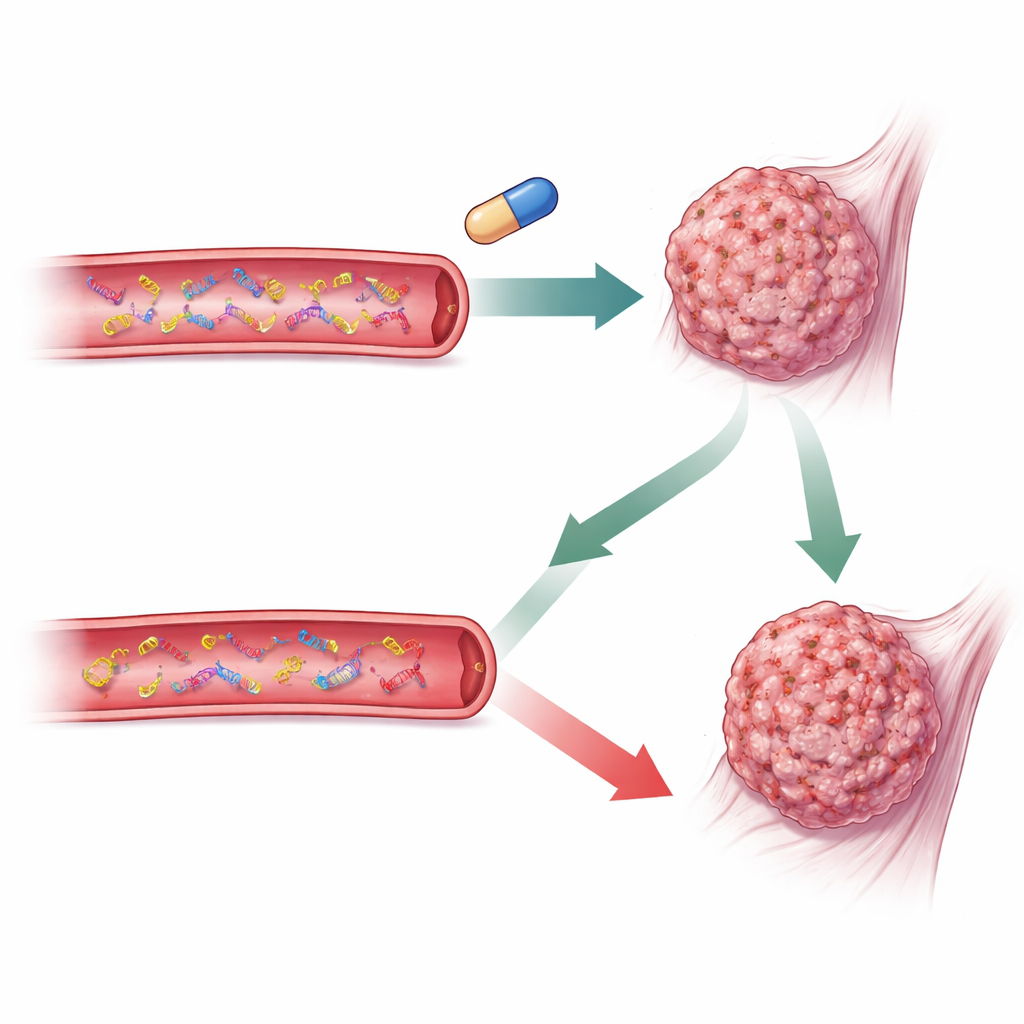
Beyond baseline traits, changes in ctDNA during treatment proved highly informative. Patients whose ctDNA levels fell by more than three quarters after a short time on therapy tended to have longer periods before their disease worsened, and this pattern was stronger with giredestrant than with standard drugs. Many patients on giredestrant switched from having detectable ctDNA at the start to having no detectable ctDNA on treatment, especially when their tumors carried ESR1 mutations. Conversely, patients whose ctDNA stayed high—or even rose—were much more likely to experience rapid progression within the first three months, often alongside large, growing tumors and signs of spread to the liver.
Flagging patients at high risk of fast worsening
To tackle the common and troubling pattern of very early treatment failure, the researchers combined several pieces of information into a prediction model. Low estrogen receptor activity in the tumor, high baseline ctDNA, prior treatment with CDK4/6 inhibitors, and the presence of liver metastases together identified patients at high risk of rapid progression on hormone therapy alone. This model performed well at separating those likely to progress quickly from those who were more likely to enjoy longer benefit, suggesting such tools could help steer high-risk patients toward alternative or combination treatments.
What this means for future breast cancer care
Overall, the study shows that neither a single mutation nor a single test can capture how advanced breast cancers will behave. Instead, pairing blood-based ctDNA measurements with deeper readouts of tumor hormone activity can guide the smarter use of drugs like giredestrant. For patients, this points toward a future in which a simple blood draw, combined with selective tissue testing, could help doctors choose the right hormone therapy, recognize early when it is not working, and personalize combinations for those at greatest risk of quick relapse.
Citation: Collier, A.E., Hilz, S., Chibly, A.M. et al. ctDNA and tumor-based biomarkers of giredestrant response in acelERA breast cancer. Nat Commun 17, 3848 (2026). https://doi.org/10.1038/s41467-026-70335-0
Keywords: advanced breast cancer, circulating tumor DNA, endocrine therapy resistance, giredestrant, precision oncology