Clear Sky Science · en
Enterocytes rely on purine biosynthesis/salvage pathway to facilitate dietary fat absorption
Why the Gut’s Energy Use Matters
Every time we eat a fatty meal, our intestines perform an intense burst of work: they must take in fat, process it, and ship it safely into the bloodstream. This process is so energy-hungry that it raises a basic question: where do intestinal cells get the extra fuel to keep up? This study uncovers a previously hidden energy source inside the cells that line the small intestine and shows how it helps determine how much fat ultimately reaches the rest of the body.
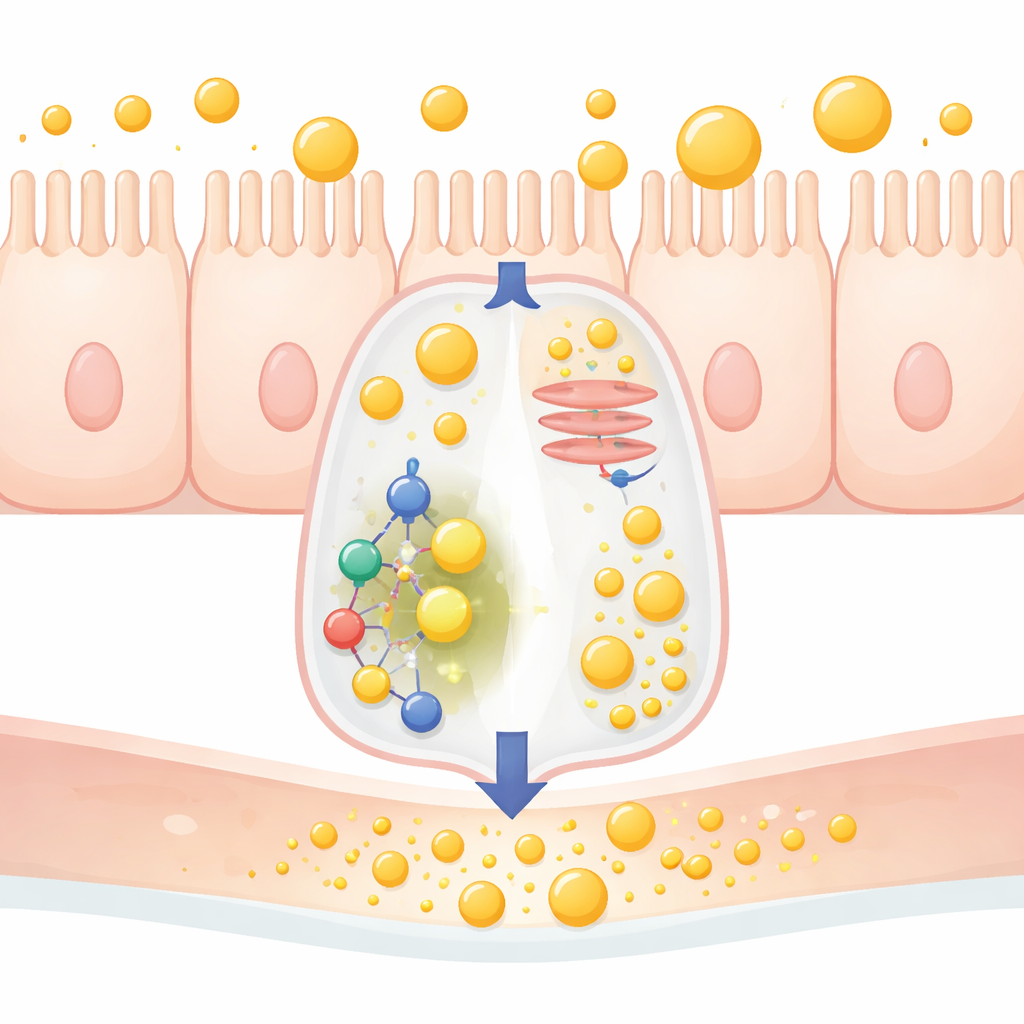
A Hidden Power Plant Inside Intestinal Cells
The small intestine is lined with enterocytes, tall cells that absorb nutrients. When these cells take up fat from food, they package it into tiny particles called chylomicrons, which then enter the circulation. Making and moving these particles requires large amounts of ATP, the cell’s “energy currency.” The researchers discovered that, during fat absorption, enterocytes rely heavily on a specific chemical route that makes the building blocks of DNA and RNA—purines—to rapidly generate ATP. They focused on a protein called ANKRD9, found at high levels in metabolically active tissues such as intestine, heart, and skeletal muscle, and asked whether it helps coordinate this energetic demand with the handling of dietary fat.
What Happens When ANKRD9 Is Missing
To test ANKRD9’s role, the team studied mice engineered to lack the Ankrd9 gene. These animals looked healthy and weighed the same as normal mice, but had significantly less body fat. Surprisingly, the liver and blood fat levels were normal, while the small intestine was overloaded with triglycerides, especially in the jejunum, the main site of fat absorption. Microscopy showed fat droplets piling up inside enterocytes near their nuclei. Detailed measurements revealed that these mice absorbed fatty acids from the gut normally and could build triglycerides, but the later steps—packaging fat with a structural protein called ApoB and exporting chylomicrons—were slowed down.
Traffic Jams in the Cell’s Shipping Center
Inside enterocytes, ApoB and fat must travel through the cell’s secretory system, passing from the endoplasmic reticulum to the Golgi apparatus and then out to the cell surface. In normal mice, ApoB quickly moves from a perinuclear location to the apical and side membranes after a fat-rich challenge, mirroring the efficient formation and export of chylomicrons. In mice lacking Ankrd9, this choreography is delayed: ApoB lingers in scattered vesicles, arrives later at the membranes, and shows a weaker signal there. Electron microscopy revealed that the Golgi stacks in these mutant cells are enlarged and structurally altered, suggesting a “traffic jam” in the cell’s shipping center. ANKRD9 itself clusters near the early side of the Golgi and along the lateral membrane, placing it at a strategic site to influence both energy supply and cargo flow.
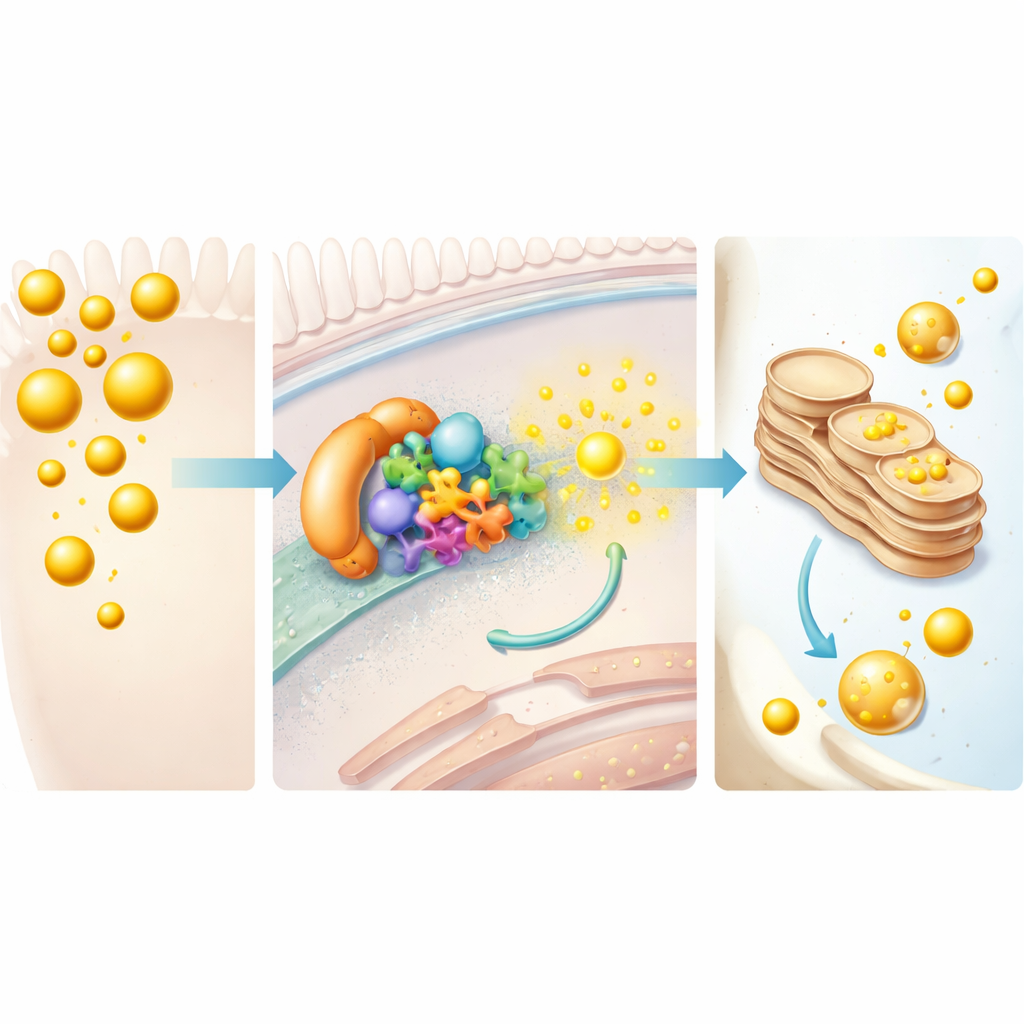
Rewiring the Cell’s Energy Balance
Because chylomicron trafficking depends on ATP and related molecules, the researchers examined the enterocytes’ energy state. They found that, without Ankrd9, intestinal organoids had markedly less ATP and GTP and more of their partially used forms (ADP and GDP), even though mitochondrial respiration and glycolysis appeared normal. Proteomic and metabolic analyses pointed to a disturbance in the purine biosynthesis and salvage pathway, which normally helps top up ATP levels. Key enzymes and intermediates shifted in ways that diverted resources away from efficient ATP production. In normal cells, the arrival of fatty acids rapidly reorganized purine enzymes and increased nucleotide levels; in Ankrd9-deficient cells, this adaptive response was blunted. Restoring ANKRD9 or supplying extra ATP could rescue proper ApoB localization, tying the energy defect directly to the impaired fat export.
What This Means for Body Fat and Future Therapies
Altogether, the study shows that ANKRD9 acts as a molecular coordinator that links a specialized energy-generating pathway to the machinery that moves dietary fat through intestinal cells. When ANKRD9 works, purine metabolism surges to supply ATP right where it is needed, keeping the Golgi flexible and chylomicron traffic smooth. When it is absent, energy levels in the intestine sag, fat is retained in enterocytes, and less fat reaches body stores—producing leaner mice despite a normal diet. For a lay reader, the key message is that how much fat we absorb does not depend only on what we eat, but also on how our gut cells power the handling of that fat. ANKRD9 and the purine pathway emerge as promising targets for future strategies aimed at fine-tuning fat absorption and possibly protecting against obesity and metabolic disease.
Citation: Wang, Y., Chen, L., Ma, Y. et al. Enterocytes rely on purine biosynthesis/salvage pathway to facilitate dietary fat absorption. Nat Commun 17, 3888 (2026). https://doi.org/10.1038/s41467-026-70332-3
Keywords: intestinal fat absorption, ATP metabolism, purine biosynthesis, ANKRD9, chylomicron trafficking