Clear Sky Science · en
Low-frequency ionic-electronic coupling for energy-efficient noise-resilient wireless bioelectronics
Why safer wireless body sensors matter
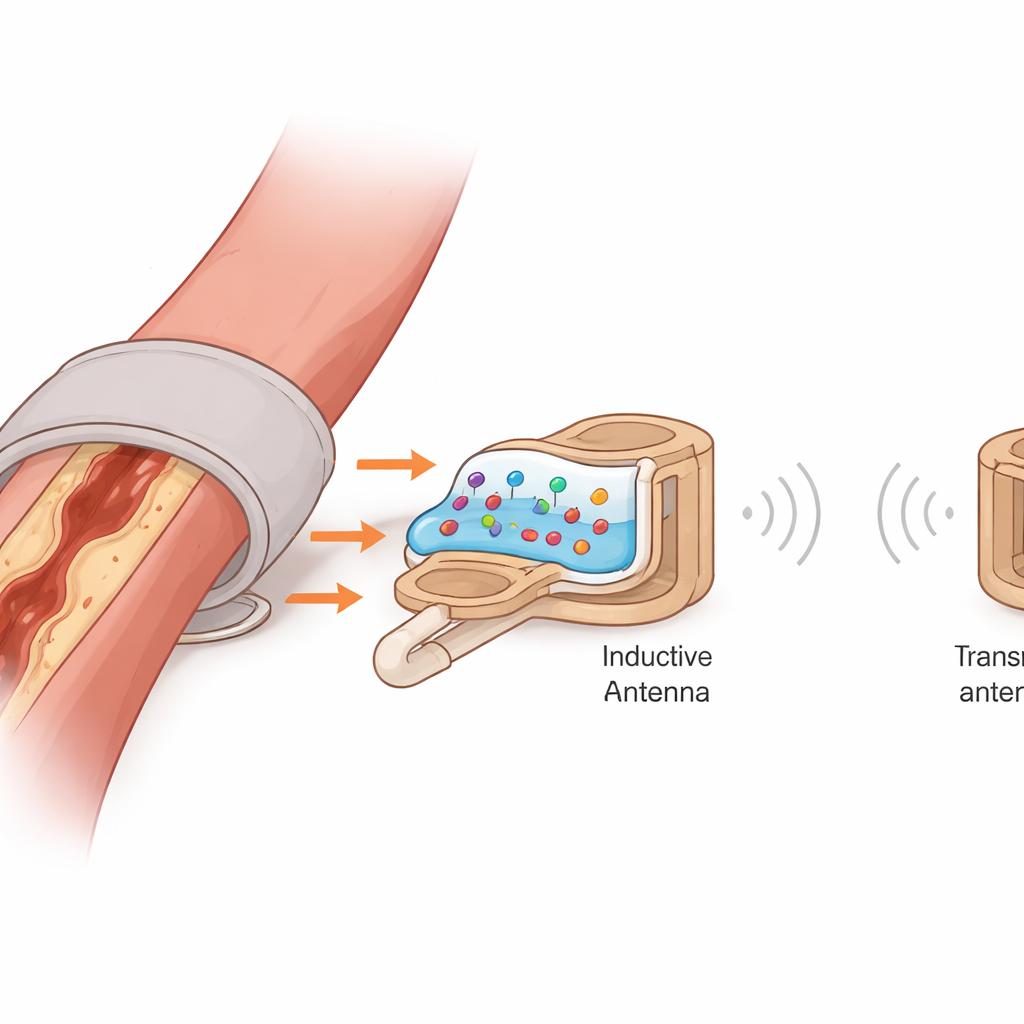
Imagine a tiny band wrapped around an artery, quietly listening to every heartbeat and warning doctors before a heart attack strikes—without batteries, without wires, and without bathing the body in strong radio waves. This paper introduces a new kind of wireless sensor designed exactly for that job. It shows how pairing the movement of charged particles in a soft gel with gentle, low‑frequency electronics can make blood-pressure monitoring both safer and more reliable inside the body.
The problem with today’s wireless health gadgets
Modern bioelectronic devices already let doctors track blood pressure, blood flow, and other vital signs without bulky cables. Most of these devices use a simple recipe: a coil of wire and a tiny capacitor form a resonant circuit that can be powered and read wirelessly. But there is a catch. Conventional capacitors in these circuits store very little charge, so to work at all they must operate at high radio frequencies, typically in the megahertz range. In the complex environment of the human body, those frequencies can cause electromagnetic interference, tissue heating, and noisy, unreliable signals. For implants that sit close to delicate organs and must work for years, this is a serious limitation.
A soft gel that turns pressure into gentle signals
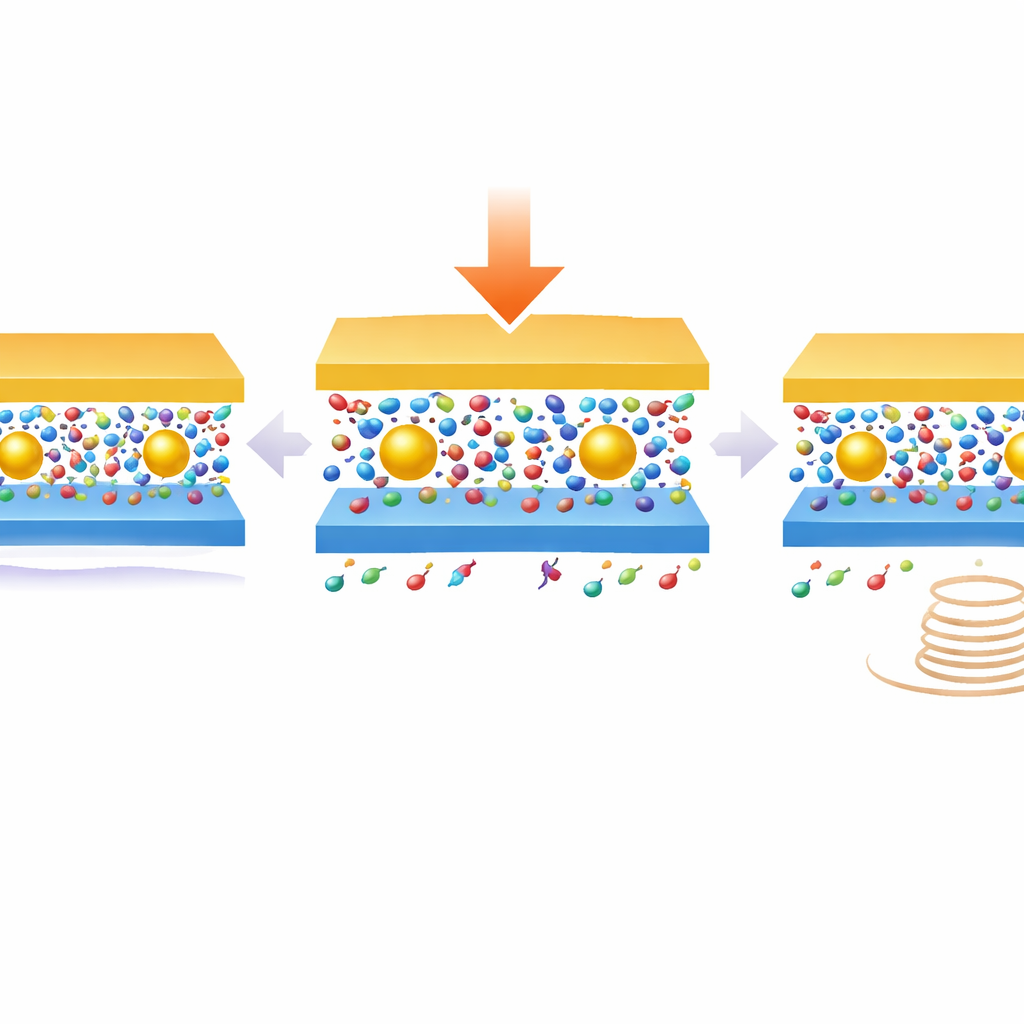
The researchers propose a different approach, called wireless low-frequency electrochemical sensing (WiLECS). Instead of a hard, conventional capacitor, they use a soft, biocompatible ion gel built from a natural polymer (chitosan) mixed with a specially designed liquid salt made of choline and malate. Tiny gold nanoparticles coated with short molecules act as “parking spots” for ions, holding them in place through hydrogen bonds. The gel sits between thin gold electrodes and is wired to a miniature antenna coil, forming an LC circuit whose resonant frequency depends on how easily ions can move. When blood pressure presses on this gel, it does more than simply squeeze the structure—it rearranges how ions are trapped and released, which strongly changes the circuit’s capacitance and therefore its resonance at low, biologically safer frequencies below 1 MHz.
How trapped ions make the sensor extra sensitive
At rest, many ions cling to the gold nanoparticles and cannot move freely, so the gel’s starting capacitance stays relatively low. Under pressure, stress is focused at the boundaries between the stiff particles and the soft gel. This stress breaks the hydrogen bonds that held ions in place, freeing them to rush toward the electrodes under the electric field. The result is a dramatic jump in capacitance and a clear shift in the resonant frequency that can be picked up wirelessly. By carefully tuning the size of the gold particles and the chemistry at their surface, the team maximizes how many ions can be trapped and then released, achieving a pressure sensitivity far higher than traditional air‑filled or rubber‑based wireless sensors, while still keeping the gel soft enough to match artery tissue and safe enough to support living cells in lab tests.
Listening to diseased arteries in real time
To show what this technology can do, the authors built an artificial artery system. A balloon catheter simulated a blood vessel that could expand and contract, and fat deposits inside the balloon mimicked atherosclerotic plaque that raises blood pressure. The cuff-like WiLECS sensor wrapped around this artificial artery. As the balloon inflated and deflated, the sensor’s ion gel felt the changing pressure, freed or re-trapped ions, and shifted the wireless resonance accordingly. Compared with simpler gels, the engineered ion-trapping gel produced much larger capacitance changes and clearer wireless signals, with a signal-to-noise ratio nearly five times better than a conventional polymer sensor. The device continued to work through spacers and animal tissue, and did so using low-frequency signals that are less likely to disturb surrounding biology.
What this means for future medical implants
This work shows that linking the motion of ions in a soft material directly to an electronic circuit can unlock safer, more efficient wireless sensing inside the body. By operating at low frequencies and using a pressure‑responsive ion gel instead of a rigid capacitor, the WiLECS platform turns subtle mechanical changes—like those caused by plaque‑stiffened arteries—into clear wireless readouts without relying on high-power, high-frequency fields. While the team demonstrates blood-pressure monitoring as a first example, the same strategy could be adapted to other soft tissues and signals, paving the way for long‑lived, battery‑free implants that quietly and safely keep watch over our health.
Citation: Kim, J.H., Kim, H., Rhee, J. et al. Low-frequency ionic-electronic coupling for energy-efficient noise-resilient wireless bioelectronics. Nat Commun 17, 3800 (2026). https://doi.org/10.1038/s41467-026-70331-4
Keywords: wireless bioelectronics, blood pressure monitoring, ion gel sensor, low-frequency resonance, implantable devices