Clear Sky Science · en
Root wounds facilitate the uptake of microplastics in crop plants
Why tiny plastics in roots matter to your dinner
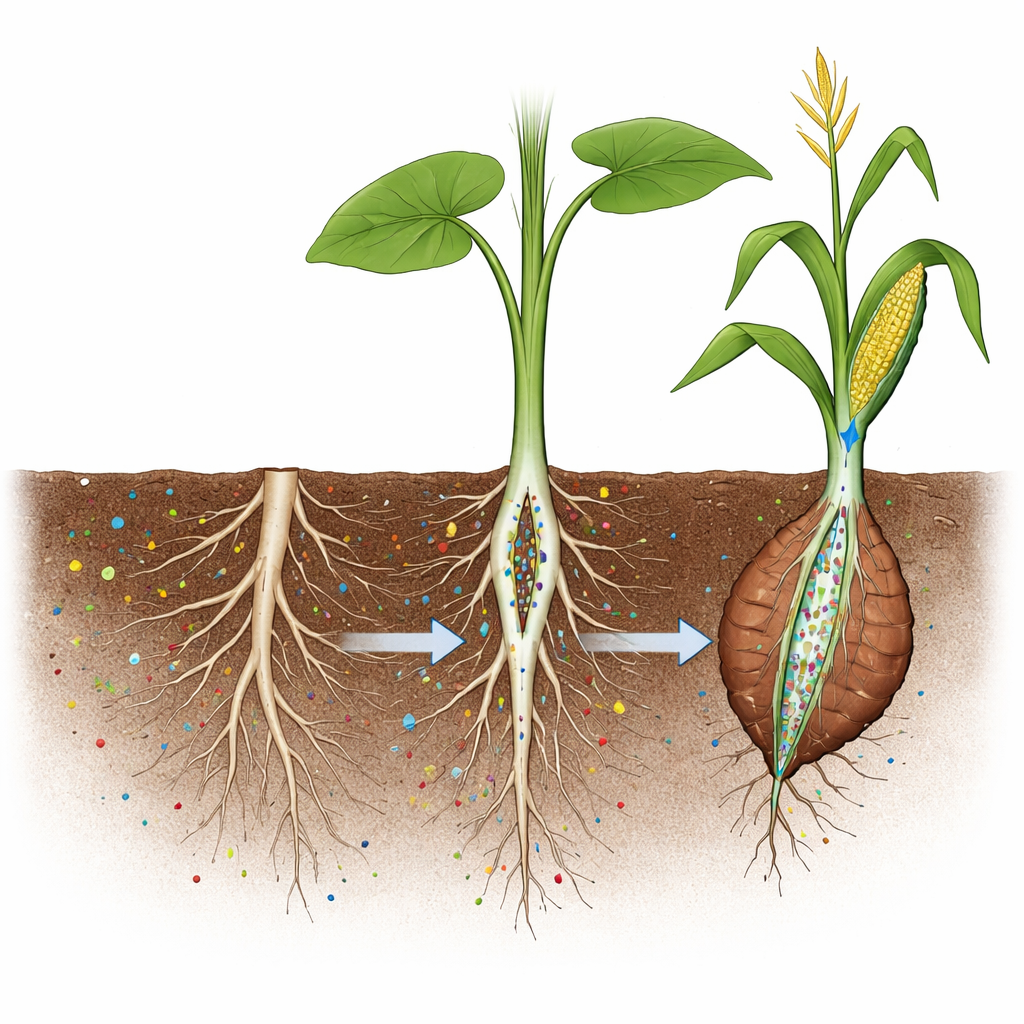
Plastics break down into pieces so small that they can slip between grains of soil. Those microplastics are now common on farms around the world, raising a worrisome question: can they get into the crops we eat? This study shows that when plant roots are deeply injured, tiny plastic particles can bypass natural defenses, ride the plant’s internal plumbing, and end up in edible tissues such as taro corms and maize stems. The work links farming practices, soil pollution, and food safety in a very tangible way.
Hidden plastic in farm soils
Microplastics—plastic fragments and beads smaller than a grain of sand—are no longer just an ocean problem. They accumulate in fields through plastic mulches, fertilizers made from sewage sludge, tire wear, and other sources. In Chinese agricultural soils, measured levels already reach tens to hundreds of milligrams per kilogram. Previous research has shown that these particles can change soil structure, reduce helpful microbes, and stress plants. But the most unsettling prospect is that microplastics might move from soil into crops, and from there into livestock and people. Plants do have tough outer cell walls and specialized barrier layers that usually block foreign particles, leaving it unclear when and how microplastics might break through.
Roots as both shields and gateways
The authors worked with four common crops—taro, maize, wheat, and mung bean—to test how different kinds of root damage affect microplastic entry. They grew plants in either sterile vermiculite or soil mixed with several plastic types, mainly fluorescent polystyrene spheres one or five micrometers across, but also fragments of PVC, polyethylene, PLA, and PMMA. By labeling the plastics with dyes and slicing plant tissues into thin sections, they could track exactly where the particles went. In undamaged roots, and in roots with only shallow scrapes that removed the outer skin and some cortex, plastics stuck to the surface but could not cross into the central core where water-conducting vessels lie. This confirmed that intact outer layers—especially the exodermis and endodermis—act as effective shields.
When deep cuts open a shortcut
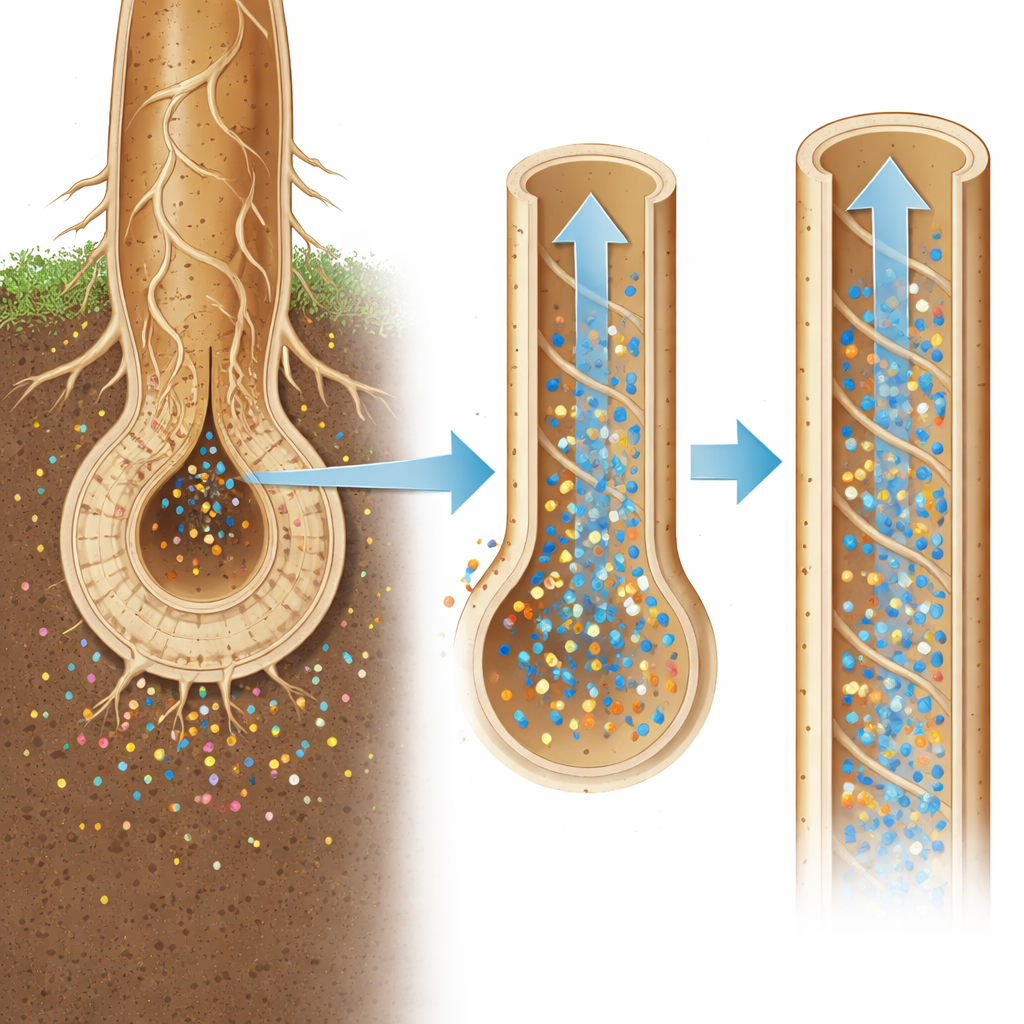
The picture changed dramatically when roots were deeply cut so that the inner core, or stele, was exposed. Within a day, large numbers of microplastic particles clustered at the wound and slipped straight into the open water pipes, the xylem vessels. From there they moved centimeters upward, forming bead-like strings inside the tubes. After longer exposure, taro corms and maize stems connected to these injured roots contained surprisingly high loads of plastics. In taro, corms reached more than a hundred particles per gram of fresh tissue for both one- and five-micrometer beads; in maize stems, counts were even higher. Larger five-micrometer particles—previously thought too big to enter plants easily—traveled almost as efficiently as the smaller ones, aided by the wide diameter of xylem tubes and spiral ridges that can trap and carry them. Importantly, this wound-driven pathway worked for multiple polymer types and shapes and in both vermiculite and real soil.
Tracing plastics inside plants
To move beyond snapshots, the team developed a practical way to quantify microplastics in plant tissues. They fixed corms and stems, cut them into dozens of serial slices, and counted fluorescent particles in each section under the microscope. This avoided some drawbacks of standard chemical analyses, which can be costly, slow, and may damage the plastics. The counts confirmed that particles remained confined mainly to the vascular bundles—the plant’s plumbing network—rather than spreading into surrounding storage cells. That pattern suggests the xylem behaves as a conduit and trap: water flow pulls plastics upward, but the rigid, lignin-rich walls and wound-sealing responses help lock many of them in place.
What this means for farming and food safety
Although the experimental setup used relatively strong, deliberate injuries—about one fifth of the roots cut—the study shows that deep root damage can turn microplastic exposure into actual contamination of edible plant parts, especially in tuber and forage crops directly connected to the root system. Routine farm operations such as tillage, transplanting, and root pruning, along with pests and storms, can all wound roots in real fields. The authors argue that reducing such damage—through practices like no-till farming, careful fertilization, better drainage, and pest control—could help limit plastic uptake. As microplastics in soils continue to build up and break into ever smaller pieces, understanding and managing this wound-driven pathway may be crucial for keeping invisible plastics out of the food chain.
Citation: Yin, J., Li, X., Cui, F. et al. Root wounds facilitate the uptake of microplastics in crop plants. Nat Commun 17, 3509 (2026). https://doi.org/10.1038/s41467-026-70273-x
Keywords: microplastics, root injury, food safety, taro and maize, soil pollution