Clear Sky Science · en
Restoration of RBM22 overcomes the transcriptional and epigenetic barriers of cardiomyocyte proliferation for heart regeneration
Why healing the heart matters
When a heart attack kills heart muscle cells, the body patches the injury with scar tissue instead of rebuilding strong, beating muscle. That patch keeps us alive but weakens the heart over time, often leading to heart failure. Unlike the skin or liver, the adult human heart has only a tiny ability to regrow itself. This study asks a simple but profound question: can we coax heart muscle cells to divide again by flipping the right genetic switches, and in doing so, help the heart repair itself after injury?
A hidden switch in young hearts
In newborn mice, the heart can briefly regenerate after damage, but this ability fades within the first week of life. The researchers combed through gene-activity data from mouse, pig, and human hearts to find molecules whose levels change with age and injury. One stood out: a protein called RBM22. It was high in newborn hearts and dropped as the animals matured, yet rose again after heart damage in both mice and people with ischemic heart disease. Closer inspection showed that, after injury, RBM22 appeared mainly in heart muscle cells near the damaged area, hinting that it might be part of the body’s own, limited attempt to regrow heart tissue.
What happens when the switch is removed
To test whether RBM22 is truly needed for regeneration, the team engineered mice in which RBM22 could be deleted only in heart muscle cells and only at chosen times. When they removed RBM22 around birth and then injured the heart, the pups’ hearts healed poorly. Their pumping function was weaker, scars were larger, and there were fewer heart muscle cells. Markers of cell division, including DNA copying, entry into mitosis, and final cell separation, all fell sharply. The same was true when RBM22 was deleted in adult mice before a heart attack: their hearts dilated more, pumped less effectively, formed bigger scars, and contained fewer of the small, simple heart cells that are most capable of division. In short, without RBM22, the heart’s limited capacity to replace lost muscle cells nearly vanished.
How RBM22 unlocks cell division
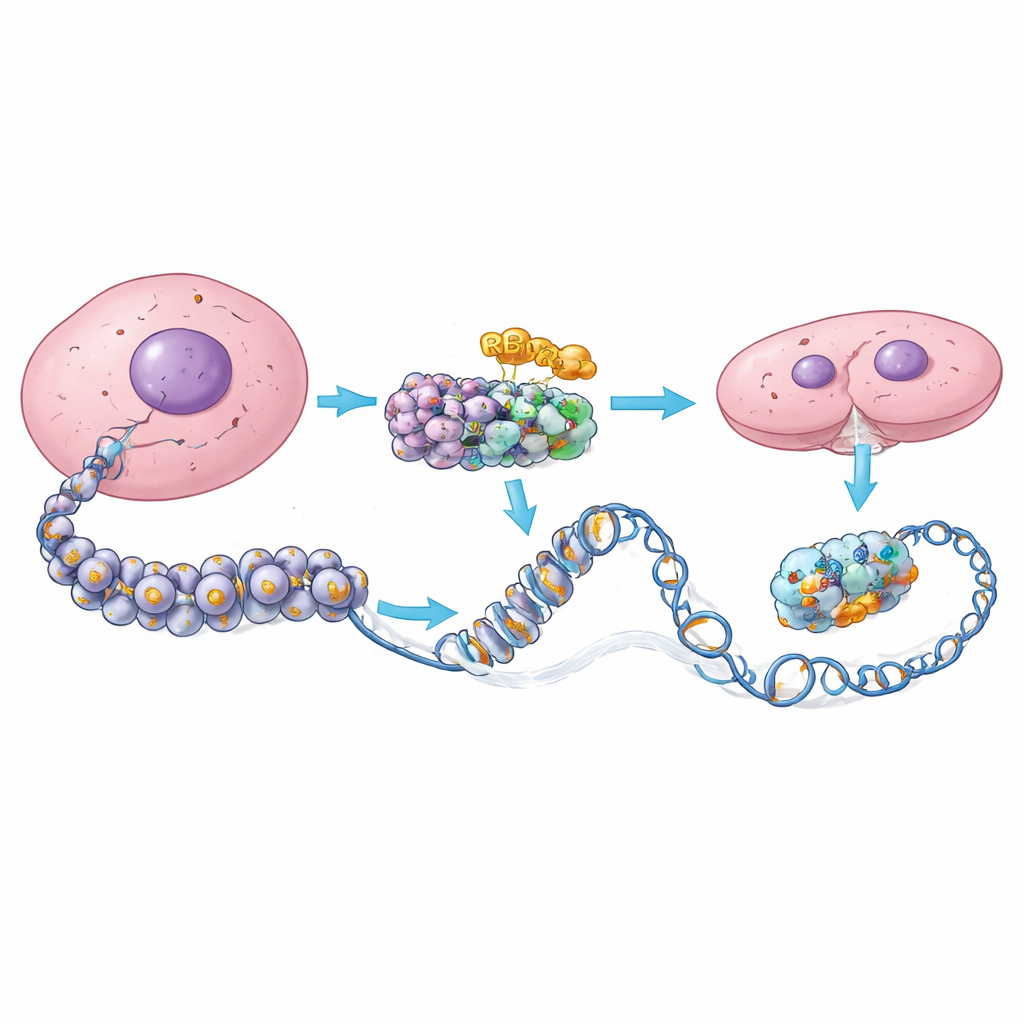
RBM22 was previously known as an RNA-binding protein that helps process genetic messages. Here, the authors discovered that in heart cells it plays a very different role, acting directly on DNA. Detailed genome-wide mapping showed that RBM22 sits on the control regions of key cell-cycle genes—particularly Cdk4, Ccna2, and Ccne1, which drive cells through the division process. At these sites, RBM22 partners with a chromatin “remodeling” machine containing a component called SMARCA4. Together, they loosen the packing of DNA near these genes, making the local genetic material more accessible. This, in turn, allows the cell’s transcription machinery to bind more easily and switch the division genes on. When RBM22 was reduced, these regions became less accessible, division genes fell silent, and heart cells exited the cell cycle. When RBM22 was restored, the opposite occurred.
Turning the switch back on for repair
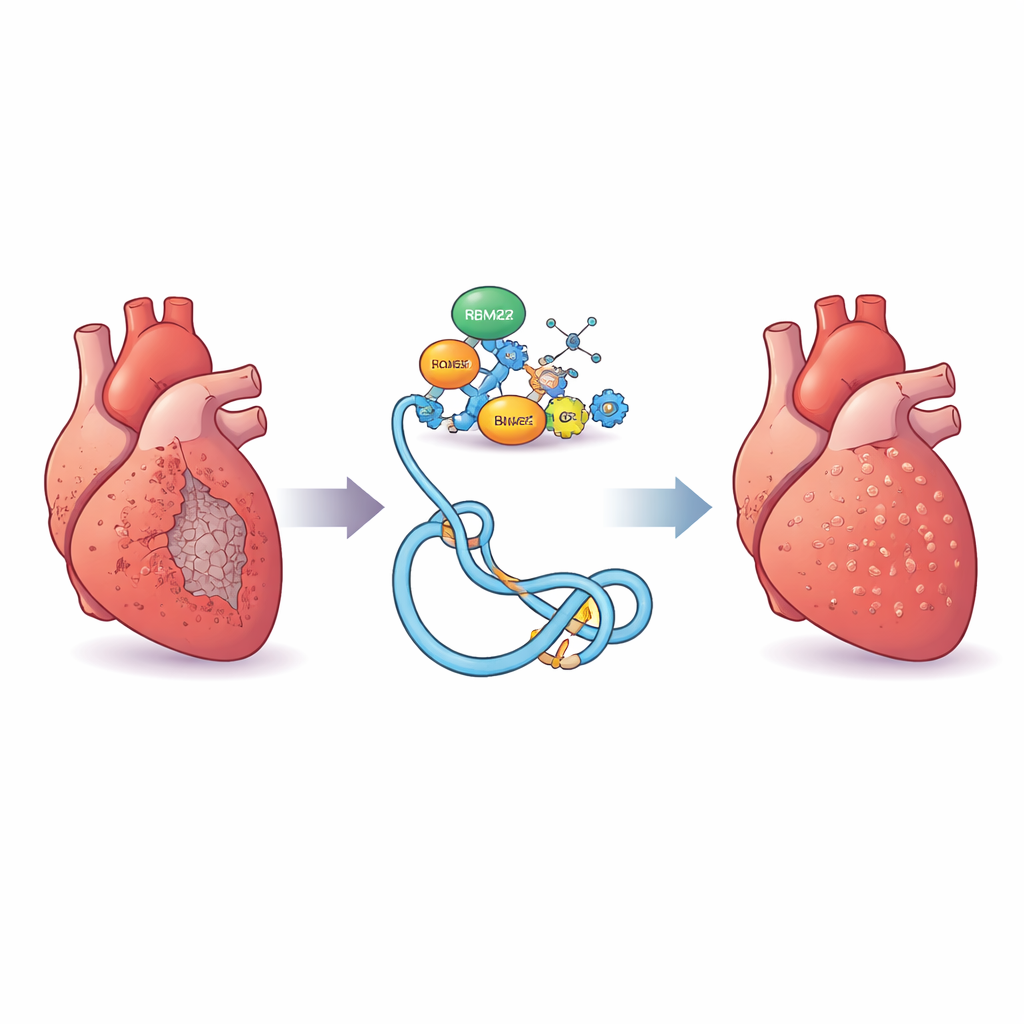
Because permanently altering genes in people is not practical today, the team tested a gene-therapy style approach. They packaged the Rbm22 gene into an AAV9 viral vector designed to target heart muscle cells and injected it into mice just after a heart attack. This boosted RBM22 levels specifically in the injured heart. Treated animals showed better pump function, smaller scars, and more heart muscle cells than untreated controls. Their heart cells more often had a simple, division-competent structure and showed more signs of actively cycling. Chromatin measurements revealed that regions controlling cell-cycle genes became more open, matching the surge in gene activity. The same treatment pushed human stem cell–derived heart cells to divide more frequently in culture and increased the activity of human cell-cycle genes, suggesting that RBM22’s regenerative effect may extend beyond mice.
What this means for future heart repair
Put simply, this work identifies RBM22 as a master switch that helps heart muscle cells re-enter the cell cycle by prying open key stretches of DNA and turning on division genes. In newborn hearts, RBM22 is naturally high and supports regeneration; in adult hearts, it declines, contributing to the loss of self-healing ability. Restoring RBM22 after injury appears to overcome both transcriptional and epigenetic barriers that usually keep heart cells from dividing, enabling the heart to regrow muscle instead of laying down more scar. While much work remains to confirm long-term safety and to translate this approach to patients, RBM22 now stands out as a promising target for therapies aimed at true heart regeneration rather than simply limiting further damage.
Citation: Duan, X., Tan, Y., Zhang, Y. et al. Restoration of RBM22 overcomes the transcriptional and epigenetic barriers of cardiomyocyte proliferation for heart regeneration. Nat Commun 17, 3684 (2026). https://doi.org/10.1038/s41467-026-70235-3
Keywords: heart regeneration, cardiomyocyte proliferation, RBM22, chromatin remodeling, gene therapy