Clear Sky Science · en
Epitope-spanning antigenic variation reprograms immunodominance and broadens immunity in sequential influenza vaccination
Rethinking How Flu Shots Train Our Defenses
Seasonal flu shots save lives, but they often struggle to keep up with an ever-changing virus. One reason is that our immune system “remembers” its first encounters with flu and tends to keep making the same kinds of antibodies, even when the virus has moved on. This study explores a new way to design back-to-back flu vaccinations so that they deliberately shake up that memory and push the immune system to recognize deeper, more stable features of the virus. The work, done in ferrets, suggests a route toward longer-lasting, broader flu protection and may inspire vaccine ideas for other fast-evolving viruses.
Why Immune Memory Can Be a Mixed Blessing
When we first meet influenza, our immune system locks onto a few standout features on the virus’s outer protein, called hemagglutinin. These “head” regions are easy to reach and therefore dominate the response, but they also change rapidly from year to year. Later in life, when we get vaccinated or infected again, the immune system tends to recall those original targets instead of exploring new ones. This phenomenon, sometimes called immune imprinting or “original antigenic sin,” can make antibodies very specific to old strains but less effective against new ones. As a result, repeated vaccination with very similar strains can reinforce a narrow focus and leave us vulnerable when the virus drifts.
A New Strategy: Deliberately Changing the Target
The researchers proposed a different approach: instead of making the next vaccine look very similar to the last one, what if its viral head regions were deliberately more distinct, while still related? They focused on three major areas on the hemagglutinin head and chose vaccine strains whose differences spanned all three at once. Ferrets were first “primed” with an older H3N2 strain and later “boosted” with a newer strain, then challenged with a further drifted virus. When the first and second vaccines were quite distant from each other at these key head sites, the animals produced antibodies more quickly, neutralized a broader panel of viruses, and shed less infectious virus than animals primed with a closely related strain. 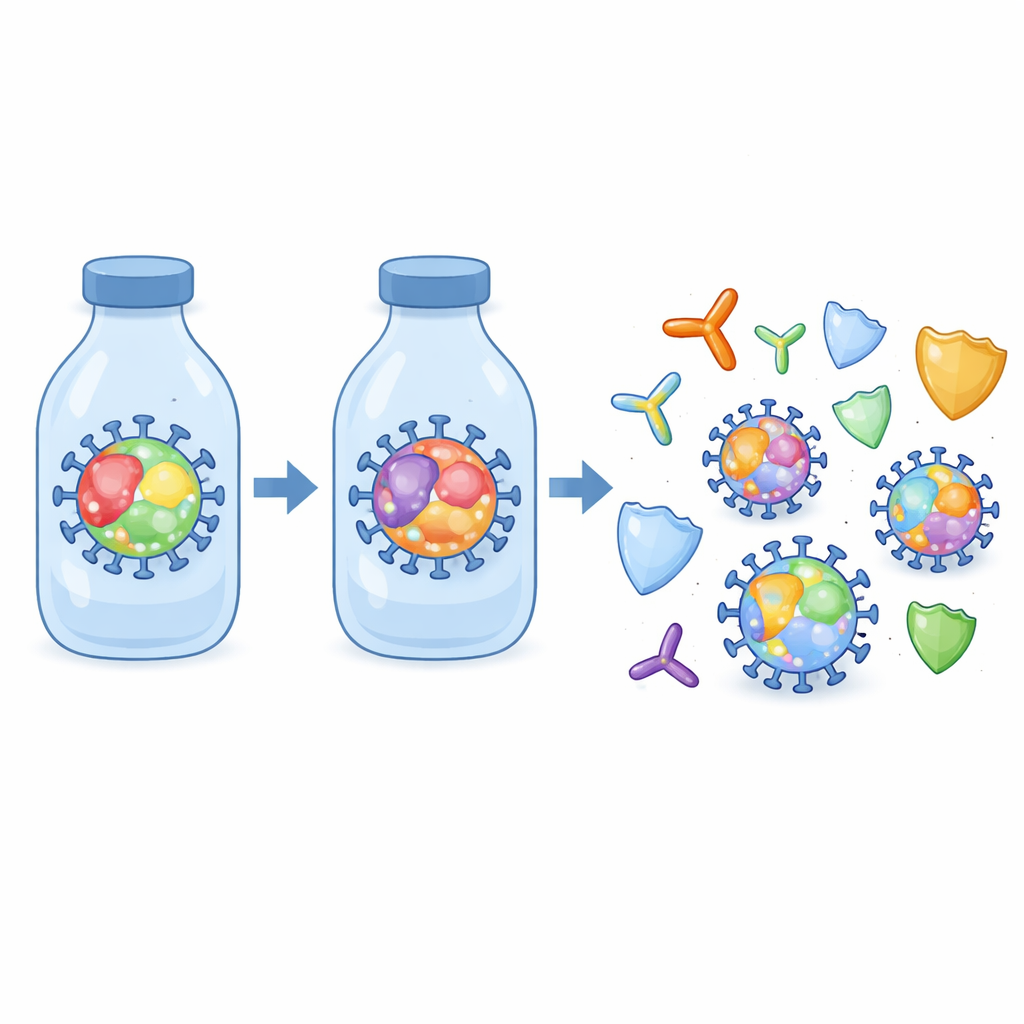
Shifting Attention to Hidden, Stable Features
To understand why this broader protection emerged, the team mapped exactly where antibodies were binding along the hemagglutinin protein. High-density peptide arrays and electron microscopy showed that distant priming followed by boosting redirected responses toward regions that change little from strain to strain—both in the head and the more recessed “stem” of the protein. Antibodies in these animals focused strongly on a conserved head region known as site C, as well as stable stretches in the stem. In contrast, animals primed with a similar strain mostly boosted antibodies that recognized the same variable hot spots they had seen before, many of which no longer matched the challenge virus. This reordering of “epitope hierarchy” means that the immune system’s priority list of targets can be reshaped by how different successive vaccines are from each other. 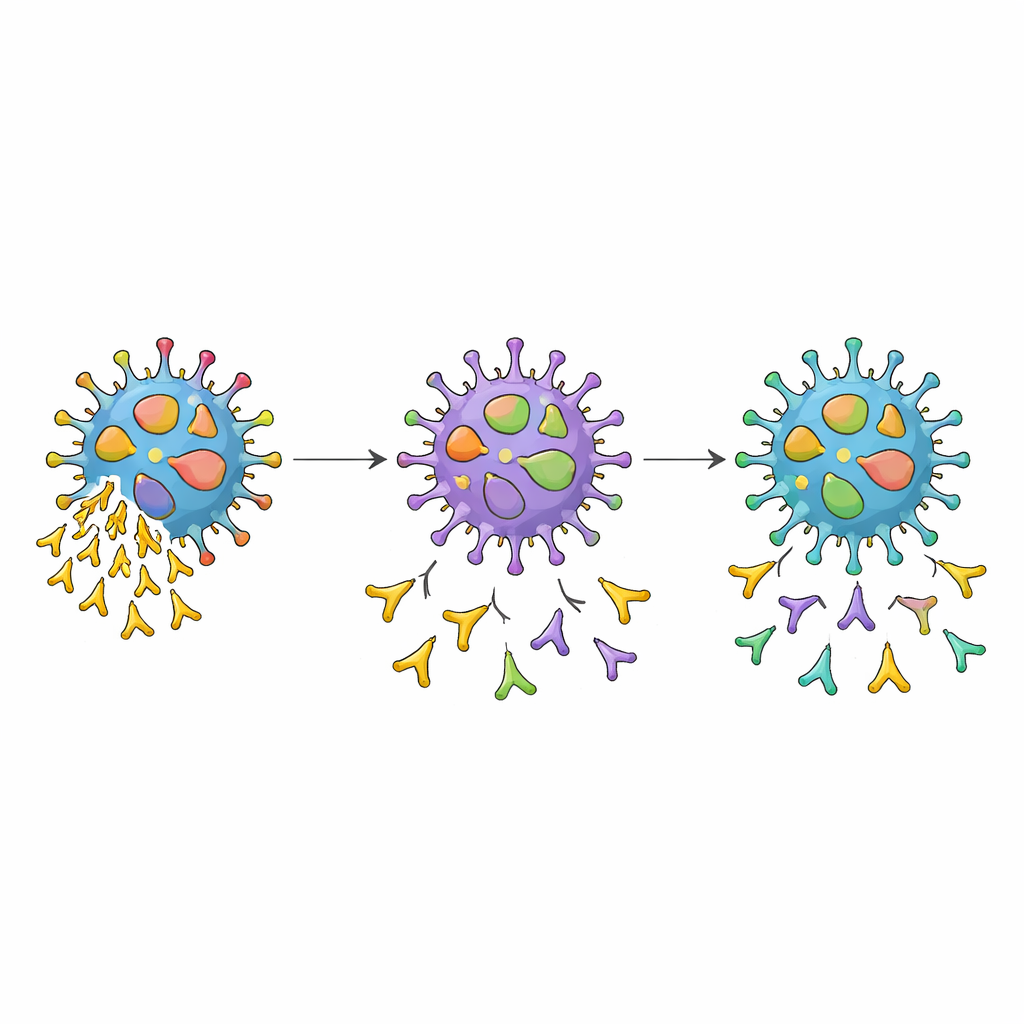
Immune Cells Working in Better Coordination
The benefits were not limited to antibody binding sites. Single-cell RNA sequencing of ferret spleens revealed that distant priming activated more germinal center B cells—the factories where antibodies are refined—and more helper T cells that support them. Key immune signaling pathways were turned up, reflecting a stronger, more coordinated response. Follow-up tests showed that antibody-producing cells and virus-specific T cells were more numerous and more cross-reactive in these animals, especially in lymph nodes draining the lungs where the virus first takes hold. Even the viruses themselves evolved differently within these hosts: the pattern of genetic changes in the challenge strain suggested that the altered immunity imposed distinct pressures compared with traditional, closely matched vaccination.
What This Could Mean for Future Vaccines
Taken together, the study shows that carefully choosing how different one flu shot is from the next can change what the immune system “sees” and remembers. By spacing differences across several key regions of the virus’s outer protein, vaccines can nudge the immune response away from fragile, fast-changing features and toward more stable ones, without giving up strong protection against current strains. Although these results come from ferrets rather than people, they outline a practical design principle that could be built into future seasonal flu updates and potentially adapted for other shape-shifting viruses like SARS-CoV-2 and dengue. In simple terms, the work suggests that sometimes, to get broader, longer-lasting immunity, the best next shot is not the closest match—but a wisely chosen step away.
Citation: Wan, XF., Guan, M., Balamalaliyage, P. et al. Epitope-spanning antigenic variation reprograms immunodominance and broadens immunity in sequential influenza vaccination. Nat Commun 17, 3340 (2026). https://doi.org/10.1038/s41467-026-70202-y
Keywords: influenza vaccination, immune imprinting, broadly protective antibodies, epitope targeting, vaccine design