Clear Sky Science · en
Long-range magnetic order with disordered spin orientations in a high-entropy antiferromagnet
When Disorder Behaves Like Order
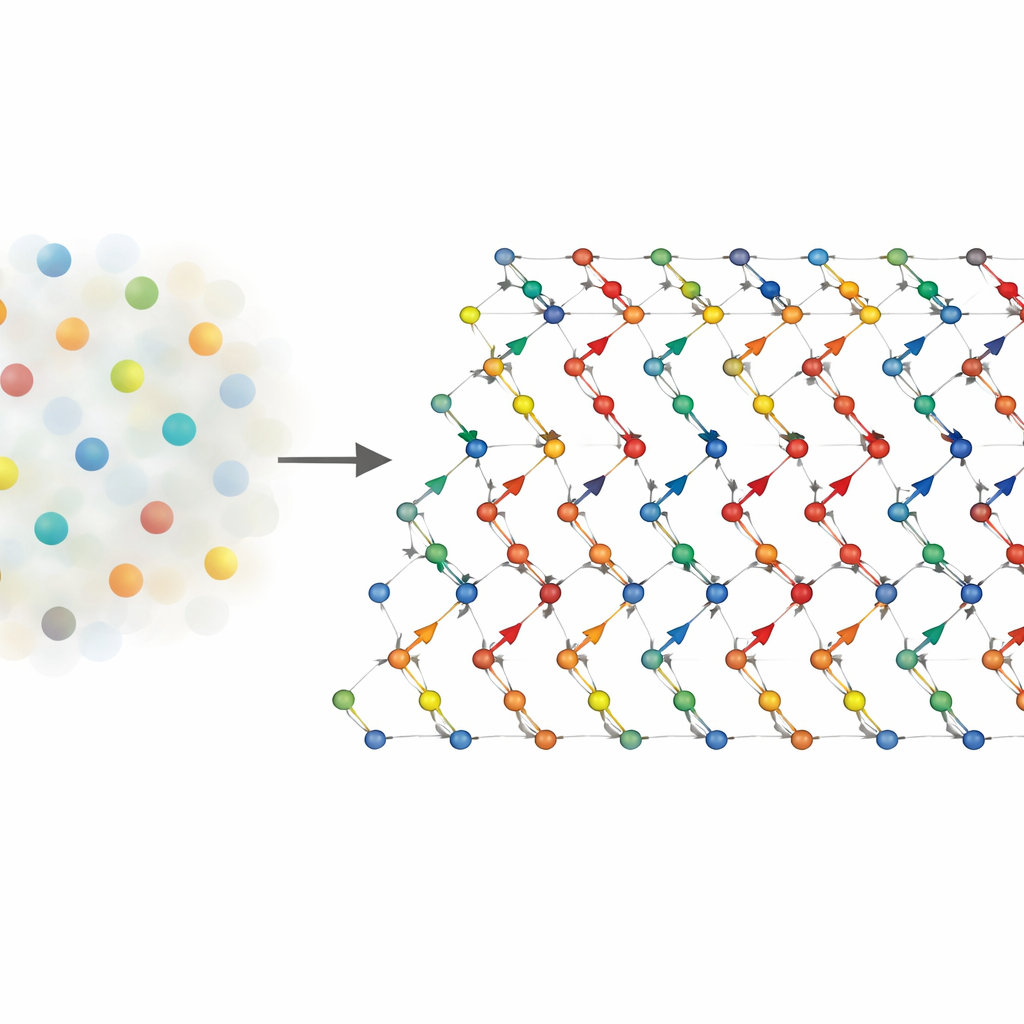
Magnetic materials are the backbone of technologies from data storage to future quantum devices, and conventional wisdom says that too much atomic disorder destroys their neat, long-range magnetic patterns. This study overturns that expectation by showing that a highly disordered "high-entropy" crystal can still form a robust, large-scale magnetic pattern—yet with each type of atom keeping its own preferred direction, like a choreographed crowd where every dancer faces slightly differently.
Mixing Many Metals into One Crystal
The material at the heart of this work is called HEPS3, short for (Mn1/4Fe1/4Co1/4Ni1/4)PS3. It belongs to a family of layered crystals where metal atoms sit on a flat honeycomb grid, held together by weak van der Waals forces between the layers. In familiar relatives of this family, each crystal contains just one kind of magnetic metal, and its spins (tiny bar magnets carried by electrons) arrange into regular patterns. By contrast, HEPS3 mixes four different magnetic metals—manganese, iron, cobalt, and nickel—in equal amounts, scattered randomly across the honeycomb. That extreme randomness, or "high entropy," would normally be expected to break apart any long-range magnetic order and instead produce a disordered, glassy state.
Long-Range Order in a Sea of Randomness
To see what the spins were actually doing, the researchers used two powerful, complementary probes. Neutron diffraction, which senses collective magnetic arrangements throughout the crystal, revealed that below about 72 kelvin (roughly –200 °C) HEPS3 develops a three-dimensional zigzag antiferromagnetic pattern: spins line up in chains where neighboring chains point in alternating directions. Surprisingly, this ordered state coexists with more weakly coupled, two-dimensional magnetic layers that persist to somewhat higher temperatures. The measured magnetic peaks were sharp in the honeycomb plane, demonstrating that the zigzag pattern extends over long distances, even though the underlying atoms are randomly arranged.
Listening to Each Element Separately
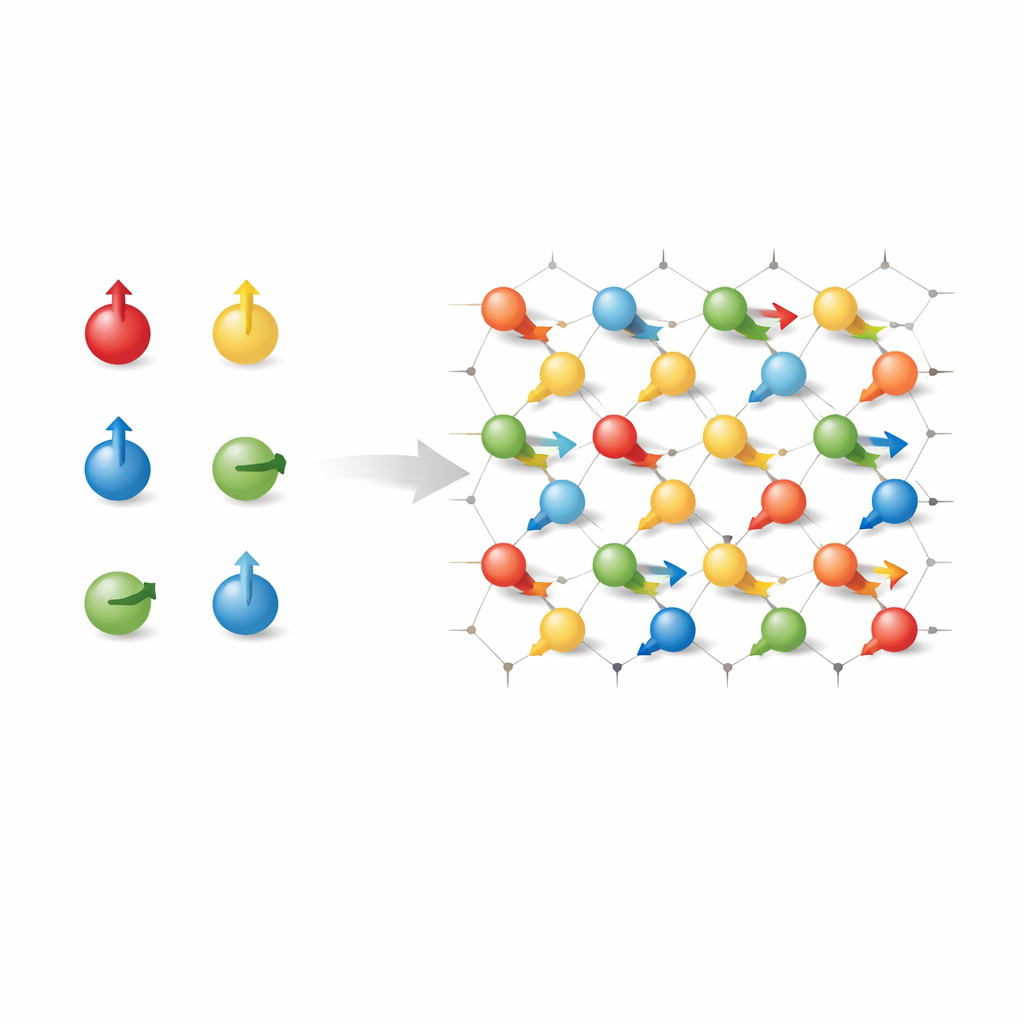
Neutron scattering averages over all atoms, so it cannot distinguish which metal does what. To gain element-by-element insight, the team turned to resonant soft x-ray scattering, which can be tuned to the specific energy levels of manganese, iron, cobalt, or nickel. By selecting each element in turn, they showed that all four participate in the same magnetic transition at the same temperature. However, a more subtle picture emerged when they examined how the scattered x-rays depended on polarization and sample rotation. Those signatures revealed that the spins of the four metals do not all point in the same direction within the crystal. Instead, each element adopts its own preferred tilt angle in the plane defined by the crystal axes, reflecting its inherent magnetic personality.
A Compromise Between Local Preference and Teamwork
The researchers interpret this unusual state as a compromise between two competing tendencies. On one side, each ion has its own “single-ion anisotropy”—a built-in preference for spin direction set by its electronic structure and local environment. On the other, exchange interactions favor neighboring spins aligning in a coordinated pattern to lower the overall energy. If exchange were very weak, every element would simply follow its own anisotropy, leading to local order but no coherent pattern. If exchange completely dominated, all spins would be forced into a single common direction. HEPS3 lands in the middle: the spins settle into a shared zigzag pattern across the lattice, but each type of metal keeps a slightly different orientation within that pattern. The result is a long-range magnetic order without a simple repeating local motif and without a conventional magnetic unit cell.
Why This Exotic Magnet Matters
This work introduces a new kind of magnetic state: a robust, large-scale antiferromagnetic order built from many distinct, randomly placed magnetic elements whose spins do not fully agree on a direction. It shows that high configurational entropy, usually thought to promote magnetic glassiness, can instead help stabilize an unusual but well-defined order. Beyond challenging the standard view of how disorder affects magnetism, these findings hint that high-entropy magnets could be deliberately engineered to tailor magnetic strength, directionality, and dimensionality. That could open up design routes for future magnetic and spintronic materials where complexity is not a bug to be eliminated, but a powerful resource to be harnessed.
Citation: Shen, Y., Zhang, G., Zhang, Q. et al. Long-range magnetic order with disordered spin orientations in a high-entropy antiferromagnet. Nat Commun 17, 3558 (2026). https://doi.org/10.1038/s41467-026-70184-x
Keywords: high-entropy magnet, antiferromagnetism, spin orientation, van der Waals materials, neutron and x-ray scattering