Clear Sky Science · en
FeCu dual-single-atom catalyst promotes gradient H2O2 activation for enhanced methane oxidation to methanol
Turning a Common Gas into a Useful Liquid
Methane, the main component of natural gas, is abundant but hard to handle: it is a potent greenhouse gas and expensive to move unless it is chilled or turned into other chemicals. Methanol, in contrast, is a liquid fuel and versatile building block for industry. This study reports a catalyst that can directly turn methane into methanol under relatively mild conditions while wasting far less oxidant than before, offering a potential route to cleaner fuels and better use of remote gas resources.
Why Hydrogen Peroxide Needs Careful Handling
Hydrogen peroxide is an appealing oxidant because it breaks down into water and oxygen, avoiding heavy pollution. However, when used to attack the very strong carbon–hydrogen bonds in methane, it is a blunt tool. If the reactive oxygen species it generates are too aggressive or too concentrated, they do not stop at methanol but keep going to unwanted acids or even carbon dioxide. Earlier approaches often poured in excess hydrogen peroxide to get reasonable reaction rates, sacrificing both selectivity for methanol and overall efficiency of the oxidant.
Designing a Two-Zone Catalyst
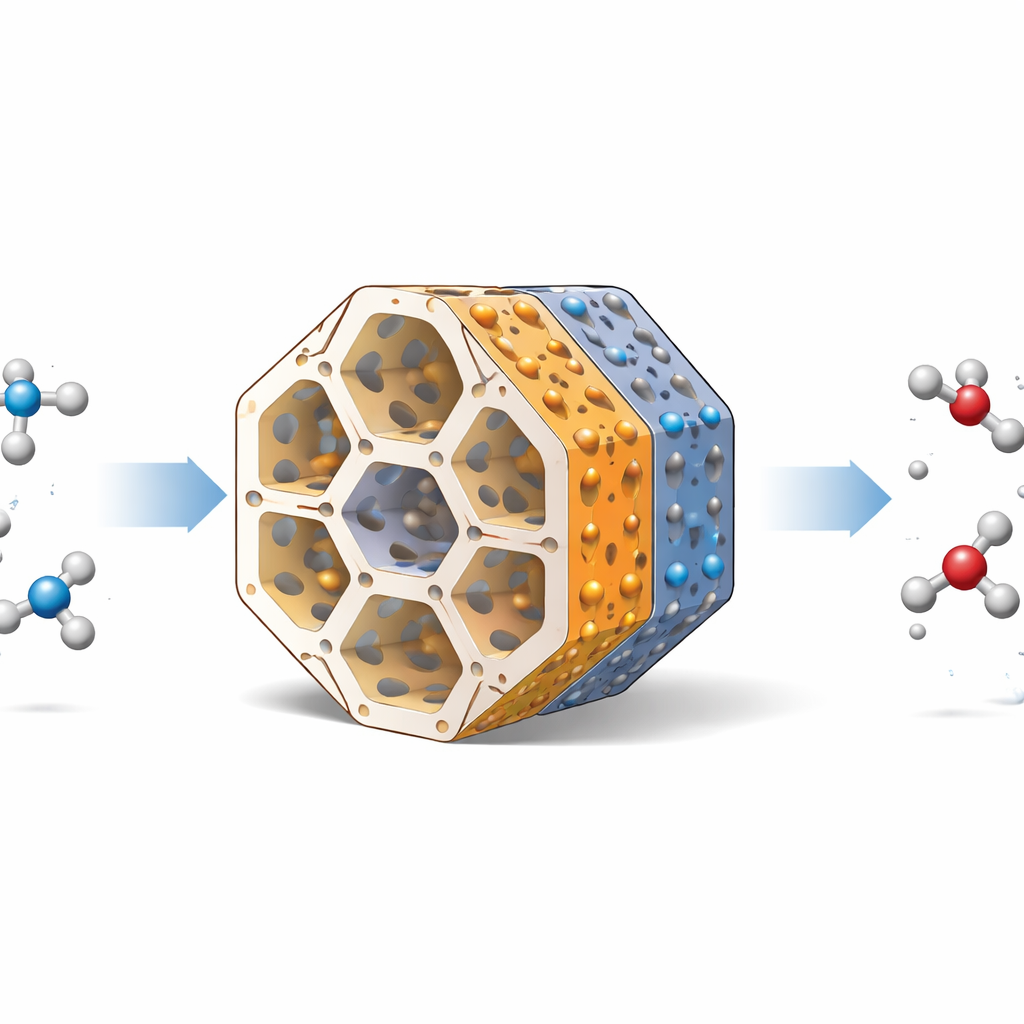
The researchers tackle this problem by designing a catalyst with two kinds of single metal atoms—iron and copper—anchored at different positions inside a porous mineral called ZSM‑5. The tiny channels inside ZSM‑5 naturally create a gradient in hydrogen peroxide concentration: lower on the inside, higher near the outer surface. By placing isolated iron atoms mainly in the inner channels and copper atoms mostly on the outer surface, the team builds a kind of spatial “assembly line” where methane first meets one type of active site and then another, each tuned for a different step of the reaction.
Guiding Reactive Oxygen Step by Step
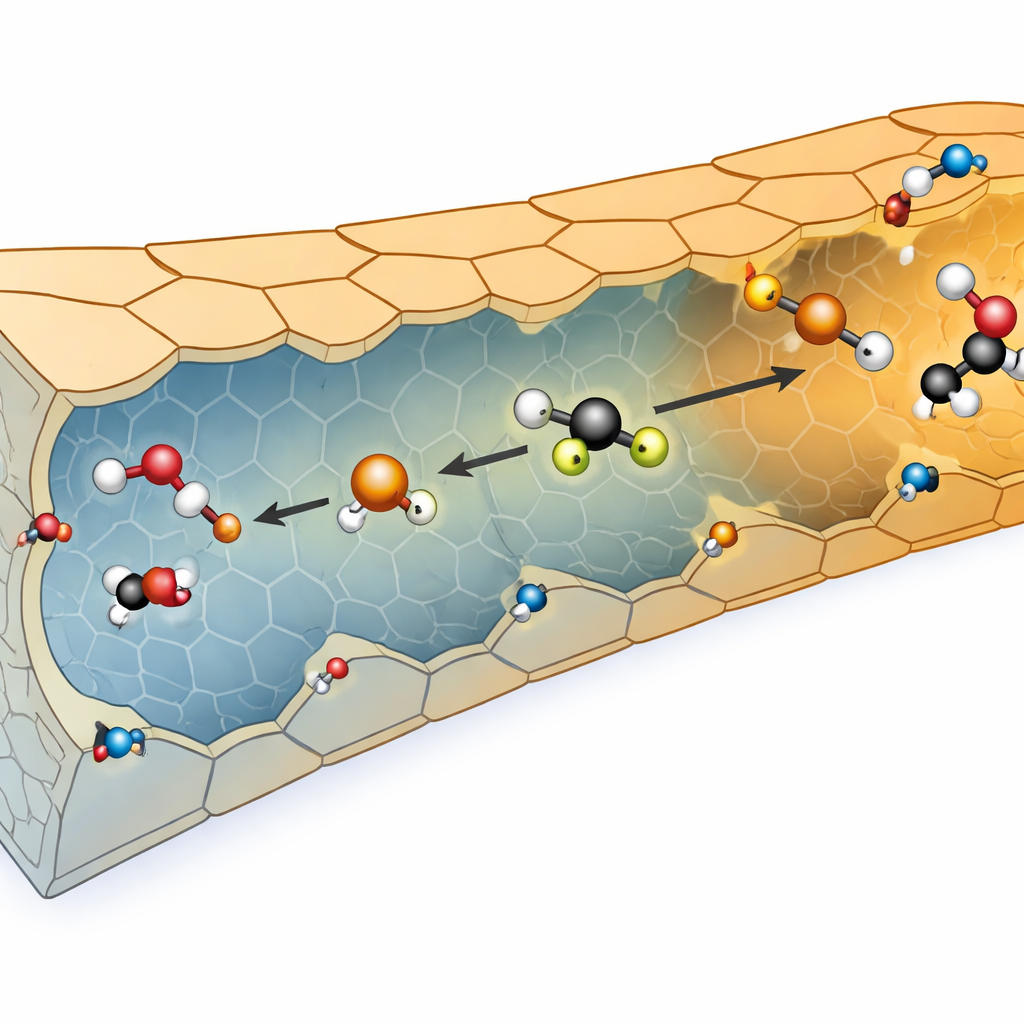
Inside the narrow pores, iron sites prefer to convert hydrogen peroxide into relatively controlled oxidizing species, including high‑valent iron‑oxo groups and milder radicals. These species are strong enough to break the stubborn C–H bond in methane, forming an intermediate, methyl hydroperoxide, without immediately burning it further. As this intermediate diffuses outward, it encounters copper sites on the outer surface. Copper activates hydrogen peroxide differently, leaning toward the formation of hydroxyl radicals under conditions where the oxidant concentration is higher. In this milder outer zone, copper helps transform the intermediate into methanol and encourages the product to leave the surface before it can be over‑oxidized.
Evidence from Experiments and Computations
To verify that this spatial strategy works, the team compares a range of catalysts where iron and copper are introduced in different ways or locations. Only when iron sits mainly inside the pores and copper outside do they observe both high methanol yield and high selectivity. Under optimized conditions, the dual‑atom FeCu/ZSM‑CI catalyst produces methanol at 20.2 millimoles per gram of catalyst per hour with 90.1 percent selectivity, and uses 74.6 percent of the hydrogen peroxide for productive chemistry rather than wasteful decomposition. Advanced spectroscopic tools and kinetic tests show that iron is chiefly responsible for activating methane, while copper governs how the peroxide breaks apart and how the intermediates evolve. Computer simulations back this picture, revealing lower energy barriers for methane activation at iron sites and favorable pathways for methanol formation and release at copper sites.
What This Means for Future Clean Chemistry
This work shows that it is not enough to choose the right oxidant or single active metal; the spatial arrangement of different atomic sites inside a porous structure can fundamentally reshape how reactive oxygen species form and where they act. By using the natural diffusion of hydrogen peroxide through tiny channels and separating iron and copper into distinct zones, the authors turn a difficult, waste‑prone reaction into a more selective and efficient one. While further engineering is needed before such systems can be widely deployed, the study offers a blueprint for turning simple, stubborn molecules like methane into valuable liquids with less waste and lower energy input.
Citation: Zhang, H., Wang, S., Li, Y. et al. FeCu dual-single-atom catalyst promotes gradient H2O2 activation for enhanced methane oxidation to methanol. Nat Commun 17, 3526 (2026). https://doi.org/10.1038/s41467-026-70179-8
Keywords: methane to methanol, single atom catalysts, hydrogen peroxide oxidation, zeolite ZSM-5, selective alkane oxidation