Clear Sky Science · en
Fine-scale structure of a whole regional population through genetics and genealogies
Why local family history matters for your DNA
Most of us think about ancestry in broad strokes: continental origins, ethnic labels, maybe a country or two. This study shows that our genetic stories can be much more finely grained. By combining modern DNA data with centuries of marriage records from a single region of Quebec, researchers uncover subtle genetic differences from town to town—and explain why overlooking this fine pattern can mislead medical genetics and risk predictions.
A region long thought to be all alike
The researchers focused on Saguenay–Lac-Saint-Jean, a region in Quebec settled mainly by French colonists in the 1800s. Because the area grew rapidly from a relatively small pool of settlers, it has often been treated as a “founder” population that is largely uniform genetically. At the same time, historians knew there were distinct settlement waves, migration routes and economic hubs within the region. The team asked whether these local historical differences had left detectable fingerprints in people’s DNA, even though standard genetic methods often treat everyone there as one homogeneous group.
Marrying DNA with family trees
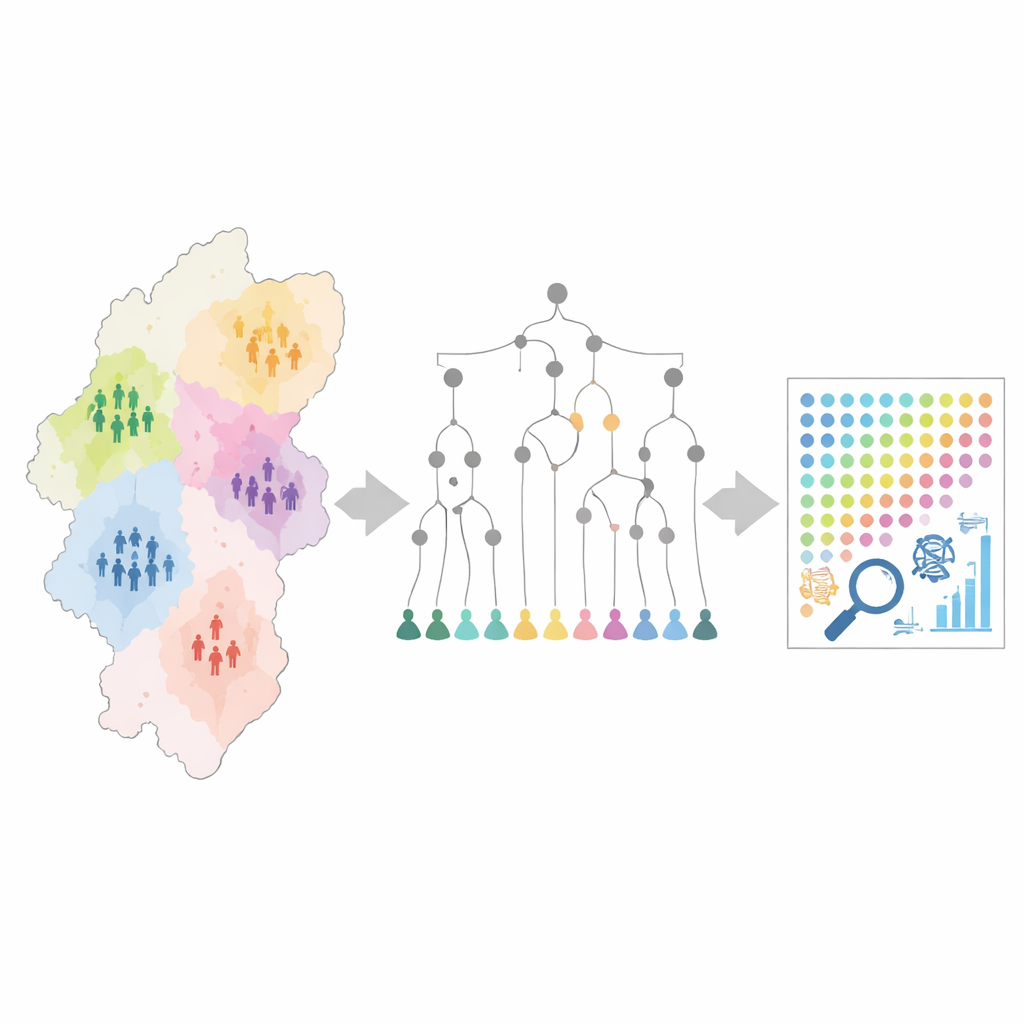
To tackle this, the scientists linked two rare resources: a large health study with DNA data from tens of thousands of Quebec residents, and the BALSAC database, which records centuries of marriages across the province. They focused on nearly 8,000 people with both DNA and deep family trees, and on more than 80,000 individuals who married in Saguenay–Lac-Saint-Jean between 1931 and 1960. Using a fast new computer algorithm, they calculated how closely related every pair of people was expected to be from their family trees, and compared this to how much DNA they actually shared. The close match between the two—strong statistical agreement between genealogical kinship and genetic kinship—showed that historical records can reliably stand in for DNA when mapping population structure.
Hidden east–west patterns across the map
When the team visualised these relationships, a surprisingly detailed picture emerged. People whose parents married in the same local subdivision tended to cluster together in the analyses, revealing clear differences between parts of the region. An especially strong pattern was an east–west gradient: individuals in eastern municipalities had a higher share of ancestors from the nearby Charlevoix area along the St. Lawrence River, whereas those in the northwest drew more of their ancestry from other parts of Quebec. Remote rural municipalities showed tight pockets of relatedness, while urban centres appeared more mixed, reflecting later waves of migration and economic attraction, such as railroad expansion and industrial jobs.
Tracing the footprints of founders
By estimating how much genetic material today’s residents are expected to inherit from specific founding couples, the researchers could reconstruct how settlement history shaped the region’s genetic mosaic. Certain Charlevoix towns, like La Malbaie and Les Éboulements, contributed disproportionately to particular eastern areas, while Baie-Saint-Paul had a stronger influence on Lac-Saint-Jean. In contrast, northwest municipalities and some urban zones showed much more diverse origins, with many founders coming from outside Charlevoix altogether. These fine-scale differences matter because the region is known to have higher frequencies of some rare genetic variants and diseases; the new work suggests that even within a single region, the local risk can vary markedly from one municipality to the next.
Why this matters for genetic risk and fairness
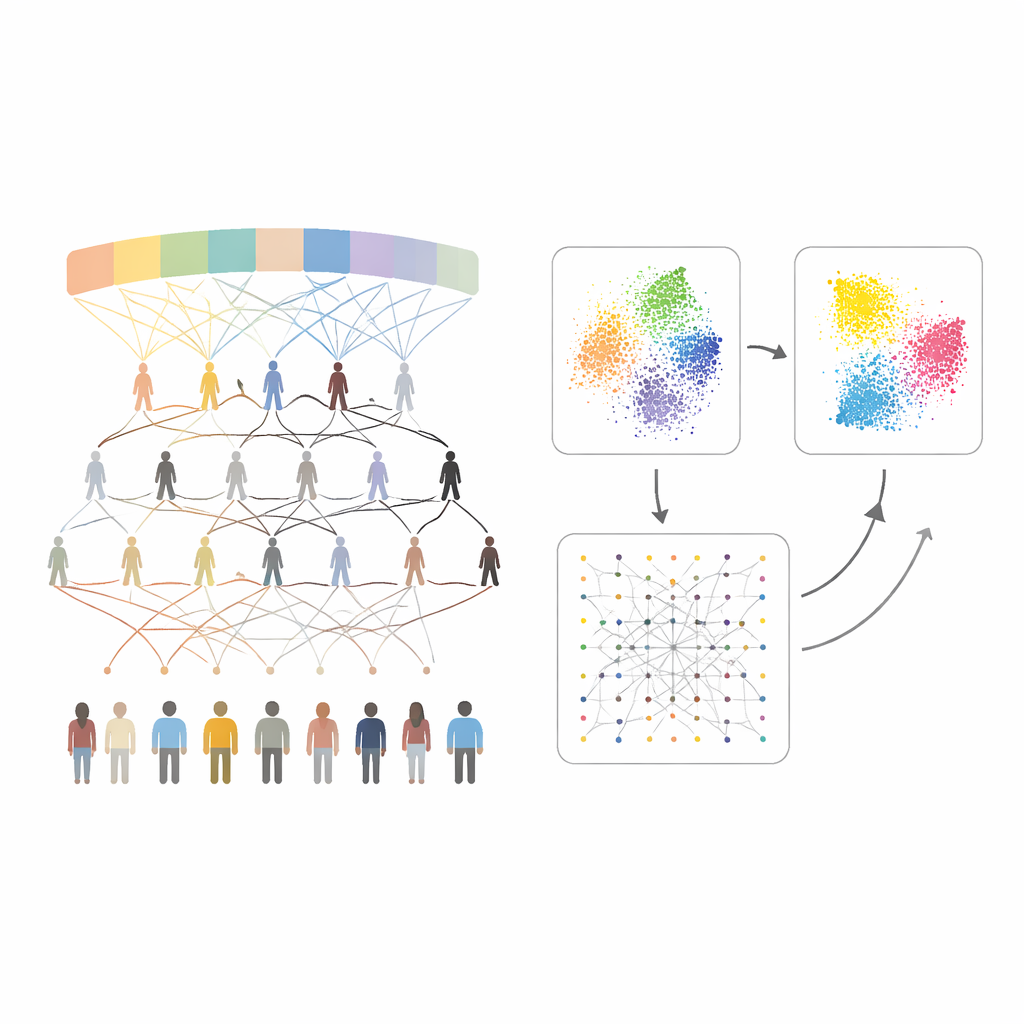
Many large DNA studies try to correct for population differences using broad statistical tools, such as principal components, and then use the results to build polygenic risk scores that estimate disease risk from many genes at once. This study shows that subtle, very local structure can survive those corrections and still bias results. If certain genetic variants are more common in one small area that also differs in lifestyle or environment, simple corrections can confuse environmental influences with genetic ones. The authors demonstrate that this kind of hidden structure can create spurious signals in simulated genetic association studies, even in what looks like a small, homogeneous population.
A closer look for better genetic medicine
For non-specialists, the key message is that human genetic diversity is not just a matter of continents or broad ethnic groups; it can vary sharply over tens of kilometres, shaped by who settled where, who married whom, and how people migrated for work. By combining detailed genealogies with DNA and new computational tools, this work maps those patterns across an entire regional population. The findings warn that medical genetics must pay attention to local structure to avoid mistaken risk estimates, while also highlighting how historical records can help bring smaller and rural communities into the fold of precision medicine.
Citation: Morin, GP., Moreau, C., Barry, A. et al. Fine-scale structure of a whole regional population through genetics and genealogies. Nat Commun 17, 3342 (2026). https://doi.org/10.1038/s41467-026-70175-y
Keywords: population structure, founder population, genealogy, genetic risk, Quebec