Clear Sky Science · en
Global economic exposure to climate change amplified by spatially compounding climate extremes
Why Weather Far Away Matters for Your Wallet
When a heatwave hits your town or floods swamp a distant country, it may feel like separate, unlucky events. This study shows that these extremes are increasingly happening at the same time in many places around the world—and that this “bad weather in stereo” can shake the global economy. By tracing how heat, floods, and droughts line up across continents, the authors reveal that poorer regions are often hit together with others, raising the risk of widespread disruption to trade, food supplies, and jobs everywhere.
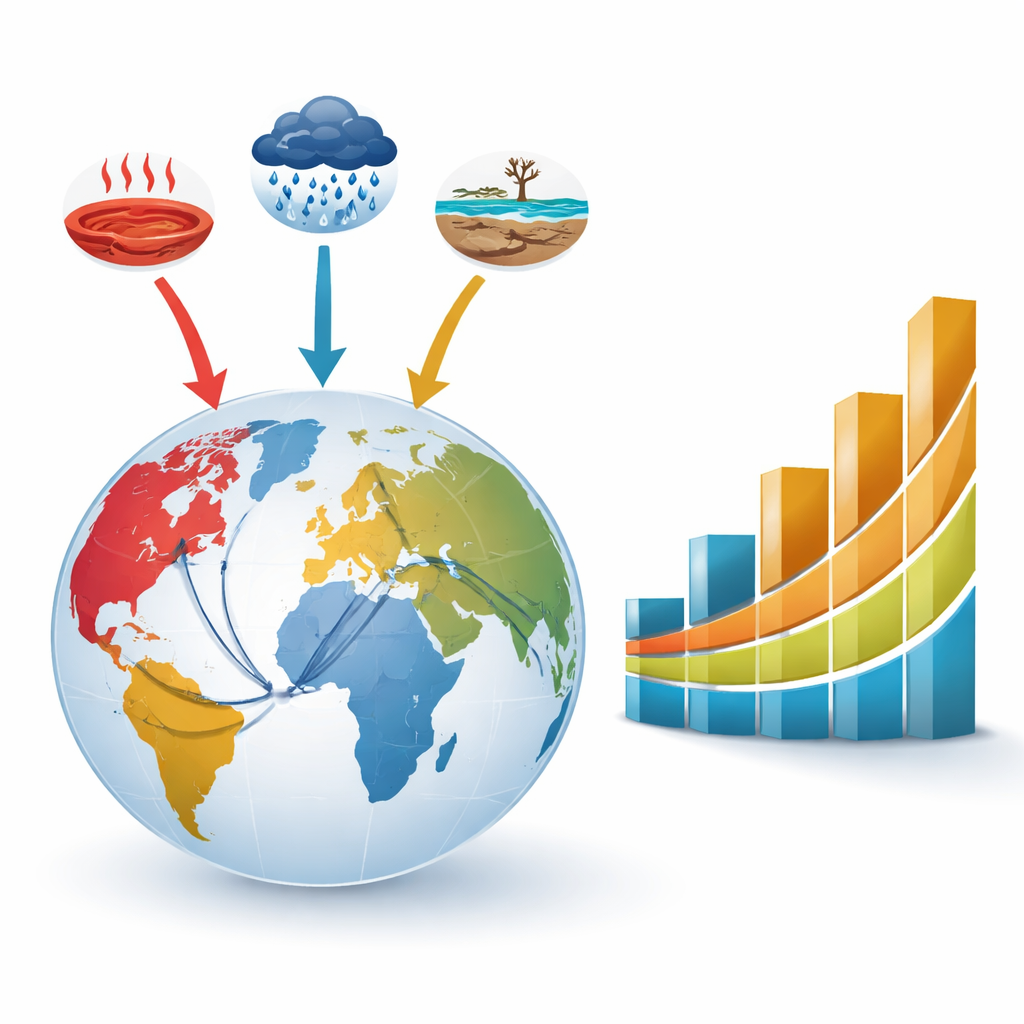
Many Disasters, One Interconnected World
Over recent decades, weather disasters—droughts, floods, heatwaves, and storms—have already shaved measurable chunks off the world’s income, with poorer countries losing the largest share of their economies. Most previous research looked at single events in isolation, such as a flood in one river basin or a heatwave in one country. This paper instead asks what happens when extremes strike many regions in the same year. Because modern economies are bound together by trade, finance, and supply chains, such synchronized shocks can cause ripple effects that are much larger than the damage in any one location.
Tracking Future Risks with Climate and Economic Models
The authors combine state-of-the-art climate simulations with maps of present and future economic activity. They focus on four types of extremes: heatwaves, bursts of heavy rainfall, deep drying of soils, and broader water scarcity. For each year up to 2100, they identify grid cells on the globe that experience an extreme, then overlay this with how much economic output lies in those same cells. This allows them to count, for each scenario of global warming and economic growth, how much of the world’s income is exposed when extremes occur at the same time across many regions, and how that exposure is split between richer and poorer parts of the world.
Heat, Deluges, and Droughts Hitting Together
Across all future scenarios, the share of global income exposed to heatwaves rises sharply as the climate warms, mainly because extreme heat spreads over more land at once. By mid-century under a middle-of-the-road pathway, tens of trillions of dollars of yearly economic activity are simultaneously exposed to severe heat. Mid-latitude belts such as the Mediterranean and eastern Central Asia, along with parts of South America and Africa, emerge as hotspots where a large slice of regional income sits in areas repeatedly hit by heatwaves. Heavy rainfall extremes and flood-related risks grow fastest in tropical regions, especially in parts of South America, central Africa, and South Asia, where rapid economic growth increasingly occurs in zones prone to intense downpours.
Drying Lands and Growing Water Stress
The study finds similarly worrying patterns for deep soil droughts and chronic water scarcity. Regions such as the Amazon basin, southwestern South America, southern Africa, the Mediterranean, and parts of Australia are projected to experience much higher odds that a large portion of their economies is affected by dry conditions in any given year. Water scarcity particularly threatens parts of northern South America, southern South America, the Mediterranean, and the Sahara zone, where economic development is expanding into already water-stressed landscapes. These drying patterns also tend to occur at the same time across continents; for example, drought-prone regions of South America, Africa, Europe, and Australia frequently experience coinciding stress, raising the risk of global food-price spikes and energy shortfalls.
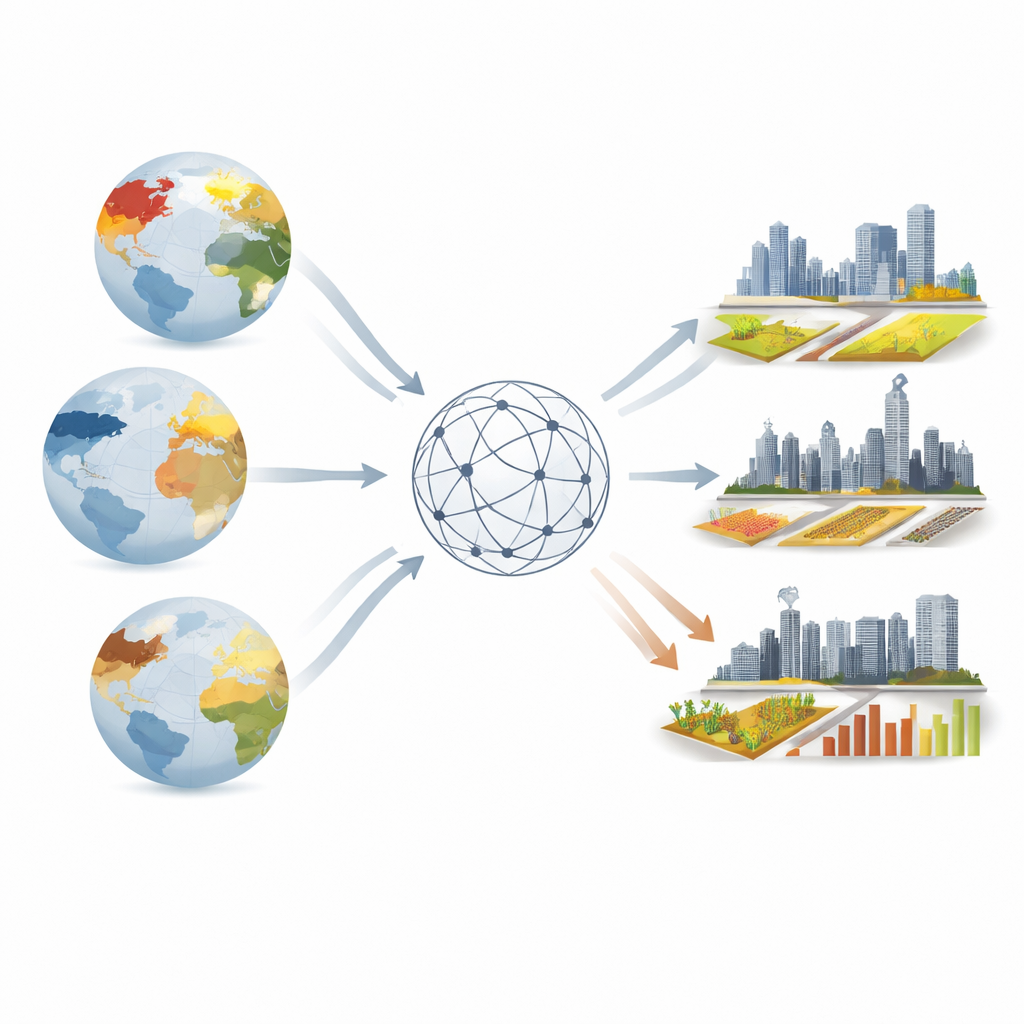
From Local Shocks to Systemic Economic Risks
Because trade and finance knit regions together, what starts as a local harvest failure or power shortage can cascade through international supply chains. The authors show that some regions, like the Mediterranean, act as global “connectivity hubs” that often share extremes with many partners, while others have fewer but very strong links. As global warming increases the odds that multiple breadbaskets or industrial regions are hit in the same year, classic risk-spreading strategies—such as diversifying insurance portfolios or pooling disaster funds across countries—become less effective. The study warns that beyond about 2 °C of warming, the value of economic activity simultaneously at risk rises steeply, especially in low-income regions with limited capacity to cope.
What This Means for Our Shared Future
The authors conclude that climate extremes will not only become more intense and frequent; they will also become more synchronized across the planet, amplifying economic inequality and systemic risk. Poorer, low-latitude regions are projected to face a disproportionate share of this growing exposure, often at the same time as key trading partners, which can send shockwaves through global markets. Limiting warming to around 1.5 °C would substantially reduce the amount of economic activity in harm’s way, while higher warming would lock in much larger and more uneven risks. Planning for this future will require not just local adaptation, but also international cooperation, smarter trade and insurance arrangements, and strong efforts to cut greenhouse gas emissions.
Citation: Biess, B., Gudmundsson, L. & Seneviratne, S.I. Global economic exposure to climate change amplified by spatially compounding climate extremes. Nat Commun 17, 3385 (2026). https://doi.org/10.1038/s41467-026-70127-6
Keywords: climate extremes, global economy, heatwaves and floods, drought and water scarcity, systemic climate risk