Clear Sky Science · en
Room-temperature ferrimagnetism and polar phase in strained La2CoRuO6 films through 3d-4d cation engineering
Why this new material matters
Modern electronics increasingly rely on the spin of electrons as well as their charge, a field known as spintronics. Devices that can control magnetism with electric signals, and vice versa, promise faster, more energy‑efficient memory and logic. Such "multifunctional" materials, however, are rare, especially those that work well at room temperature. This study reports a thin‑film material that combines robust magnetism with switchable electric polarization at everyday temperatures, pointing toward practical building blocks for future low‑power technologies.
Building a special crystal sandwich
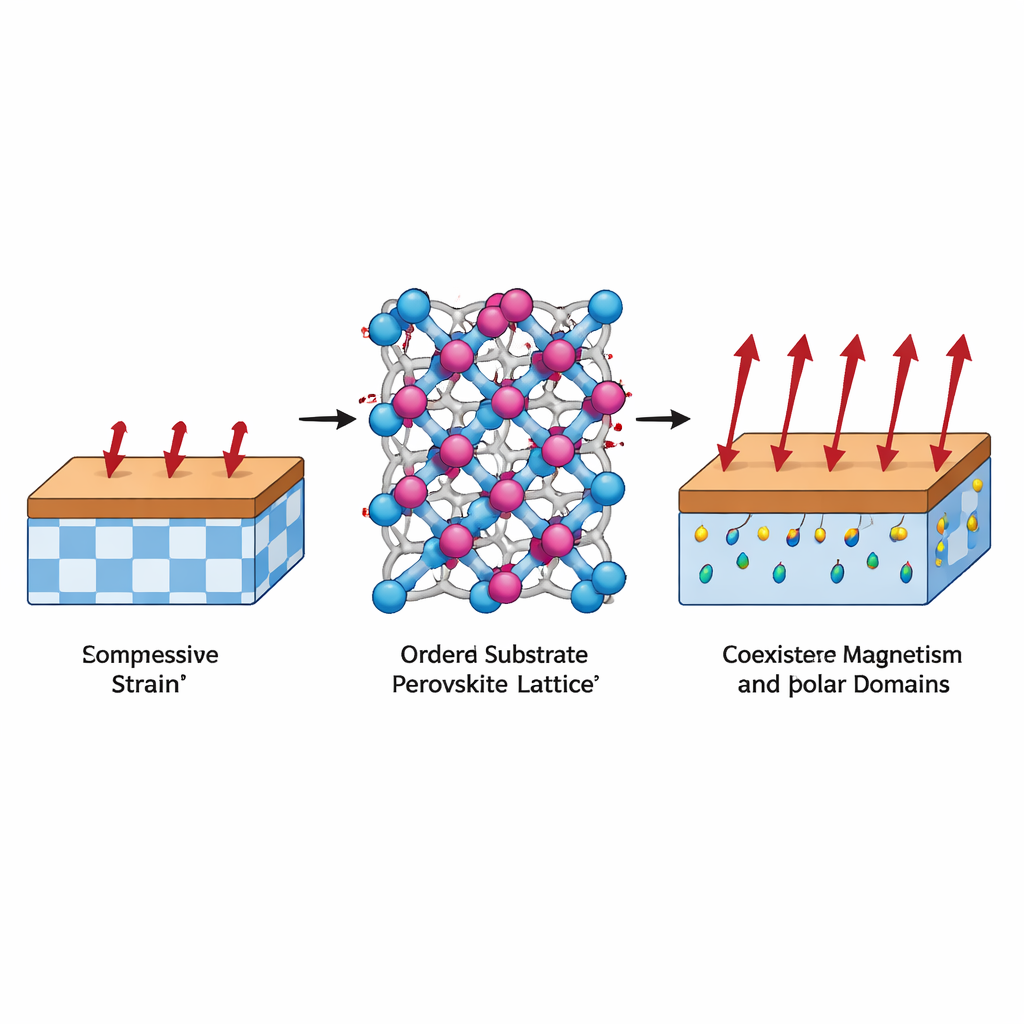
The researchers focused on a compound called La2CoRuO6, which belongs to a versatile family of oxides known as double perovskites. These crystals have two different metal atoms arranged in an ordered checkerboard pattern, offering many ways to tune their behavior. In bulk form, La2CoRuO6 is an electrical insulator with antiferromagnetic order, where neighboring atomic magnets cancel each other. The team grew ultra‑thin, highly ordered films of this material on carefully chosen strontium titanate substrates. Because the film and substrate have slightly mismatched atomic spacings, the film is forced into a strained state that subtly squeezes and tilts its atomic framework.
Turning strain into strong magnetism
Using a suite of techniques—including X‑ray diffraction, atomic‑resolution electron microscopy, and neutron reflectometry—the authors showed that the films possess excellent crystal quality and long‑range ordering of cobalt and ruthenium atoms. Magnetization measurements revealed a ferrimagnetic state: the cobalt and ruthenium sublattices remain oppositely aligned, but their strengths no longer perfectly cancel, leaving a net magnetic moment. Remarkably, this ordered magnetic state persists up to about 623 kelvin, far above room temperature and significantly higher than many oxide magnets. Electrical tests confirmed that the films stay insulating, an attractive combination for spintronic devices where currents should be minimized.
How atomic distortions reshape the spins
To uncover why strain produces this ferrimagnetic insulating state, the team examined the fine details of the lattice. High‑resolution imaging showed that oxygen octahedra—the cages surrounding each metal ion—are noticeably tilted and distorted compared with the bulk crystal, and these distortions vary gradually from the film–substrate interface toward the surface. Cobalt ions adopt a high‑spin configuration, carrying large individual magnetic moments, while ruthenium ions contribute smaller moments. Advanced quantum‑mechanical calculations revealed that compressive strain shrinks the unit‑cell volume and strengthens the magnetic interaction along direct cobalt‑oxygen‑ruthenium paths, while weakening competing routes between like ions. This rebalancing of exchange pathways favors parallel alignment within each sublattice but opposite alignment between them, yielding a net ferrimagnetic moment while preserving an energy gap that keeps the material insulating.
Hidden electric patches inside the film
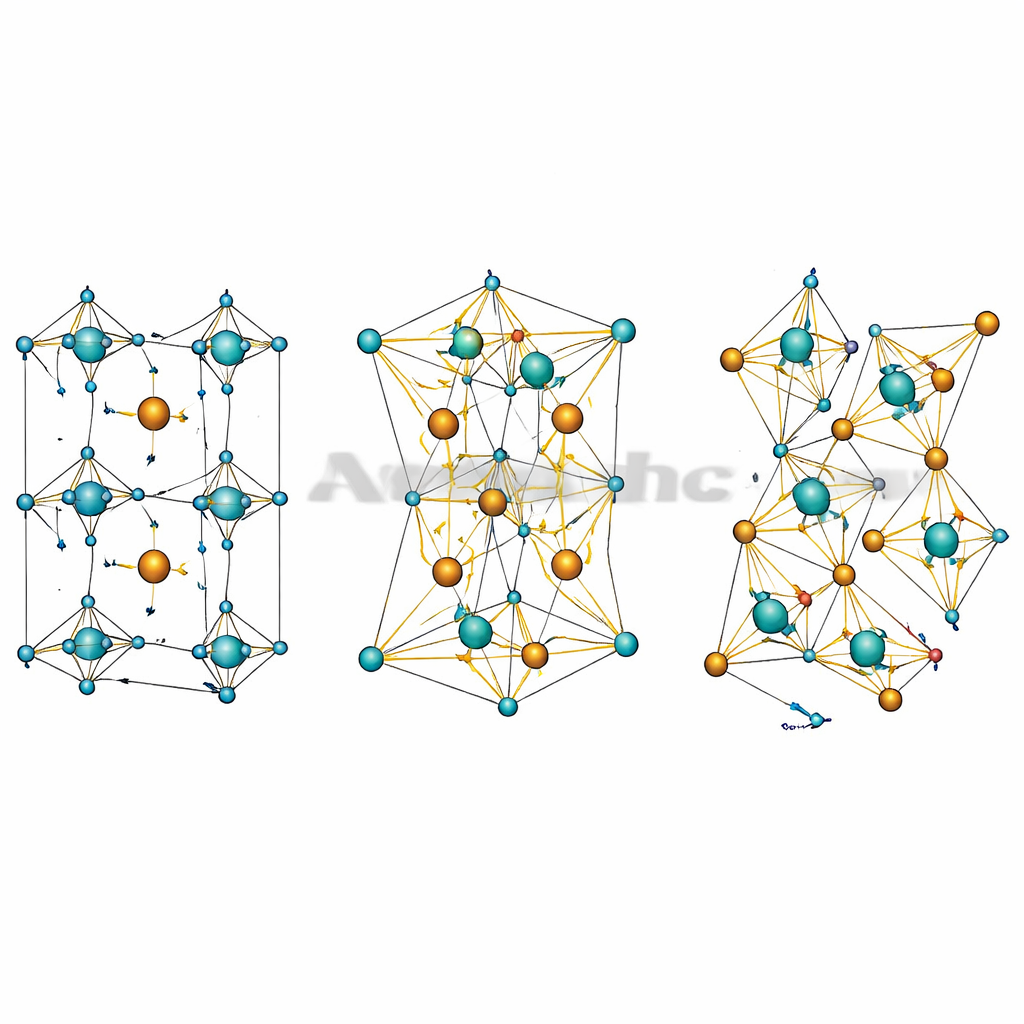
Beyond magnetism, the team looked for signs of electric polarization—tiny shifts of positive and negative charges that can be reversed by an external field. Macroscopic measurements hinted at a polar response but were complicated by leakage currents. Nanoscale imaging with piezoresponse force microscopy, however, clearly showed that local regions could be written and erased with opposite voltage pulses, proving that the polarization is switchable. Optical measurements based on second‑harmonic light generation further indicated that the film as a whole no longer respects the inversion symmetry of the bulk crystal, consistent with the emergence of a polar phase. Atomic‑level mapping of cation positions revealed many nanometer‑sized polar regions where cobalt and ruthenium atoms shift off center in a preferred direction, forming a patchwork of polar nanodomains rather than a single uniform ferroelectric state.
Linking lattice twists to electric behavior
Calculations showed that a perfectly uniform strained film would still be non‑polar, implying that something more subtle is at work. The key is that the rotations of the oxygen octahedra are not uniform: they change gradually through the film thickness, producing a "gradient" of structural distortions. This gradient breaks inversion symmetry locally and nudges cobalt and ruthenium ions in slightly different directions, generating nanoscale electric dipoles. Theoretical models that explicitly included such gradients produced finite polarization, matching the experimental observations. In essence, the same strain‑driven lattice distortions that reshape the magnetic interactions also create a landscape of switchable polar regions.
What this means for future devices
By carefully engineering strain and atomic ordering in a 3d–4d double perovskite, the authors have realized a material that is both ferrimagnetic and polar well above room temperature. Although the electric polarization is fragmented into nanoscale domains rather than perfectly uniform, it is still switchable and coexists with robust magnetism in an insulating film. This work closes an experimental gap for oxide materials containing heavier elements and offers a design roadmap: use epitaxial strain and controlled lattice rotations to couple magnetism and polarization in a single crystal. Such strategies could ultimately yield practical multiferroic components for low‑power, high‑density spintronic technologies.
Citation: Li, D., Zhou, Y., Jiang, K. et al. Room-temperature ferrimagnetism and polar phase in strained La2CoRuO6 films through 3d-4d cation engineering. Nat Commun 17, 3887 (2026). https://doi.org/10.1038/s41467-026-70125-8
Keywords: multiferroics, spintronics, strained thin films, double perovskites, ferrimagnetism