Clear Sky Science · en
Tailoring the glassy phase in polymer semiconductors tunes their optical properties
Why this matters for future electronics
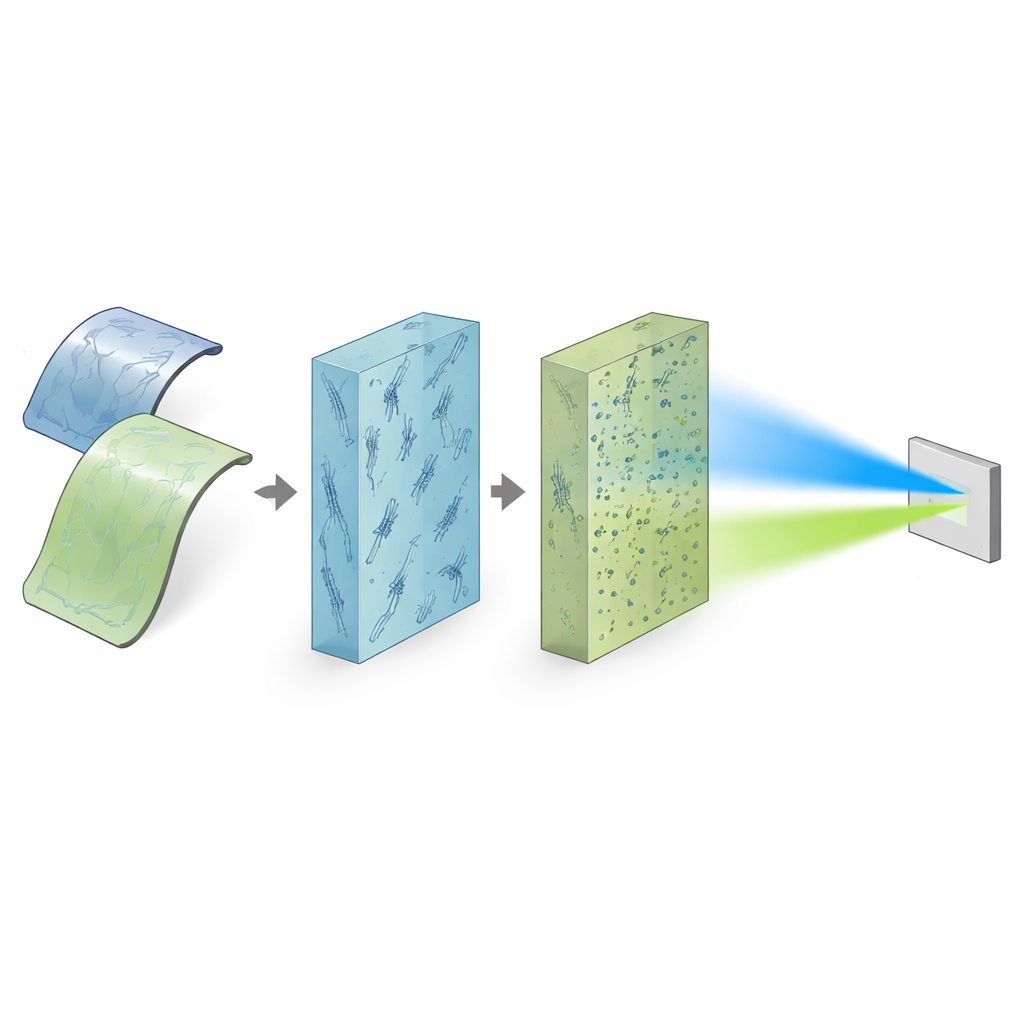
Phones, TVs, and wearable gadgets increasingly rely on thin, flexible layers of organic materials that emit or harvest light. Most of these layers are not perfectly ordered crystals but rather “frozen” disordered solids, known as glasses. This study shows that the way these polymer glasses are formed—how fast they are cooled and from what kind of liquid state—can be used like a hidden dial to tune how brightly and in what color they shine. That insight could help engineers design more efficient and more stable displays and solar cells without changing the chemical recipe of the materials themselves.
A new handle in soft electronics
Organic electronic devices, such as OLED displays and organic solar cells, are made from carbon-based semiconducting polymers that can be printed over large areas on flexible substrates. Because these devices are usually made by rapidly drying or cooling thin films, the polymer chains rarely have time to form extensive crystals. Instead, they typically end up in glassy, non-crystalline states. While enormous effort has gone into optimizing the fraction and quality of crystals in these materials, the majority glassy regions have often been treated as a passive background. The authors argue that this view is incomplete: by treating the glass itself as an adjustable state of matter, one can systematically control the optical behavior of polymer semiconductors.
How to tune a frozen disorder
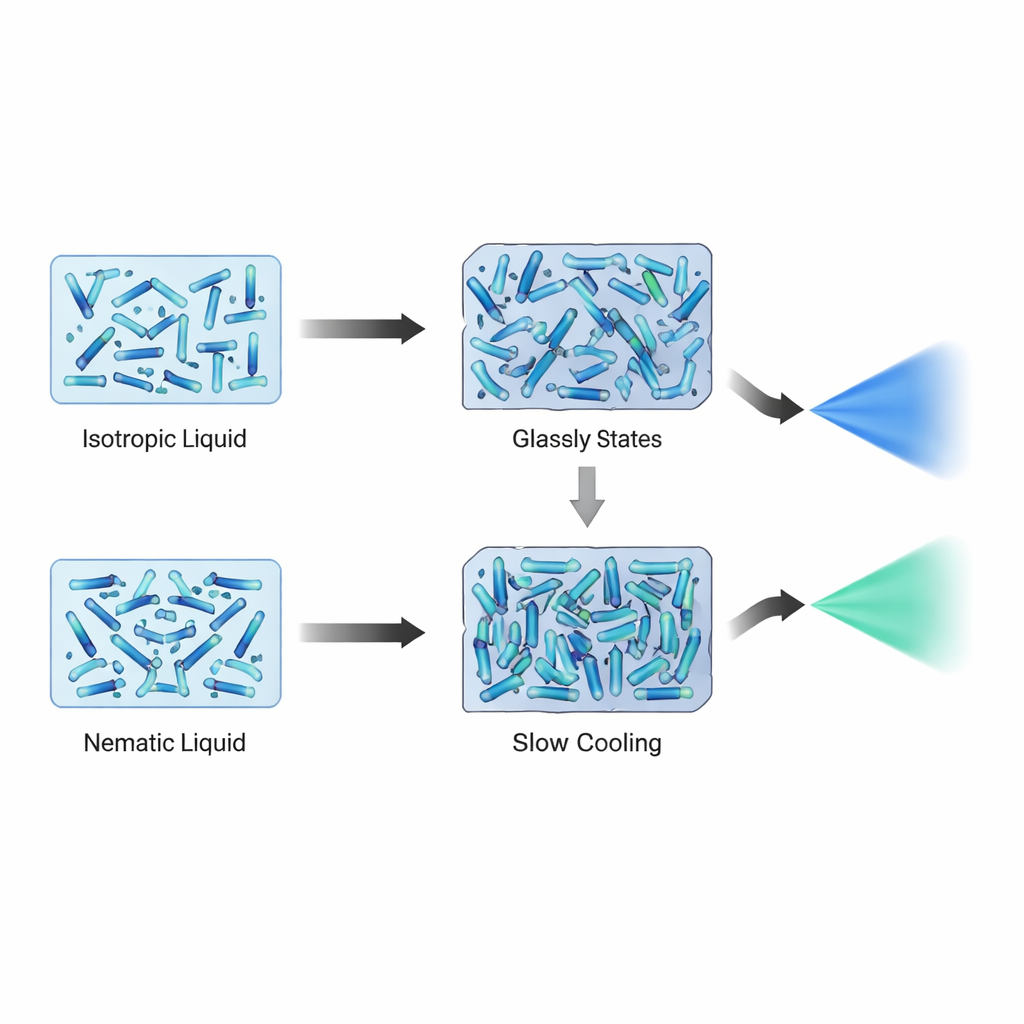
The key idea is that a glass “remembers” how it was made. Unlike a crystal or a liquid at equilibrium, a glass can have different internal energies and densities at the same temperature, depending on its cooling path. The team studies this using a model light-emitting polymer called PFO, which can exist as a fully disordered liquid or as a liquid crystal with some molecular alignment before it is frozen. They use ultrafast chip-based calorimetry to cool PFO films at rates spanning many orders of magnitude and to cool them either from a completely disordered liquid or from a partially ordered nematic state. The resulting glasses are characterized by a quantity called the fictive temperature, a measure of how “relaxed” and dense the glass is; lower fictive temperatures correspond to deeper, more stable glassy states.
Linking frozen structure to emitted light
To connect these thermodynamic differences to device-relevant behavior, the authors measure photoluminescence, the light emitted by the polymer when excited with a laser. They prepare four kinds of fully glassy PFO films: fast- and slow-cooled samples, each formed either from the isotropic liquid or from the nematic liquid crystal. As the fictive temperature decreases—meaning the glass becomes denser and more energetically relaxed—the main emission peak shifts steadily toward longer wavelengths, and the balance between pure blue and slightly greener components changes. This shift is consistent with a higher refractive index in denser glasses, which enhances the well-known “gas-to-solid” spectral shift. In simple terms, by changing only the cooling history and starting phase, the same polymer can be made to emit subtly different shades of blue-green light.
Hidden motions in a seemingly solid state
Delving deeper, the researchers analyze how the polymer molecules move as the liquid freezes into a glass. They monitor the characteristic relaxation times associated with cooperative rearrangements and how these compare with the cooling rates used to vitrify the material. At higher temperatures near the conventional glass transition, the freezing process follows expectations based on these main collective motions. However, at lower temperatures, the data reveal that vitrification proceeds further than predicted by this single-timescale picture: additional, slower mechanisms allow the glass to keep relaxing into denser, lower-energy configurations. These small-scale rearrangements, active even well below the usual glass transition, enable access to unusually stable glassy states, especially when cooling slowly or starting from the more ordered nematic liquid.
What this means for real devices
For non-specialists, the core message is that the “frozen disorder” in polymer electronics is not fixed; it can be programmed. By choosing how quickly a film is cooled and from which type of liquid arrangement it is formed, manufacturers can dial in the density and internal energy of the glassy phase, which in turn shifts its color output and potentially its efficiency and stability. Crucially, this strategy does not require changing the material’s chemistry or adding new components—it relies purely on thermal processing. The work suggests that future OLEDs, solar cells, and related devices could be improved by systematic glass-phase engineering, turning what was once an overlooked byproduct of fast processing into a powerful design parameter.
Citation: Ramos, N., Asatryan, J., Di Lisio, V. et al. Tailoring the glassy phase in polymer semiconductors tunes their optical properties. Nat Commun 17, 3530 (2026). https://doi.org/10.1038/s41467-026-70115-w
Keywords: polymer semiconductors, glassy phase engineering, organic electronics, photoluminescence, vitrification kinetics