Clear Sky Science · en
Breaking the activity-selectivity trade-off for acetylene semihydrogenation by Pd2 dual-atom site
Cleaning a vital building block of plastics
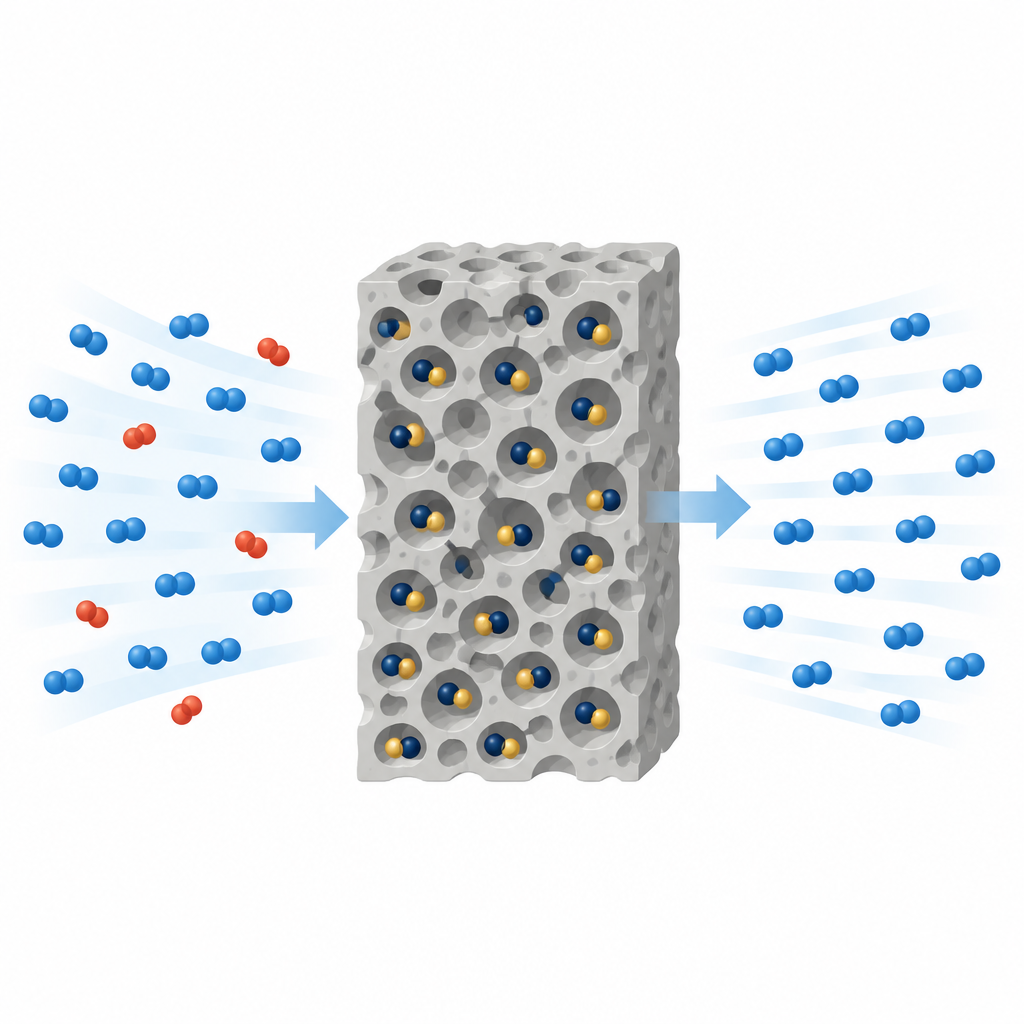
Modern life runs on plastics, and many of them start from a gas called ethylene. Yet the ethylene that leaves giant refineries always carries a tiny but troublesome hitchhiker called acetylene, which can ruin the catalysts used to turn ethylene into plastic. This study shows how a finely tuned palladium catalyst can more cleanly remove that hitchhiker without wasting valuable ethylene, offering a smarter way to run one of the chemical industry’s workhorses.
Why a trace impurity matters
Ethylene production tops 200 million tons a year and feeds everything from packaging to pipes. The streams that come out of crackers contain only about half a percent to two percent acetylene, but even these traces can poison the catalysts used in downstream polymer plants. Industry therefore uses a reaction called semihydrogenation to turn acetylene into less reactive products before the gas is sent on. The catch is that it is very easy to go too far and also overhydrogenate ethylene into ethane, which is much less valuable. Catalysts that work fast tend to be less choosy, while those that are selective are often sluggish, creating a long-standing trade-off between activity and selectivity.
Designing a new kind of catalytic site
Traditional palladium particles on supports are excellent at activating hydrogen and acetylene, but they also bind ethylene too strongly, so ethylene keeps reacting instead of leaving the surface. Single atoms of palladium solve part of this problem, since they hold ethylene only weakly and avoid phases that favor overhydrogenation. However, single atoms struggle to split hydrogen efficiently and to handle more than one reactant at once, which makes them slow. In this work the researchers set out to build something in between: pairs of palladium atoms, anchored far apart enough to behave like isolated sites, yet close enough to cooperate during the reaction.
Building and confirming palladium pairs
The team used a hybrid material made of nanodiamonds coated with thin graphitic carbon, rich in defects that can pin down metal atoms. By carefully choosing palladium carboxylate precursors and solvents, they steered the metal to deposit either as single atoms or as well-defined pairs. After mild heat and hydrogen treatment to strip away organic ligands, they used advanced electron microscopy and X-ray absorption methods to verify the structure. Images showed many isolated bright spots for single atoms and closely spaced pairs for the dual sites, while spectroscopy confirmed a direct bond between neighboring palladium atoms and a slightly more metallic electronic character for the pairs compared with lone atoms.
Faster cleanup without wasting ethylene
When tested on acetylene removal in an ethylene-rich stream, the dual-atom catalyst converted acetylene completely at 100 degrees Celsius, far lower than the 180 degrees needed for the single-atom version. The rate at which each palladium atom processed acetylene was almost thirteen times higher on the paired sites, yet the fraction of ethylene preserved stayed high at about 93 percent. In contrast, small palladium clusters were extremely active but quickly consumed large amounts of ethylene by overhydrogenation. The dual-atom catalyst also ran for many hours without losing performance, and microscopic checks after the test showed that the palladium remained as single atoms and pairs rather than clumping into larger particles.
How paired atoms shift the reaction path
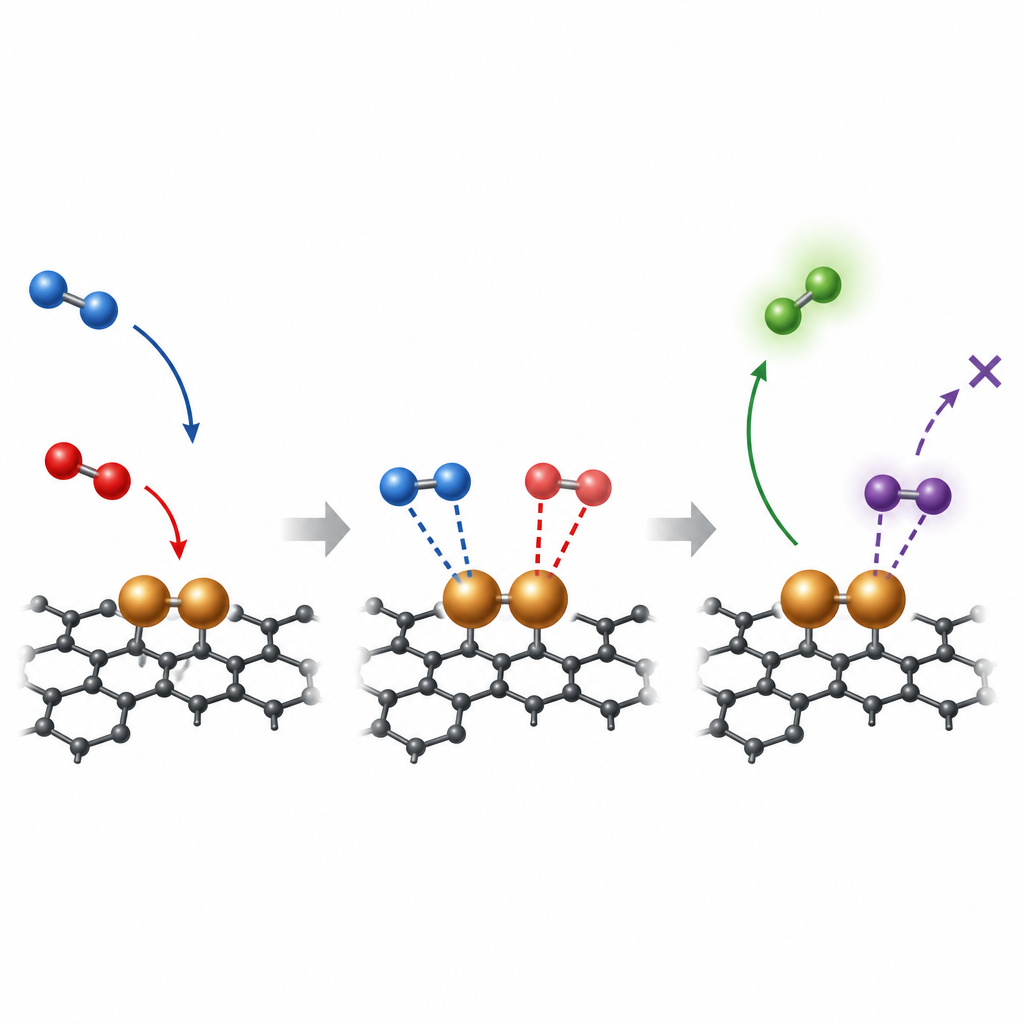
To understand why pairing works so well, the researchers measured how acetylene, ethylene, and hydrogen interact with the different catalysts and backed this up with computer simulations. Temperature-programmed desorption experiments showed that the paired sites hold acetylene more strongly than single atoms do, which helps activity, while ethylene still binds only weakly, which helps selectivity. Hydrogen–deuterium exchange tests revealed that pairs split hydrogen more easily than single atoms but less aggressively than large clusters. Isotope tracing suggested that on single atoms, acetylene crowds out hydrogen, limiting the reaction, whereas dual sites can host both at once. Detailed quantum calculations supported this picture, indicating that the paired atoms reshape the usual energy relationships between reactants and products so that acetylene activation is easier but further hydrogenation of ethylene remains disfavored.
A smarter balance for cleaner ethylene
Overall, the study shows that carefully engineered pairs of palladium atoms on a defect-rich carbon support can sidestep the usual compromise between speed and selectivity in acetylene cleanup. By letting two neighboring atoms share the work of binding acetylene and splitting hydrogen, while still releasing ethylene readily, the catalyst removes harmful impurities efficiently without sacrificing much of the desired product. This paired-atom approach may offer a general design path for industrial catalysts that need to be both fast and highly discerning.
Citation: Hong, F., Chen, H., Chen, J. et al. Breaking the activity-selectivity trade-off for acetylene semihydrogenation by Pd2 dual-atom site. Nat Commun 17, 4391 (2026). https://doi.org/10.1038/s41467-026-70107-w
Keywords: acetylene semihydrogenation, ethylene purification, dual-atom catalyst, palladium catalysis, nanodiamond graphene