Clear Sky Science · en
One-pot co-upcycling of mixed polyolefin waste
Turning Everyday Plastic Trash into Useful Fuel
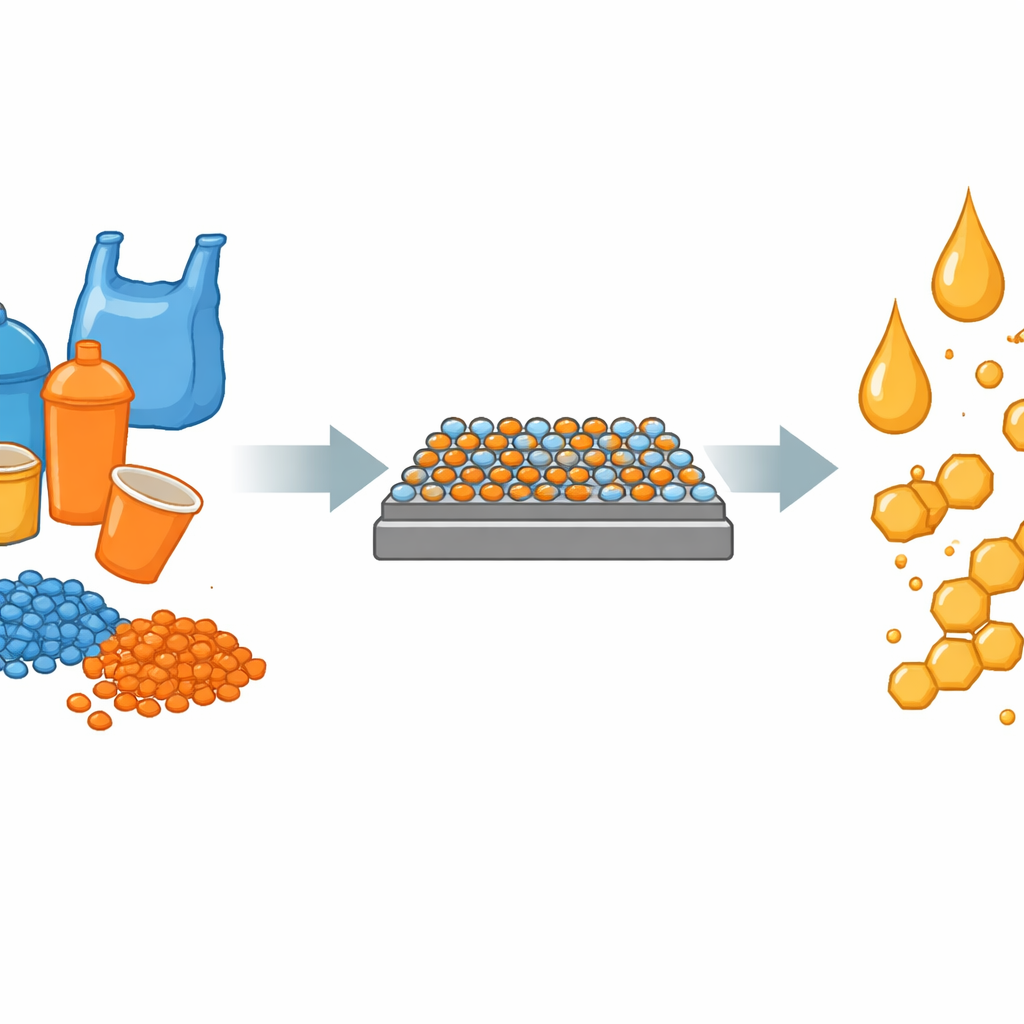
Plastic bags, bottles, and food containers made from common plastics like polyethylene and polypropylene are incredibly useful—but they are also notoriously hard to recycle. Most of this waste ends up in landfills or the environment because current recycling technologies struggle when different plastics are mixed together. This study introduces a new catalyst that can turn mixed plastic trash into high-quality liquid fuels in a single step, offering a potential route to cleaner cities, lower pollution, and better use of fossil resources.
Why Mixed Plastics Are So Hard to Recycle
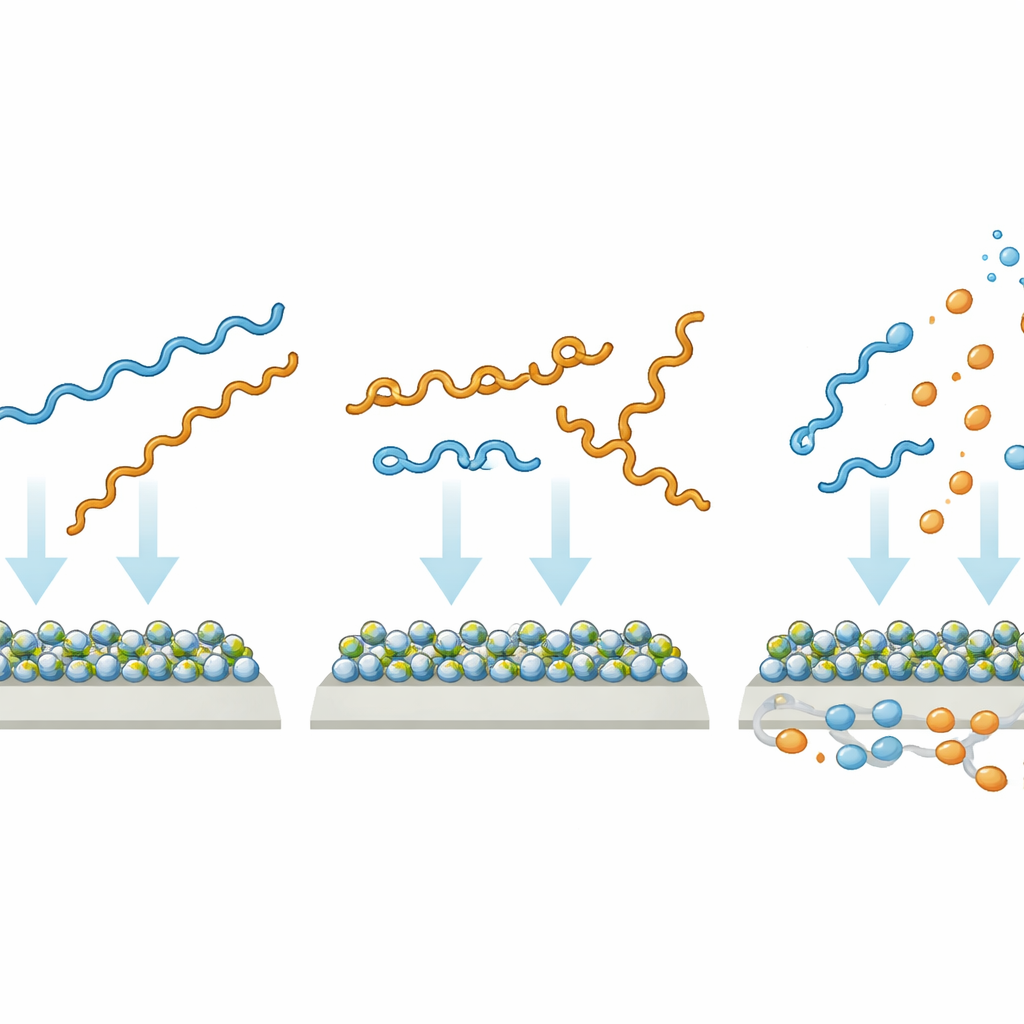
Two plastics dominate our daily lives: polyethylene (PE) and polypropylene (PP), together making up more than half of all plastics produced. Although they look similar to the naked eye, they behave very differently when broken down chemically. PE chains are relatively simple and break apart more easily, while PP chains have extra side branches that slow down their reactions. In current recycling processes, this mismatch means PE breaks too fast, often being over-cracked into low-value gases such as methane, while PP lags behind and remains only partly converted. As a result, attempts to process mixed PE–PP waste in one pot usually waste energy and produce less than half the desired liquid fuel.
Designing a Smarter Catalyst Surface
The researchers tackled this challenge by rethinking the surface where the reactions occur. They built a catalyst from ruthenium oxide (RuOx) grown in an orderly, sheet-like fashion on a specific crystal form of titanium dioxide called rutile TiO2. Because the atomic spacing of RuOx closely matches that of rutile TiO2, the RuOx layer grows in an “epitaxial” manner—like well-fitted tiles on a floor—forming ultra-small, flat nanoclusters. Advanced imaging and spectroscopy showed that, unlike conventional metal ruthenium particles, these RuOx clusters stay partly oxidized and strongly bound to the support, creating many controlled sites where hydrogen and plastic fragments can interact.
Making Different Plastics React in Harmony
With this engineered surface, the catalyst reshapes how both PE and PP break down. The RuOx nanoclusters provide extra spots for removing hydrogen atoms from the more stubborn, branched PP chains, which helps weaken their internal carbon–carbon bonds. At the same time, the small cluster size prevents PE from being chopped too aggressively into tiny molecules. Tests with both pure plastics and model molecules showed that this catalyst activates the types of bonds found in PE and PP at nearly the same rate. When mixed PE–PP feeds were processed, the system converted up to about 95% of the plastic into liquids while keeping gas formation as low as about 0.6%, far better than standard ruthenium catalysts.
From Lab Plastics to Real-World Waste
The team went beyond ideal powders and used real post-consumer plastic items such as discarded bottles, films, and boxes. After simply cutting them into small pieces and mixing them with the catalyst under hydrogen, the process still delivered over 80% liquid yields across a variety of feeds. By adjusting temperature, reaction time, and the ratio of PE to PP, they were able to tune the product mixture from heavier wax-like oils down to lighter liquids similar to gasoline and diesel. In one demonstration using waste HDPE bottles and PP centrifuge tubes, extended reaction produced a liquid in which roughly 84.6% of the carbon appeared as low-carbon alkanes, with gasoline- and diesel-range fractions in nearly equal proportions and only modest methane formation.
What This Means for the Future of Plastic Waste
In essence, this work shows that carefully shaping the atomic structure of a catalyst surface can make two very different plastics behave as if they were the same feedstock. The epitaxial RuOx on rutile TiO2 balances the reaction speeds of PE and PP, avoiding wasteful over-cracking while still fully breaking down the tougher polymer. For a layperson, the takeaway is straightforward: instead of struggling to sort and separate every piece of plastic, it may become possible to feed mixed plastic trash into a single reactor and pull out useful liquid fuels. While scaling and economics still need to be addressed, this strategy points toward more practical, efficient, and cleaner upcycling of the world’s growing mountain of plastic waste.
Citation: Tu, W., Chu, M., Yan, T. et al. One-pot co-upcycling of mixed polyolefin waste. Nat Commun 17, 3358 (2026). https://doi.org/10.1038/s41467-026-70104-z
Keywords: plastic upcycling, polyolefin recycling, ruthenium catalyst, mixed plastic waste, liquid fuel production