Clear Sky Science · en
Copper-catalysed dynamic kinetic (4+1) cyclization of 1,3-enynes for atroposelective arylpyrrole synthesis
Why New Twists in Molecules Matter
Chemists are increasingly interested in “twisted” molecules whose mirror-image forms are not interchangeable, much like left and right hands. These shapes, known as axial chirality, can make a big difference in how a drug behaves in the body or how a catalyst speeds up a reaction. This paper introduces a streamlined way to build a valuable family of such twisted molecules—called arylpyrroles—using abundant starting materials and a simple copper-based catalyst, with air as the oxidant. The work not only delivers a versatile route to potential medicines and advanced materials, but also unlocks new, highly selective catalysts for other difficult chemical reactions.
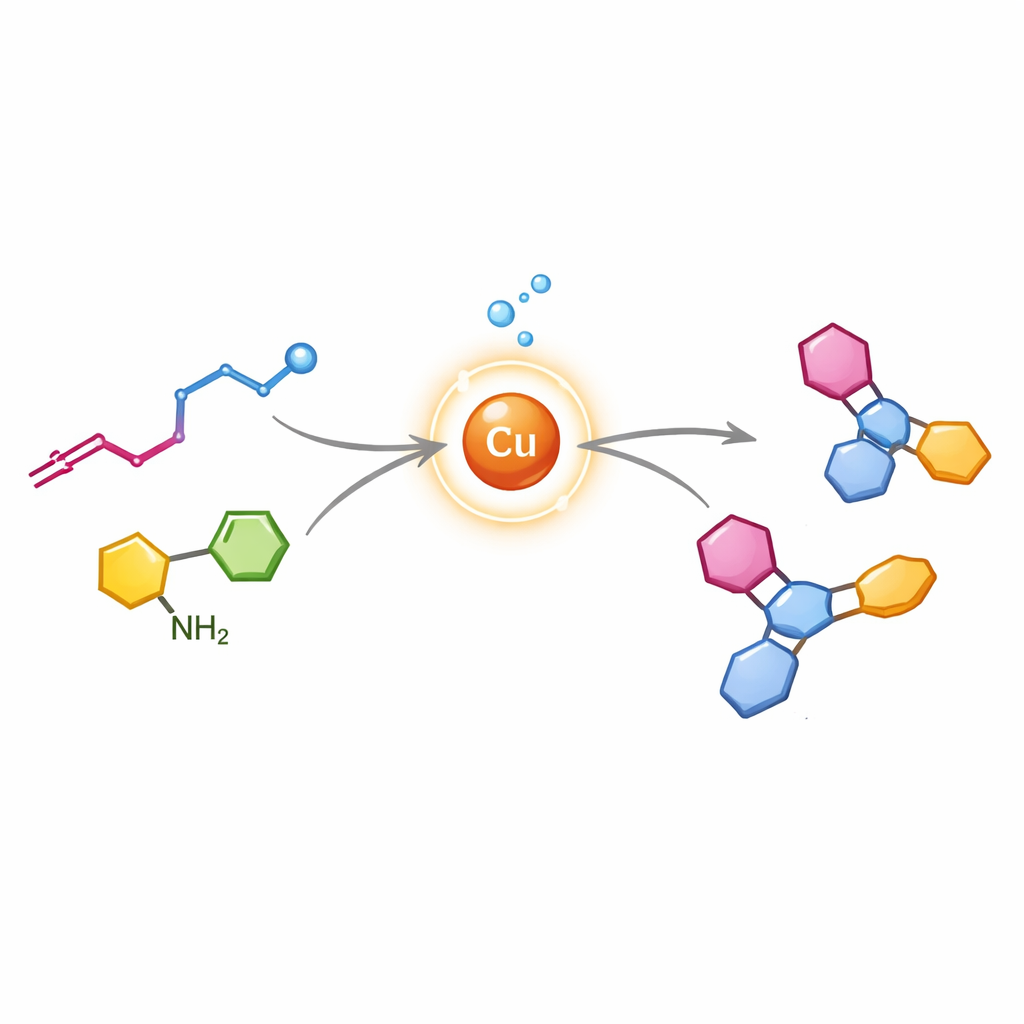
Building Useful Twisted Rings
Arylpyrroles combine a flat, five‑membered ring (the pyrrole) with an attached aromatic ring that can twist into two mirror-related arrangements. These “axially chiral” versions have shown strong antibiotic and anticancer activity in nature, and one related compound is already an approved blood‑pressure drug. Yet making these twisted arylpyrroles in a single, preferred form has been hard. Many older methods start from pre‑built pyrrole rings and require extra steps or wasteful separations to isolate just one mirror image. The team set out to design a more direct, “from-scratch” construction that joins simple carbon–carbon and carbon–nitrogen fragments in one cascade, while still exerting very fine control over the final three‑dimensional shape.
A Copper Engine Runs the Cascade
The authors discovered that combining a copper salt with a chiral “Pybox” ligand and a common organic base, DABCO, triggers a powerful chain reaction between 1,3‑enynes and primary amines. In a single operation, these components fold up into arylpyrroles with a well‑defined twist around one or even two axes. Air supplies the needed oxidizing power, making the process relatively green. The key design feature is that an early carbon–nitrogen bond can form and break reversibly, allowing different temporary arrangements to interconvert before a later ring‑closing step locks in the final architecture. This approach, called dynamic kinetic asymmetric transformation, lets the chiral copper complex “steer” the system toward the most stable, preferred mirror image even though the critical carbon–nitrogen bond is far from the metal center.
Wide Range of Building Blocks
Under the optimized conditions, the reaction proved remarkably tolerant of variety. Aromatic amines bearing electron‑rich, electron‑poor, or bulky groups all participated smoothly, as did heteroaromatic amines such as pyridines. By choosing amines with substituents positioned close to the twisting axis, the team could generate molecules that carry not just one, but two locked axes, giving rise to “1,2‑diaxial” products with complex three‑dimensional shapes. Aliphatic amines—from simple linear chains to highly crowded cage‑like structures, fluorinated chains, and even amino acids and short peptides—also gave high yields and excellent preference for a single mirror image. On the other side of the reaction, a wide assortment of nitro‑substituted enynes, including those attached to steroidal frameworks, successfully furnished axially chiral arylpyrroles, underscoring the method’s broad reach.
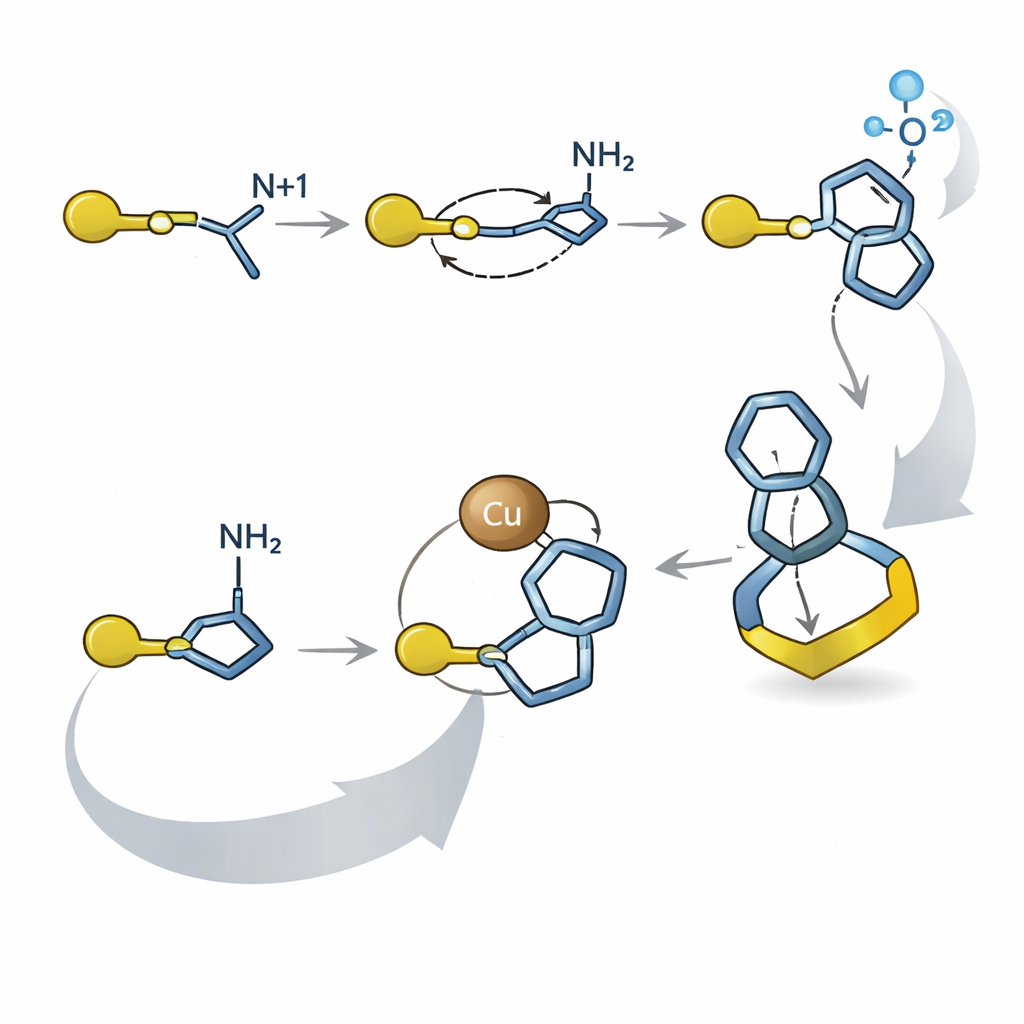
Turning Products into Designer Catalysts
Because arylpyrroles are not just end points but also valuable platforms, the team transformed their twisted products into an array of new tools for synthesis. Simple follow‑up reactions added halogens, reduced nitro groups, built additional rings, or attached known drug fragments, illustrating how easily these scaffolds can be diversified. Most notably, the authors converted certain dual‑axis products into advanced versions of DMAP, a workhorse catalyst used to transfer acyl groups. These new “atropisomeric DMAPs” possess one or more locked axes and showed superior selectivity in demanding reactions such as Mannich‑type additions and gold‑catalyzed cycloadditions, outperforming established chiral DMAPs and metal ligands and highlighting the practical value of the new synthetic route.
Peeking Under the Hood of the Reaction
To understand why the process is so selective, the researchers combined control experiments with detailed computer simulations. They showed that nothing happens without the copper complex, and that the step where the five‑membered ring closes is both the slowest and the one that decides which mirror image wins. Before that point, the early carbon–nitrogen bond steps are reversible, so less favored intermediates can “erase” themselves and recycle into more favorable ones. Calculations reveal that, in the decisive ring‑forming step, the preferred pathway minimizes steric clashes while maximizing stabilizing contacts such as stacking between aromatic rings and subtle attractions involving the nitro group. Once the ring is formed, rotation around the key bond is effectively frozen, so the twist set at that moment is carried through to the final oxidized product.
What This Means Going Forward
This work delivers a highly efficient, copper‑driven recipe for making twisted arylpyrroles directly from simple ingredients, using air as an oxidant and generating products in excellent yield and with a strong preference for one mirror image. Beyond offering easier access to bioactive and functional materials, the method rapidly produces new families of chiral catalysts that already outperform standard options in challenging reactions. By proving that dynamic, reversible steps can be harnessed to control distant twisting axes, the study points the way toward designing even more sophisticated molecules whose shape—and therefore function—can be programmed from the outset.
Citation: Zhong, YJ., Ren, X., Qi, T. et al. Copper-catalysed dynamic kinetic (4+1) cyclization of 1,3-enynes for atroposelective arylpyrrole synthesis. Nat Commun 17, 3198 (2026). https://doi.org/10.1038/s41467-026-70053-7
Keywords: axial chirality, arylpyrrole synthesis, copper catalysis, asymmetric catalysis, chiral DMAP catalysts