Clear Sky Science · en
Photonic spin-Hall effect in chiral plasmonic assemblies
Light That Knows Which Way to Go
Imagine a tiny railway for light, where a built‑in switch automatically decides whether signals travel left or right—using only the “twist” of light and matter. This study shows how specially shaped gold nanoparticles and silver nanowires can steer light and light‑generated signals in a chosen direction, even when the incoming beam is an ordinary linearly polarized laser. Such control could underpin future ultra‑small optical circuits and information technologies that use new properties of electrons called valleys, rather than just their charge.
Twisting Light on a Metal Wire
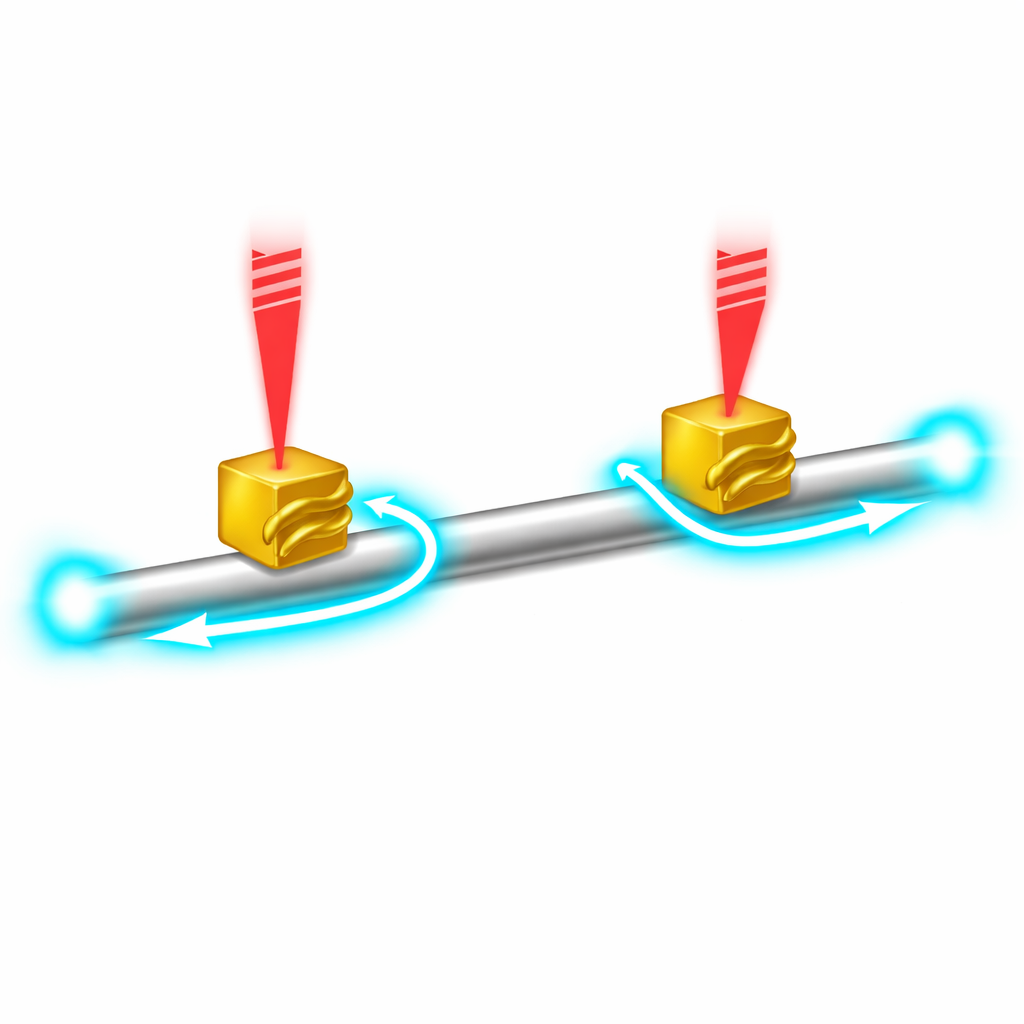
At the heart of the work is the photonic spin‑Hall effect, an optical analogue of a famous effect in electronics. Here, the “spin” is the polarization of light, and it determines which way surface waves called surface plasmon polaritons travel along a metal. The researchers built tiny structures where a single chiral (handed) gold nanocube sits on the side of a thin silver nanowire. When they illuminated the nanocube with circularly polarized light, they observed that light of one handedness launched waves mainly toward one end of the wire, while the opposite handedness sent them to the other end. This spin‑dependent locking between polarization and direction forms the basic routing principle.
Handed Nanocubes as One‑Way Switches
The real breakthrough comes when the team switches from circularly polarized light—difficult to integrate everywhere on a chip—to simple linearly polarized light. A linearly polarized beam can be viewed as an equal mixture of left‑ and right‑handed circular components. A chiral gold nanocube does not treat these components equally: depending on whether the cube is left‑ or right‑handed, it preferentially scatters one circular component more strongly than the other. When the laser is focused on such a cube attached to the nanowire, this imbalance turns the locally scattered field into an elliptically polarized one. Because the spin‑Hall effect ties each circular component to a propagation direction along the wire, this imbalance cleanly biases the surface waves toward only one end. Experiments showed robust directionality—up to about 96% of the energy emerging from a single side—while control devices with achiral cubes showed almost no directional preference under the same linear illumination.
Simulations Reveal How the Routing Works
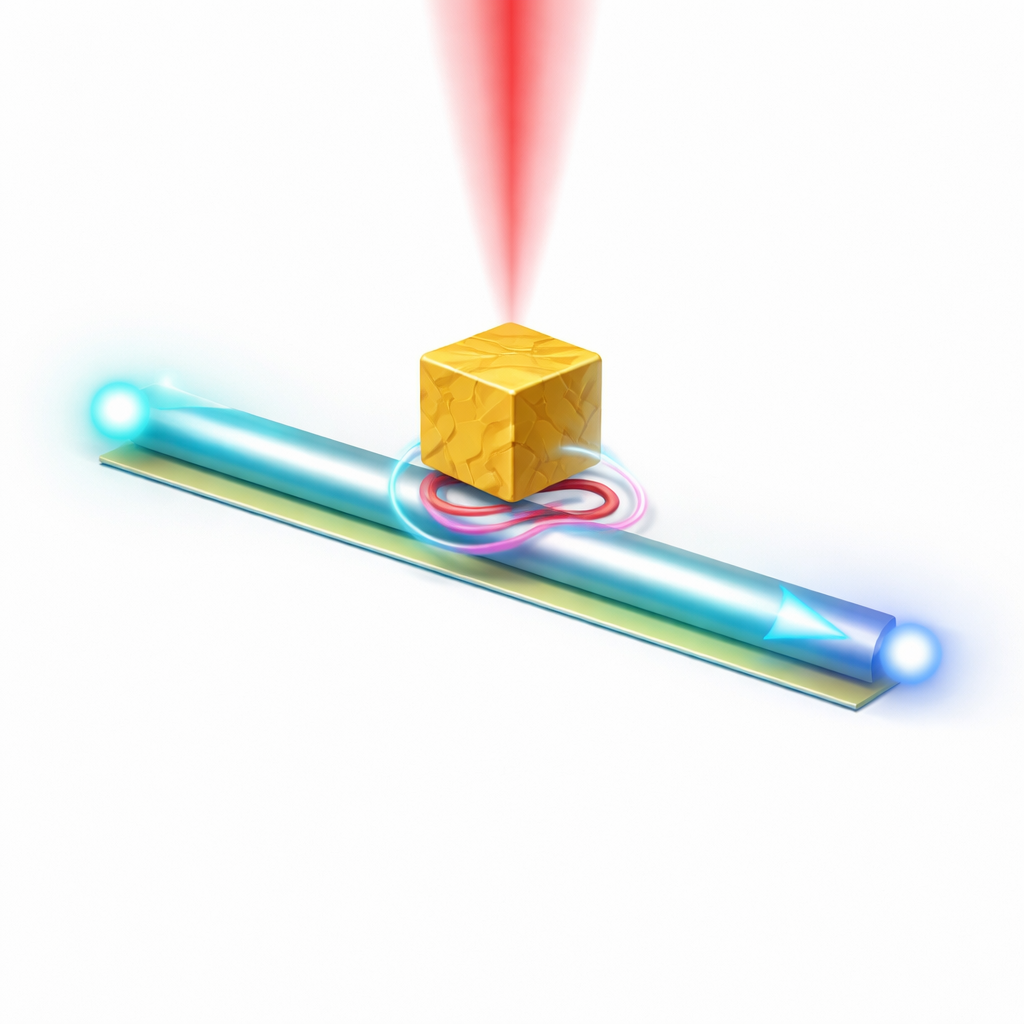
To understand this behavior in detail, the authors used numerical simulations of the electromagnetic fields around the nanocube–nanowire junction. They calculated how different polarizations overlap with guided modes supported by the silver wire. The simulations confirmed that circular components of light localized on one side of the wire couple into modes that travel in a specific direction, realizing the spin‑Hall effect at the nanoscale. When a chiral nanocube is present and excited by linear light, the near field in the tiny gap between cube and wire becomes strongly elliptical, with its handedness flipping between left‑ and right‑handed cubes. This local ellipticity predicts which side of the wire will carry stronger waves, matching the observed routing. The simulations also showed that changing the distance between cube and wire, for example by adding a thin glass shell, can even reverse the preferred direction by altering how strongly the particles couple.
Steering Exotic Signals in Atom‑Thin Semiconductors
Beyond routing bare light, the team connected their chiral metal structures to an ultrathin semiconductor called WS2, a member of the transition metal dichalcogenide family. In these materials, electrons can occupy different “valleys” in momentum space, which can be addressed by left‑ or right‑handed circularly polarized light. When the nanocube–nanowire assembly was placed on a WS2 monolayer and excited with linearly polarized lasers, the gold cube’s chiral plasmon resonances reshaped the local field that pumps excitons (bound electron–hole pairs) in specific valleys. Those valley excitons then coupled into the nanowire’s surface waves and emerged as light at the wire’s ends. Measurements showed that the total light and its circular polarization differed strongly between the two ends, and that flipping the cube’s handedness flipped the routing direction. Control structures—bare wires, achiral cubes, or cube dimers—failed to show this effect, underscoring the central role of chirality.
Why This Matters for Future Light‑Based Circuits
In simple terms, the researchers have built a nanoscale track where a single chiral building block decides which way light‑driven signals go, and they have extended this control to subtle valley‑encoded information in atom‑thin semiconductors. Their chiral nanocube–nanowire waveguides exploit the spin‑Hall effect of light to translate the twist of both light and matter into directional pathways, all under practical linearly polarized excitation. Such compact, robust routing elements could help form the basis of future valleytronics and quantum photonic circuits, improving how efficiently and selectively signals are guided between components while filtering out unwanted paths.
Citation: Chen, Y., Chen, Y., Fang, Y. et al. Photonic spin-Hall effect in chiral plasmonic assemblies. Nat Commun 17, 3246 (2026). https://doi.org/10.1038/s41467-026-70039-5
Keywords: photonic spin Hall effect, chiral plasmonics, surface plasmon polaritons, valleytronics, 2D semiconductors