Clear Sky Science · en
Kilogram-scale one-pot synthesis of multicomponent fullerene composites for efficient inverted perovskite solar cells
Why better solar films matter
Solar panels are becoming cheaper and more efficient, but many promising next‑generation designs still struggle to last for years in real‑world conditions. This study tackles that problem for a rising star of solar technology called inverted perovskite solar cells. The authors show how a cleverly engineered mix of soccer‑ball‑shaped carbon molecules, made in a single large‑scale step, can both boost efficiency and dramatically slow long‑term damage in these cells—while also cutting material cost.
Making a smarter solar sandwich layer
Perovskite solar cells turn light into electricity using a thin crystalline layer sandwiched between other films that move charges in and out. On the “electron” side of inverted devices, this helper film is usually made from a single type of fullerene, a hollow carbon cage. These standard fullerene layers extract electrons well, but they tend to clump together when exposed to heat and light. Over time, this clumping opens pathways for charged atoms to leak through the device, corroding metal contacts and breaking down the perovskite. The new work replaces that vulnerable single‑component layer with a composite film containing three related fullerene species that work together to solve these weak points.
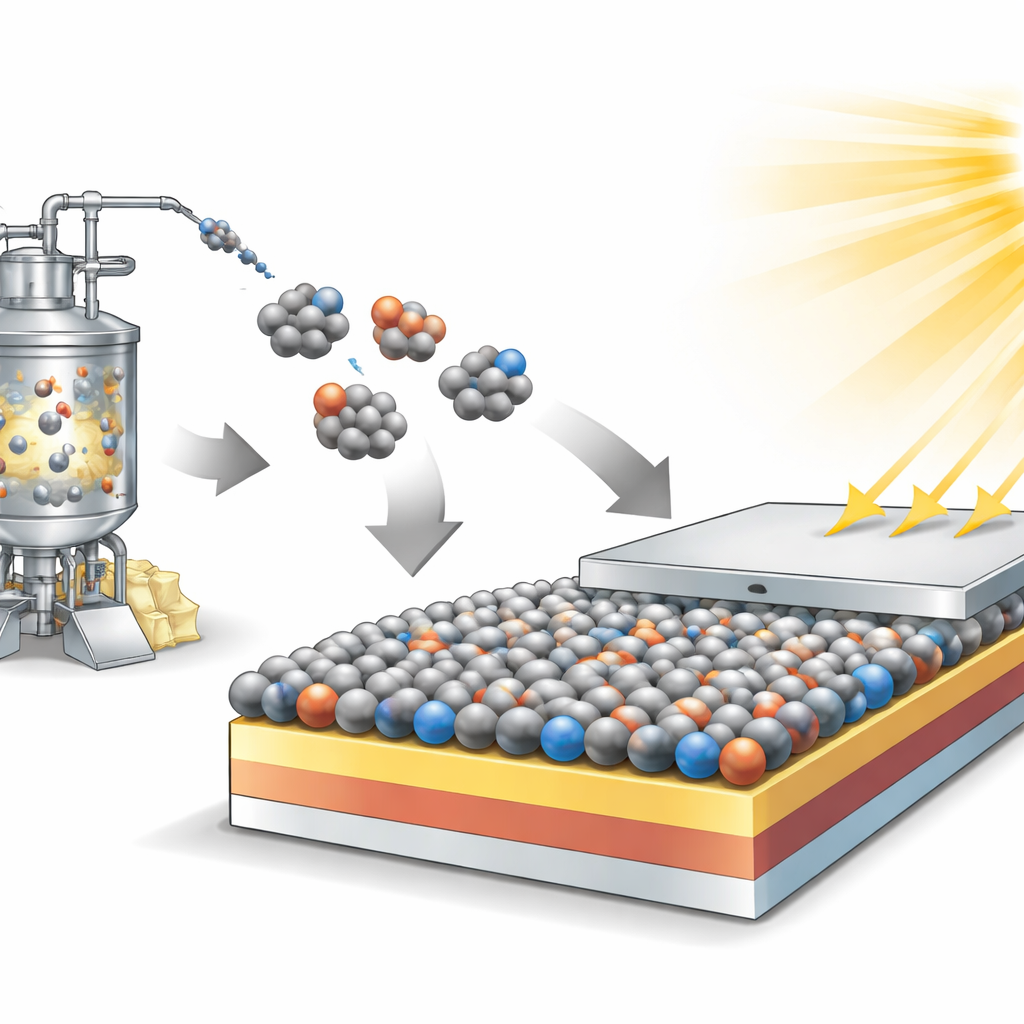
One big pot for low‑cost production
Instead of designing one highly customized molecule and then purifying it in small batches, the team uses a “one‑pot” reaction that starts from ordinary C60 fullerene and a simple small molecule. By letting the reaction run for different lengths of time, they obtain a reproducible mixture of unmodified C60 plus fullerene molecules carrying one or two reactive side groups. This fullerene composite can be made on the kilogram scale in a dedicated reactor with a yield as high as 96 percent, without the usual expensive column‑separation steps. A cost analysis suggests that the resulting material should be significantly cheaper than the widely used commercial fullerene PCBM, making it attractive for industrial production.
Locking molecules into a protective network
The key trick appears when this composite film is gently heated to just 100 °C, a temperature the delicate perovskite layer can safely withstand. Under these conditions, the side groups on two of the fullerene components link together, forming a cross‑linked network that traps the remaining C60 molecules in place. Measurements show that, after this treatment, the film becomes insoluble, denser, and more water‑repellent than standard fullerene layers. Microscopy and X‑ray tests after long‑term operation reveal that, unlike conventional films that form visible grains and trigger perovskite breakdown, the cross‑linked composite stays smooth and compact. Depth‑profiling studies further show that this dense network blocks migrating ions from reaching the silver electrode, preventing corrosion and preserving the underlying perovskite structure.
Helping charges move while defects stay quiet
Despite being tightly locked together, the fullerene network still has to move electrons efficiently. The authors use electrical tests to show that the new composite conducts electrons roughly twice as well as PCBM films. Energy‑level measurements confirm that its position relative to the perovskite absorber remains ideal for pulling electrons out. Spectroscopic studies reveal that chemical groups in the composite interact gently with lead atoms at the perovskite surface, healing electronic “traps” that would otherwise waste energy as heat. As a result, devices using the new layer show fewer defects, faster charge extraction, slower recombination of charges, and a stronger built‑in electric field that helps sweep electrons and holes apart.
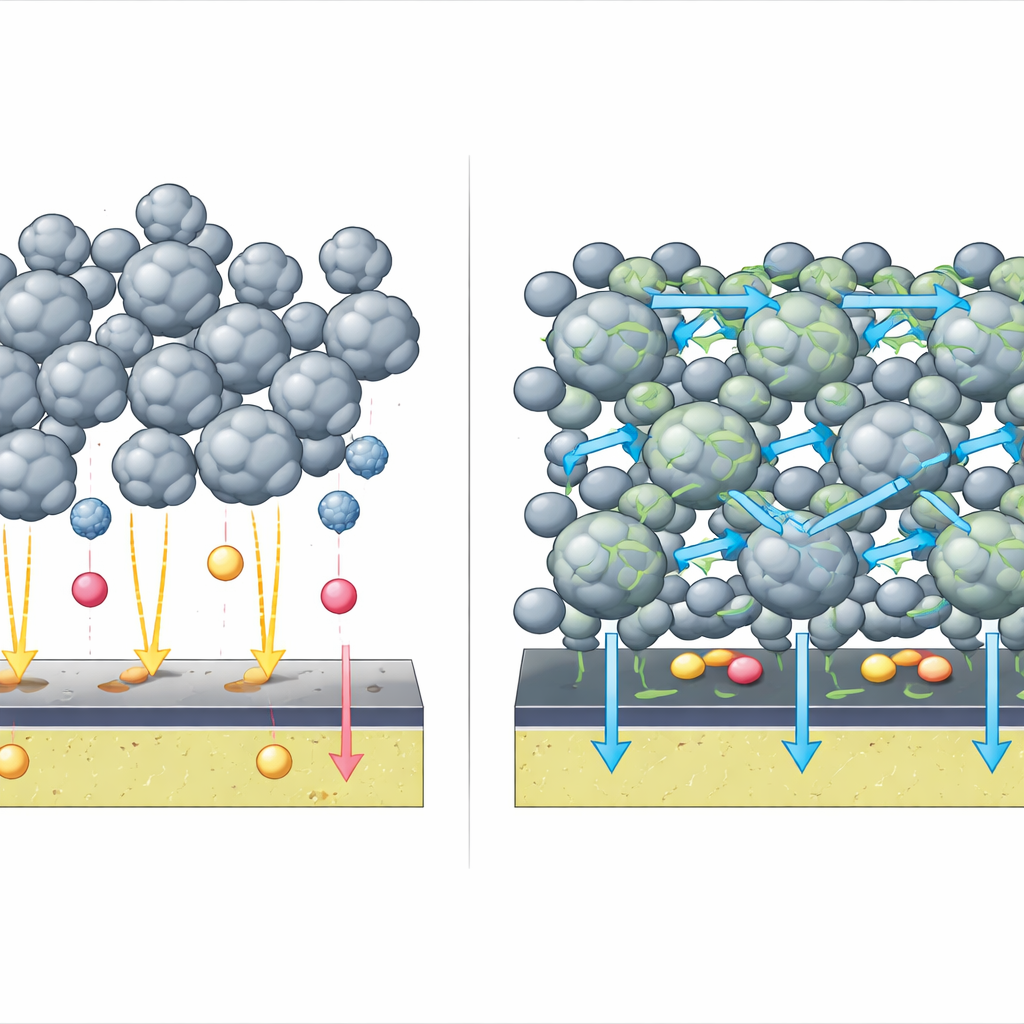
From tiny cells to mini solar modules
When this cross‑linked composite is used as the electron‑transport layer, inverted perovskite cells reach a power‑conversion efficiency of 26.55 percent—higher than otherwise identical devices that use PCBM. Under standardized light and heat stress tests, cells with the new layer retain about 96 percent of their initial performance after 1000 hours, while PCBM devices lose roughly half their output. The benefits hold across different perovskite compositions, including wide‑bandgap versions needed for tandem solar stacks, and across sizes ranging from millimeter‑scale test pixels to 1 cm² devices and 14.4 cm² mini‑modules. Larger modules with the composite layer not only perform better but also fail much more slowly during prolonged operation.
What this means for future solar panels
For non‑specialists, the take‑home message is that the authors have turned a fragile but efficient solar technology into a sturdier, more scalable option by rethinking a single supporting layer. Their multicomponent fullerene mixture is easy to make in bulk, self‑locks into a dense protective net at low temperature, and still moves electrons quickly. This combination boosts efficiency, blocks damaging ion flow, and keeps the active perovskite material intact over time. If adopted in manufacturing, such composite layers could help move perovskite solar cells from laboratory demonstrations toward durable rooftop panels and large‑area modules.
Citation: Hou, E., Cheng, S., Kong, S. et al. Kilogram-scale one-pot synthesis of multicomponent fullerene composites for efficient inverted perovskite solar cells. Nat Commun 17, 3833 (2026). https://doi.org/10.1038/s41467-026-70022-0
Keywords: perovskite solar cells, fullerene composite, electron transport layer, solar cell stability, photovoltaic materials