Clear Sky Science · en
Demonstration of high-fidelity entangled logical qubits using transmons
Keeping Fragile Quantum Links Alive
Quantum computers promise to solve problems that overwhelm today’s supercomputers, but their building blocks—qubits—are notoriously fragile. Even tiny disturbances from the surrounding environment can scramble the delicate connections, or entanglement, that give quantum devices their power. This paper shows a way to keep pairs of encoded, or “logical,” qubits entangled for much longer than bare hardware would allow, using a clever combination of two protection strategies tested on IBM’s superconducting transmon processors. 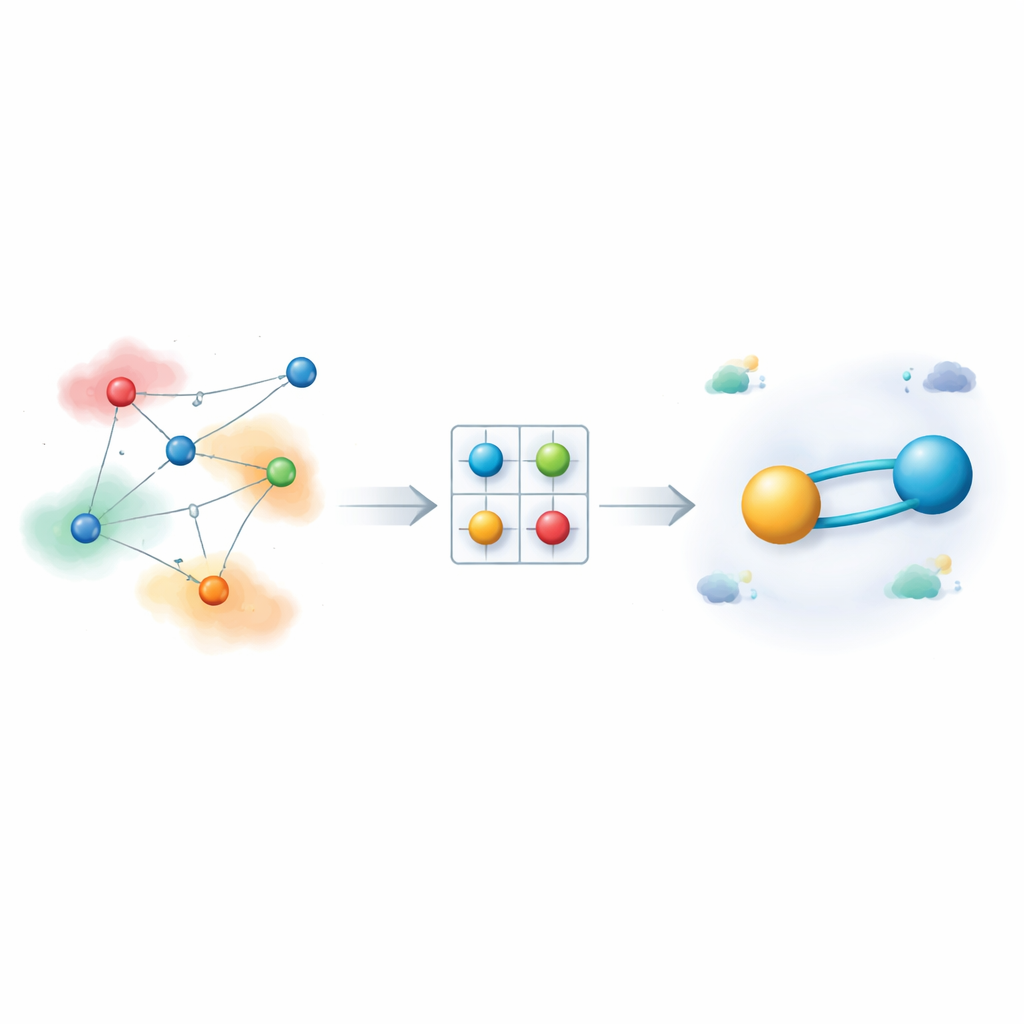
Why Ordinary Protection Is Not Enough
Standard quantum error correction stores information across several physical qubits so that small missteps can be spotted and, in principle, fixed. But every error-correcting code has blind spots: some patterns of errors look like legitimate operations on the encoded data and slip through as undetectable “logical errors.” As quantum processors scale up, unwanted interactions between neighboring qubits—especially a type of two‑qubit disturbance called crosstalk—can create exactly these dangerous patterns. The usual cure is to make codes larger and more complex, which quickly becomes expensive in hardware and control overhead.
Combining Two Shields Into One
The authors propose a hybrid strategy that keeps the code small while greatly reducing its blind spots. They start from a compact four‑qubit error‑detecting code, often written as [[4,2,2]], which encodes two logical qubits into four physical ones. On top of this, they apply dynamical decoupling, a technique in which rapid, carefully designed control pulses are applied to qubits to cancel out the effects of noise over time. The key twist is that these pulses are not arbitrary: they are chosen from the code’s own symmetry operations, called “normalizer” elements. By pulsing with these code-aware operations—an approach the authors call normalizer dynamical decoupling—they can average away exactly those disturbances that would otherwise masquerade as logical errors, without leaving the encoded subspace. 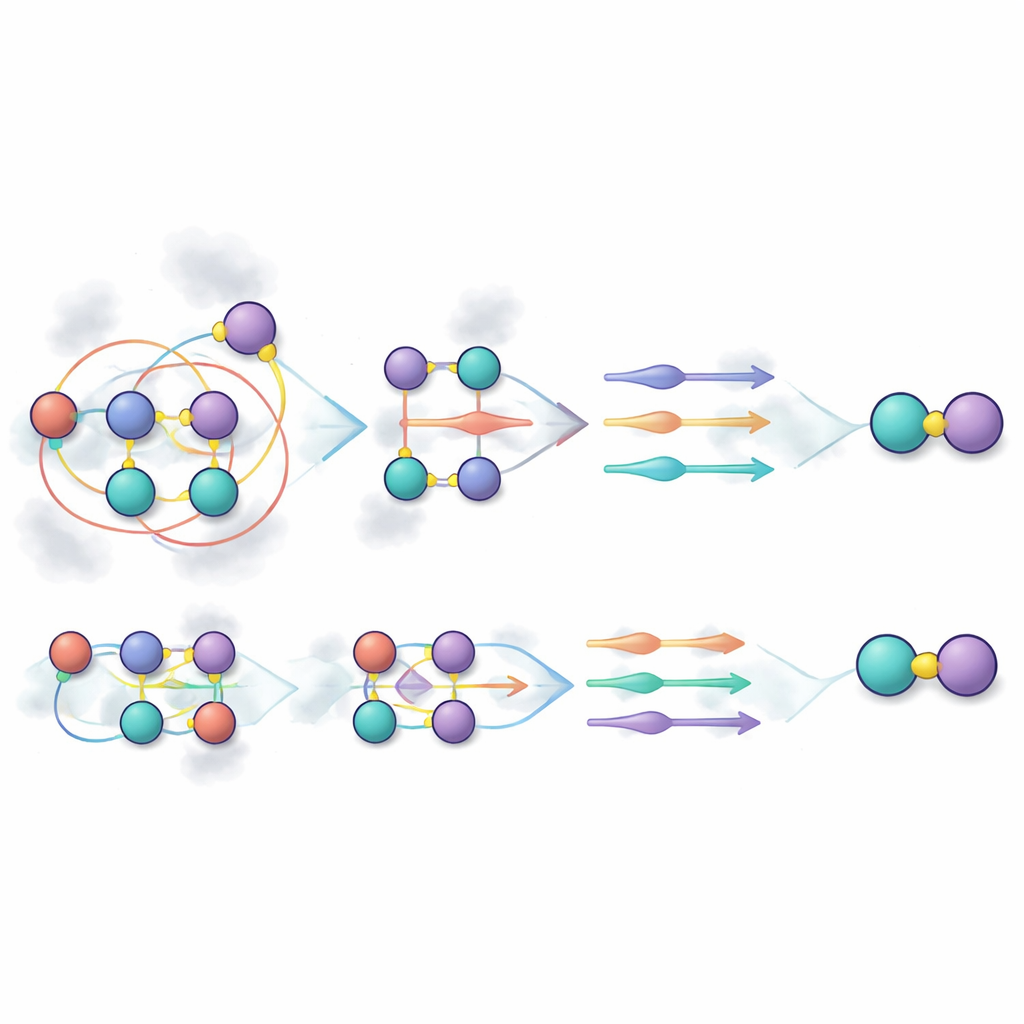
Putting the Idea to the Test on Real Hardware
To see whether this scheme truly protects information, the team focused on one of the most delicate resources in quantum computing: entangled Bell pairs. They used the four‑qubit code to encode two logical qubits and prepare them in entangled Bell states, then let the system idle on IBM’s 127‑qubit transmon chips. By deliberately decoding into different Bell states and reading out all four physical qubits, they could tell whether specific logical errors had occurred and separately track ordinary physical faults. They also padded idle periods in the encoding and decoding circuits with well‑known physical dynamical decoupling sequences, so that any further gains could be attributed to the new, logical‑level pulses. This careful design allowed them to distinguish between protection of individual qubits and genuine suppression of logical errors in the code.
How Much Extra Protection Do We Get?
On devices where neighboring transmons constantly tug on each other, crosstalk quickly ruined unprotected logical Bell pairs: their fidelity, a measure of how close the final state is to the target entangled state, fell toward 20% within about 10 microseconds and showed oscillations driven by those unwanted interactions. Physical dynamical decoupling alone improved matters, but still left sizable logical errors. When the researchers activated their code‑aware pulse sequences, tuned to cancel the dominant error channels and made robust against control imperfections, the logical Bell pairs fared dramatically better. Over storage times up to 55 microseconds, the best version of the scheme kept average encoded Bell fidelities in the 90–95% range once they also used the code’s built‑in error detection to discard runs with clear physical faults, and still above 80% even without focusing on the best qubit set. In contrast, the best unencoded Bell pair on the same hardware, even with strong physical dynamical decoupling, decayed to around 70% fidelity over the same period.
Beyond the Breakeven Point
The central message is that an entangled pair of logical qubits, protected by this hybrid of error detection and normalizer dynamical decoupling, survives better than any comparable unprotected or merely physically protected pair—what the authors call beyond‑breakeven performance. The method not only holds back logical errors but also lowers the rate of detectable physical faults, which reduces the cost of throwing away bad runs. Because the pulse patterns depend only on a small set of code symmetries rather than on code size, the approach can, in principle, scale to larger architectures without exploding in complexity. This work therefore offers a practical recipe for keeping fragile quantum links intact long enough to be useful in real algorithms and larger fault‑tolerant machines.
Citation: Vezvaee, A., Tripathi, V., Morford-Oberst, M. et al. Demonstration of high-fidelity entangled logical qubits using transmons. Nat Commun 17, 3281 (2026). https://doi.org/10.1038/s41467-026-70011-3
Keywords: quantum error correction, dynamical decoupling, logical qubits, superconducting transmons, entanglement