Clear Sky Science · en
A protein adaptor mediating Ap4A-dependent control of protein acetylation
Why this tiny stress signal matters
Inside every cell, proteins are constantly being switched on and off by tiny chemical tags. One of these tags, called acetylation, reshapes how cells use energy, copy their DNA, and build new parts. This paper uncovers how a small alarm molecule, Ap4A, helps bacteria rapidly retune this protein tagging during stress. Although the work is done in a soil bacterium, the basic players resemble those in our own cells, hinting at broadly shared ways that life responds to changing conditions.
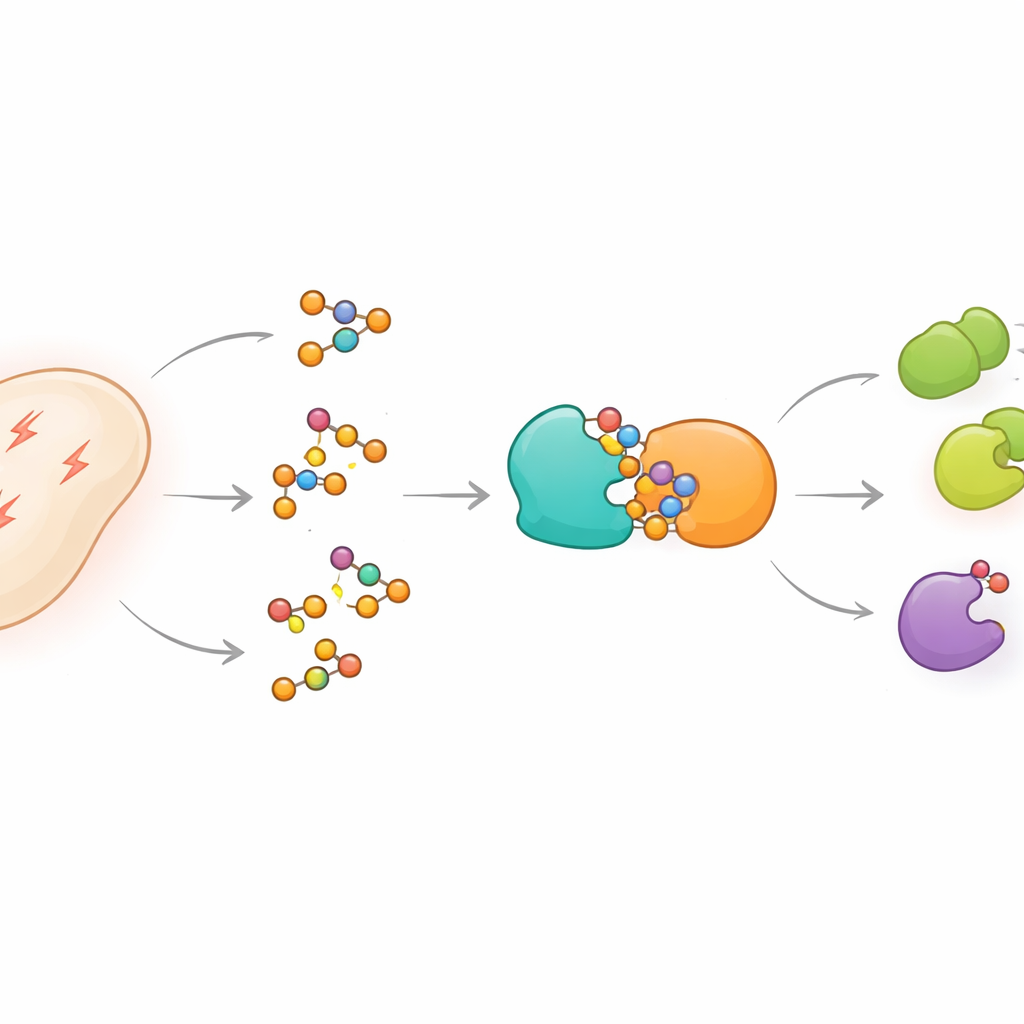
A chemical on–off switch for proteins
Many proteins carry “handles” where cells can attach or remove an acetyl group, subtly changing protein behavior without rebuilding it from scratch. Specialized enzymes add the tag, while others remove it, keeping the system in balance. In the bacterium Bacillus subtilis, one key enzyme called AcsA makes acetyl-CoA, a central fuel and building-block molecule. AcsA itself is turned off when acetylated and turned back on when a partner enzyme, the deacetylase AcuC, removes the acetyl group. The genes for AcsA’s acetylation machinery sit together with a mysterious third gene, acuB, suggesting it plays a related but previously unknown role.
Unmasking a hidden brake on deacetylation
The authors set out to discover what AcuB does. By pulling AcuB out of living cells and identifying which proteins came along for the ride, they found that AcuB forms a stable complex with AcuC, the deacetylase. Test-tube experiments with purified proteins then showed that when AcuB is present, AcuC can no longer efficiently remove acetyl groups from its targets, including AcsA and other proteins involved in protein synthesis, cell wall construction, and DNA replication control. In essence, AcuB acts as a physical brake on AcuC, keeping many proteins in their acetylated, altered state.
How the alarm molecule Ap4A locks in the brake
The study then links this brake to a broader stress alarm system. Under harsh conditions, bacteria accumulate Ap4A, a small molecule long suspected to act as a danger signal. Using binding assays and high-resolution structural work, the researchers show that Ap4A fits snugly into two paired sensor modules in AcuB, dramatically stabilizing the AcuB protein. When Ap4A is bound, AcuB not only becomes more heat-resistant but also grips AcuC more tightly. Structural and simulation data indicate that an arm of AcuB moves into the mouth of AcuC’s active site, physically blocking access for acetylated protein tails. In the presence of Ap4A, this blockade becomes more pronounced, further weakening AcuC’s ability to strip acetyl tags.
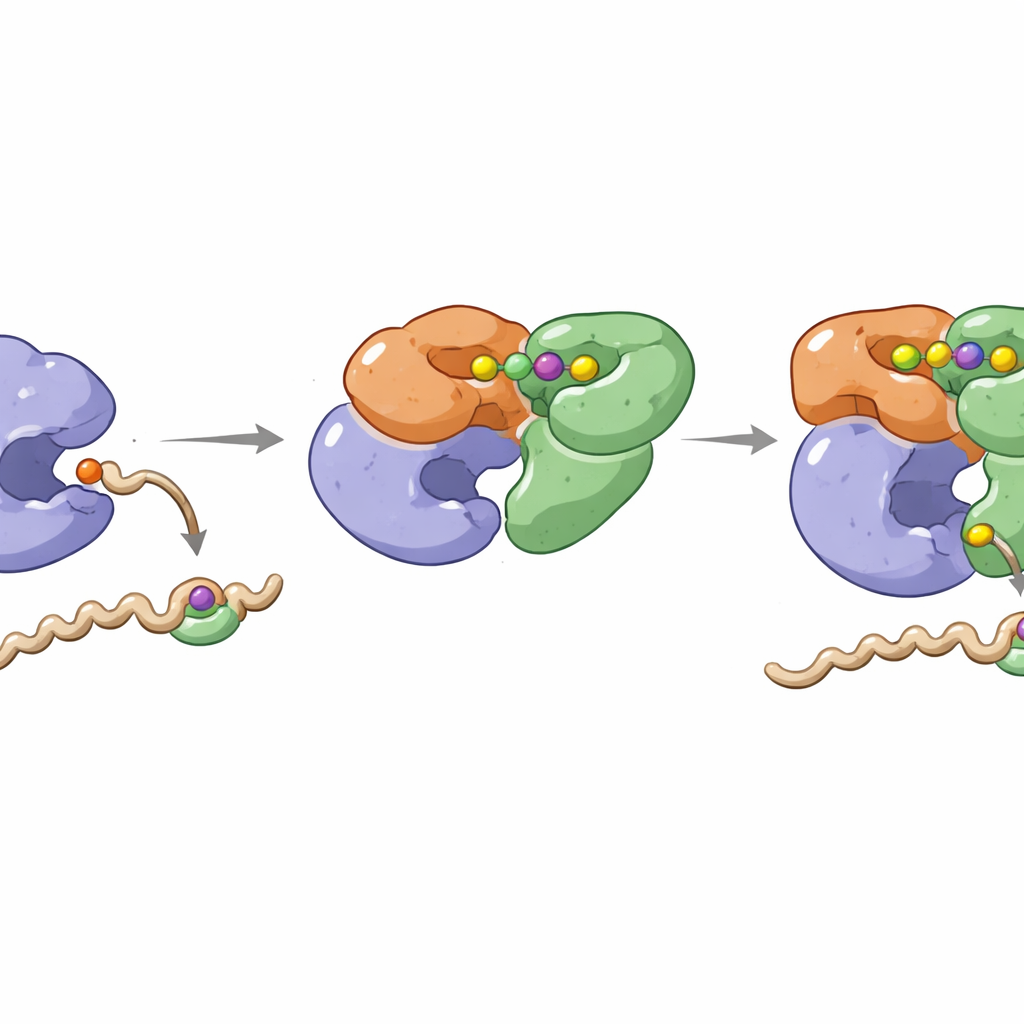
A stress-controlled network touching many cell functions
Because AcuC can act on several unrelated proteins, this one regulatory module has wide reach. When Ap4A levels are low, AcuB is relatively unstable, and AcuC is free to remove acetyl groups across the cell, promoting active enzymes and robust acetyl-CoA production. When stress drives Ap4A levels up, Ap4A-bound AcuB accumulates and clamps down on AcuC. As a result, multiple proteins stay acetylated: AcsA throttles back acetyl-CoA synthesis, and factors involved in translation, cell wall building, and DNA replication remain in altered states. The authors propose that this gives the cell a rapid way to coordinate energy use and core processes with stressful conditions, without needing to turn genes on and off first.
What this means beyond one bacterium
This work reveals AcuB as an adaptor that converts a general alarm signal, Ap4A, into targeted control of protein acetylation by inhibiting an HDAC-like enzyme. Since similar sensor modules, acetylation systems, and HDAC relatives are found from bacteria to humans, the mechanism sketched here may echo in more complex cells, where HDACs are central to gene control and are major drug targets. In simple terms, the study shows how a small stress molecule can stabilize a protein brake that dampens a key enzyme, shifting many cellular switches at once so the cell can better cope with hardship.
Citation: Zheng, L., Young, M.K.M., Steinchen, W. et al. A protein adaptor mediating Ap4A-dependent control of protein acetylation. Nat Commun 17, 3089 (2026). https://doi.org/10.1038/s41467-026-70006-0
Keywords: protein acetylation, bacterial stress response, Ap4A alarmone, histone deacetylase regulation, acetyl-CoA metabolism