Clear Sky Science · en
Bistable origami thermal switch with high switching ratios
Keeping Hot Electronics Safely Cool
Modern electronics—from AI chips to electric cars—are getting smaller, more powerful, and much hotter. If their temperature is not carefully controlled, performance drops and components fail early. Engineers would love a simple, automatic “heat switch” that turns cooling on only when a device gets too hot, then turns it off to save energy once things cool down. This paper introduces just such a switch, built from a cleverly folded sheet inspired by origami, that can dramatically change how easily heat flows—without any continuous power, sensors, or computers.
A Folded Sheet That Acts Like a Heat Valve
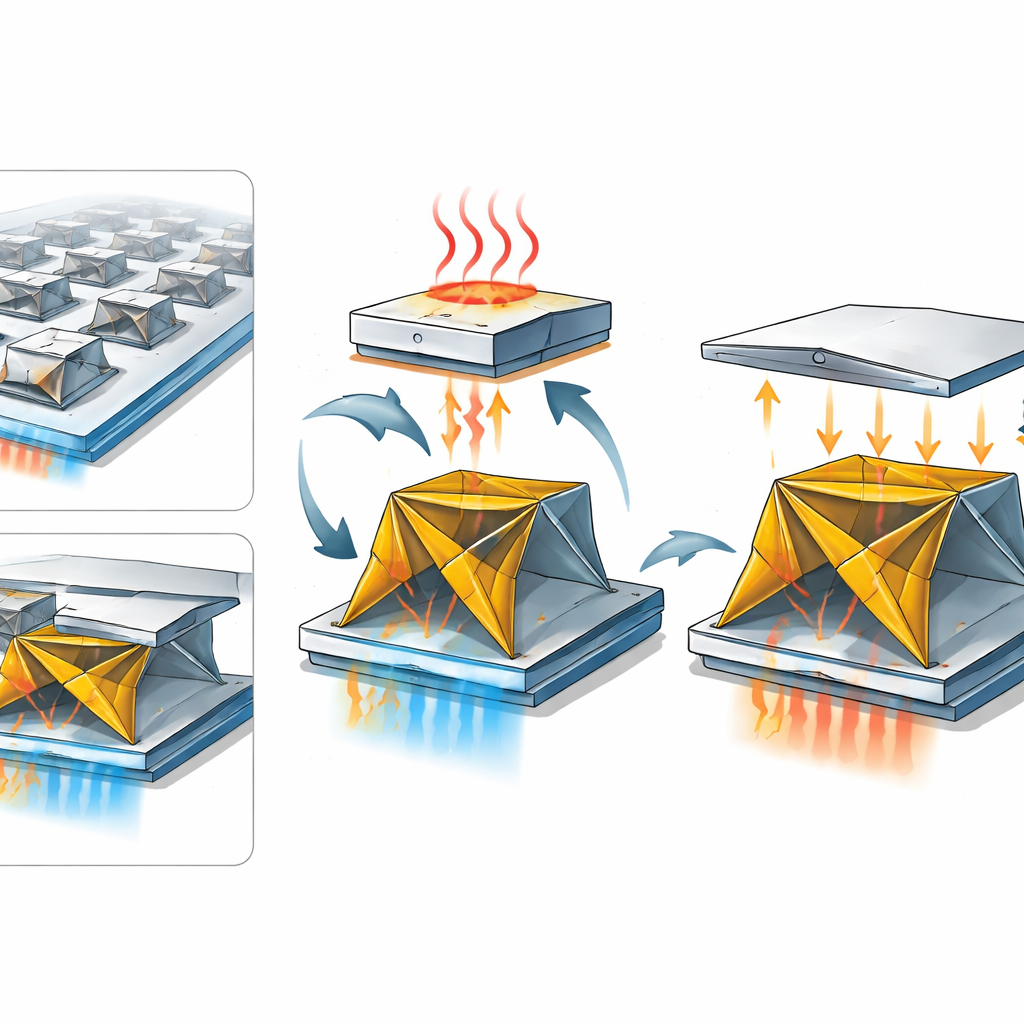
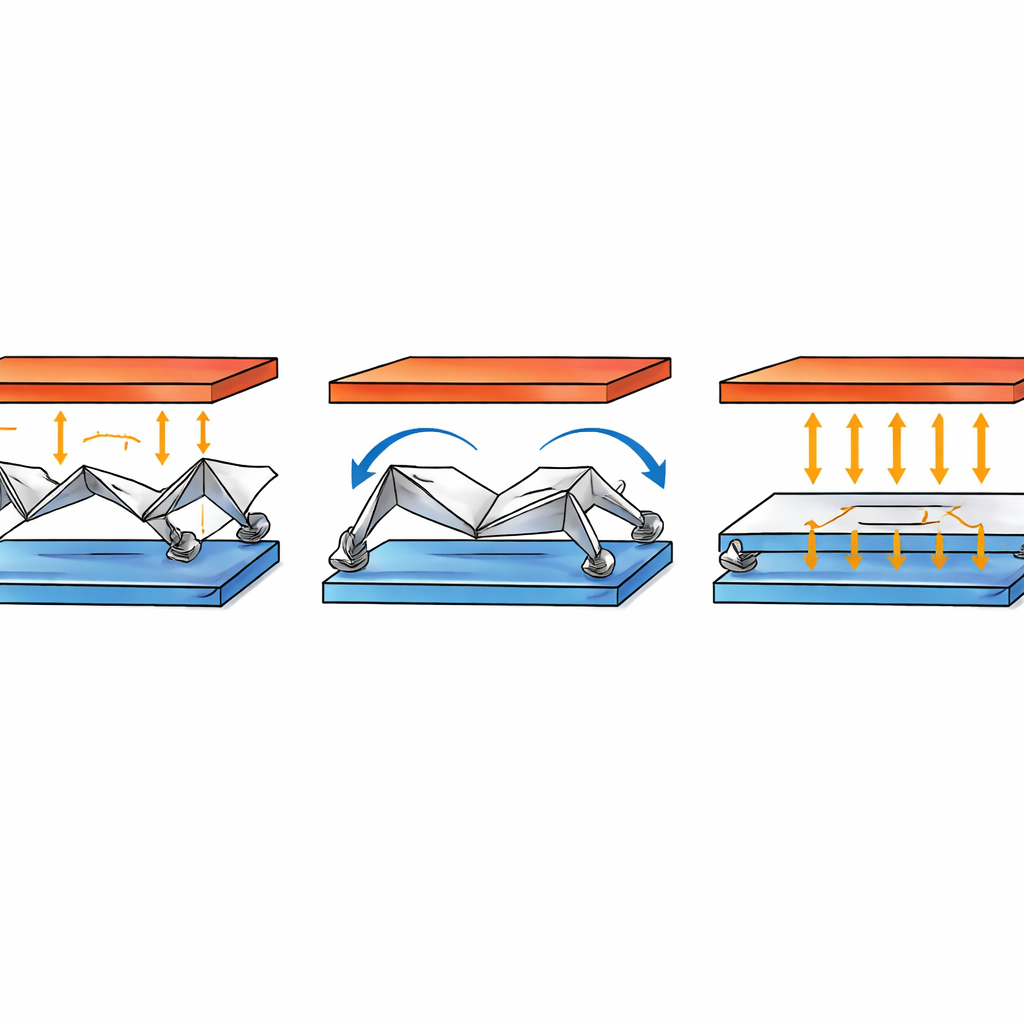
At the heart of the work is a thin-film structure cut and folded into a star-like pattern with five arms around a central plate. Thanks to its geometry, this origami piece has two stable shapes: a flat shape where the top plate sits close to a cold surface, and a raised shape where it stands above it. In the flat shape, heat flows easily through the solid contact; in the raised shape, a gap and thin pathways make heat flow extremely weak. The authors build on this property to create a “bistable origami switch” that can act like a physical on–off valve for heat, staying firmly in either the high-conducting or low-conducting state until driven to snap to the other.
How the Switch Moves by Itself
To turn this folded structure into an automatic device, the team adds small temperature-responsive actuators to the folds near the central plate. Each actuator combines a wire made of a shape-memory alloy—which changes shape when heated—with a tiny spring that pulls back when cooled. When the hosted electronic device gets hot, heat travels to the actuators. Above a chosen temperature, the alloy wire straightens and overpowers the spring, pushing the origami to snap down into the flat, heat-conducting state. As the device cools, the wire relaxes, the spring regains control, and the structure snaps back up into its raised, insulating state. An extra elastic cord, called a regulator, fine-tunes how much force is needed to flip between states, allowing the designers to set the switching temperatures.
Record-Breaking Control of Heat Flow
The researchers carefully measure how well the switch conducts heat in both shapes using a standard setup with two metal bars—one hot, one cold—with the origami device in between. Under vacuum, where stray heat through air is removed, the switch shows a huge temperature jump when in the raised state, meaning very little heat leaks across. In the flat state, that jump nearly disappears, proving that heat is flowing readily. The ratio between the “on” and “off” heat flow—a key performance number—reaches nearly 14,000 in vacuum, far higher than any previously reported passive thermal switch, and still about 1,360 in normal air. Modeling shows that this performance comes from keeping any solid heat paths very thin and separated, so that, in the off state, most heat must travel by weak radiation across a large gap.
Fast, Reliable, and Adjustable Operation
Beyond strength of switching, the team explores how quickly and reliably the device works. High-speed video of the structure itself shows that once it reaches its “tipping point,” the snap between states finishes in under a tenth of a second. By shortening the travel distance and tuning the number of actuators, they demonstrate two-way switching around 200 milliseconds, even while carrying added weight. In longer tests with a heater and a chilled plate, the switch automatically cycles on and off hundreds of times, holding temperatures within narrow bands around preset thresholds. Changing the pre-stretch of the regulator cord or using shape-memory alloys with different transition temperatures lets the designers choose the temperature window for different applications.
Real Devices and Future Possibilities
To show practical value, the authors attach their switch to everyday electronic parts: batteries, power amplifiers, light-emitting diodes, wireless chips, and DC–DC converters. In each case, the origami device automatically keeps the component’s temperature within a safe range by repeatedly connecting and disconnecting it from a cold plate—no external control electronics required. Because the switching behavior is set mainly by geometry rather than size, similar designs could be scaled up to large panels or down toward chip level, using other responsive materials instead of the current wires and springs. The fact that the two thermal states behave like a stable “0” and “1” also hints at future uses in thermal logic, where heat itself could carry information.
Why This Matters
In everyday terms, this work delivers a heat valve that flips itself fully open or fully closed at chosen temperatures and then stays put until conditions change again. It wastes almost no energy in the process, needs no power to hold a state, and offers an unprecedented contrast between “cooling on” and “cooling off.” As electronics everywhere grow hotter and more densely packed, such passive, programmable thermal switches could help protect devices, save energy, and even form the building blocks of new kinds of heat-based computing.
Citation: Tan, B., Lyu, J., Yang, F. et al. Bistable origami thermal switch with high switching ratios. Nat Commun 17, 3177 (2026). https://doi.org/10.1038/s41467-026-69956-2
Keywords: thermal switch, origami structures, shape memory alloy, electronics cooling, bistable mechanics