Clear Sky Science · en
Chiral inheritance effect in the reactive cystine-based coassembly system
Why the shape of light matters
Many modern technologies, from advanced displays to secure data tags, rely not just on the color or brightness of light, but on its “handedness” – whether it twists to the left or right. This paper explores how tiny molecules can lock in such handed behavior even while their chemical bonds are being rearranged. The authors show that, in crowded, solid-like molecular assemblies, chemical reactions can proceed efficiently and still preserve a kind of structural memory. This opens new possibilities for smart optical materials that change on command yet remember where they came from.
Building tiny spirals from simple pieces
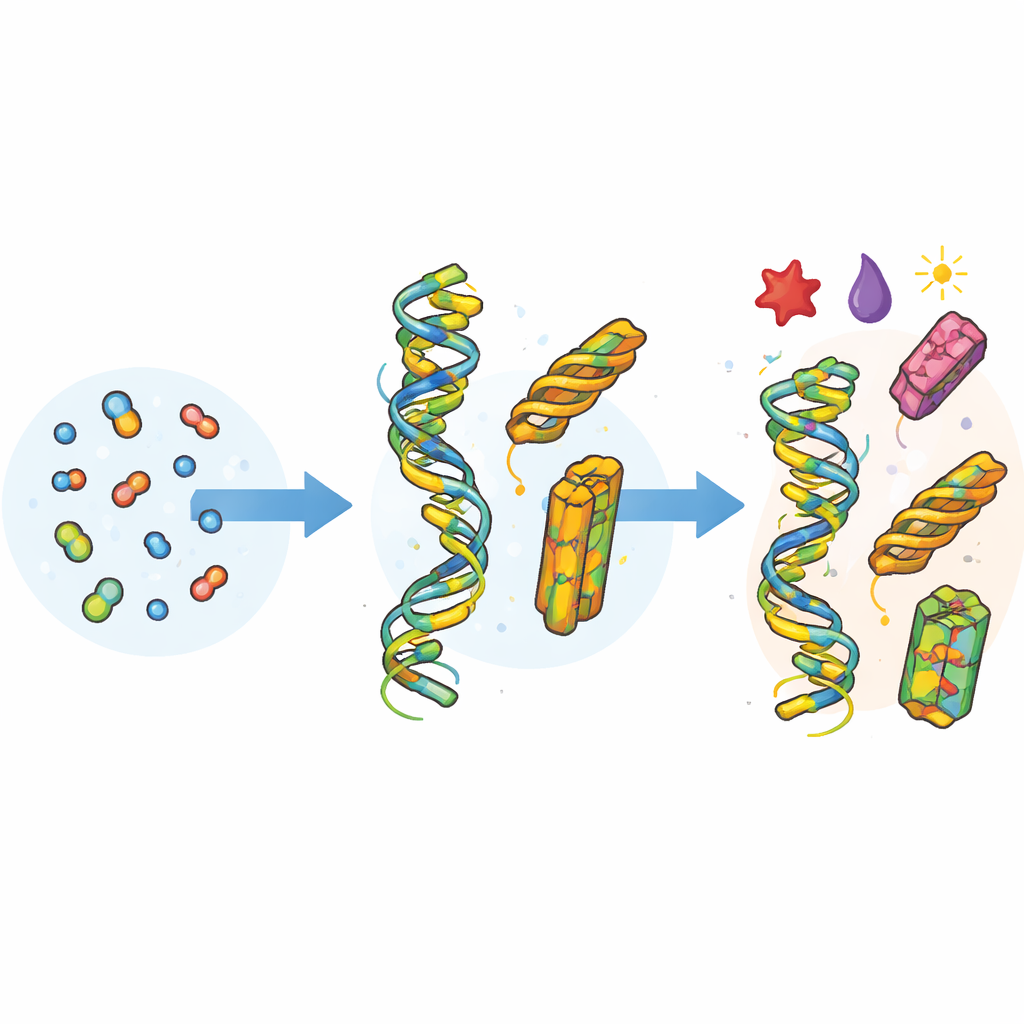
The researchers start with a small molecule built from cystine, an amino acid, decorated with a light-emitting pyrene group. In water-rich mixtures these molecules spontaneously gather into long, twisted fibers, much like threads of a microscopic rope. Because cystine itself is chiral – it comes in left- and right-handed forms – these fibers also adopt a handed twist, which strongly affects how they absorb and emit polarized light. The team confirms these twisted shapes using electron microscopy and X-ray scattering, and they detect robust chiroptical signals, meaning the assemblies interact differently with left- and right-circularly polarized light.
Rewriting bonds without losing memory
The central question is what happens if you change the chemistry inside these pre-formed fibers. The authors use a mild reducing agent to cut the internal disulfide bond of cystine, turning it into cysteine and creating new sulfur–hydrogen groups. In ordinary solution this reaction is straightforward, but in a tightly packed aggregate where molecules barely move, it is not obvious that the reaction can proceed. Surprisingly, they find that the cleavage is nearly quantitative even inside the assemblies and occurs within minutes. The nano-objects reorganize from twisted fibers into more crystalline rod-like architectures, and their fluorescence color shifts because the pyrene units stack in a new way. Yet, when they probe the polarization of the emitted light, they see that the overall handedness can be retained if the reaction happens inside the original fibers, revealing a strong “chiral inheritance” effect.
Guest molecules that steer structure and light
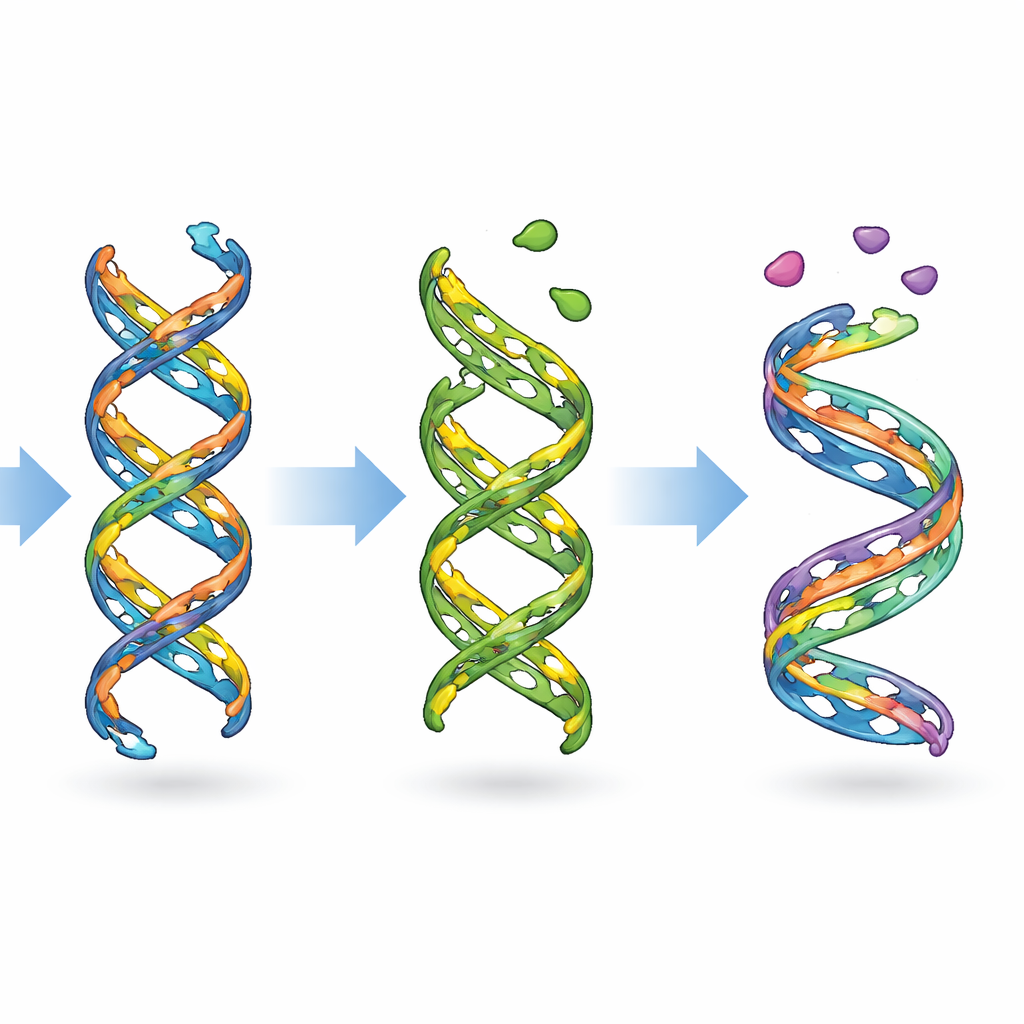
To test how general this templating is, the team introduces a second, electron-poor molecule called pentafluoropyridine. This guest slips between the pyrene units through specialized attractive forces, forming mixed coassemblies that still twist in a single handed direction. Once again, they trigger bond cleavage with the reducing agent, now in the two-component system. The coassembled structures change their emission profile but largely keep their chiroptical character, indicating that the initial mixed state guides the final arrangement. The authors then go a step further and apply a gentle base and heat to promote a second reaction, an aromatic substitution where the sulfur-bearing groups attack the guest’s ring. Even in the condensed assemblies, this second step reaches a respectable yield and produces new donor–acceptor structures with bright cyan emission and enhanced circularly polarized luminescence.
Pathways that hide and reveal information
A striking outcome of this work is that samples with the same final chemical composition can behave very differently depending on how they were prepared. “Bottom-up” assemblies built directly from the final molecules often show weaker or different chiroptical signals compared with “top-down” products formed by reacting inside pre-existing fibers. The original structures act as sacrificial templates, encoding a chiral memory that the products inherit. The authors even propose an encryption scheme: two materials that both glow blue under ultraviolet light but were reached by different paths can only be distinguished using circularly polarized measurements, providing a hidden optical key useful for anti-counterfeiting or secure labeling.
What this means for future smart materials
Overall, the paper demonstrates that complex, multi-step chemical reactions can be carried out efficiently in condensed self-assembled states while preserving or even amplifying chiral optical behavior. By carefully choosing the starting architecture and reaction pathway, scientists can program how handed light is generated, turning molecular reactions into a tool for sculpting nano-scale structure and information storage. For a lay reader, the key message is that in these tiny systems, history matters: the route taken to build a material can be just as important as the ingredients themselves, paving the way for responsive devices, sensors, and encryption tags that literally remember their past in the way they twist light.
Citation: Wang, Z., Chu, C., Hao, A. et al. Chiral inheritance effect in the reactive cystine-based coassembly system. Nat Commun 17, 3131 (2026). https://doi.org/10.1038/s41467-026-69945-5
Keywords: chiral materials, self-assembly, circularly polarized luminescence, smart optical materials, supramolecular chemistry