Clear Sky Science · en
Conformational landscape of HIV-1 Env from closed to fully open
How a Shape-Shifting Viral Spike Opens the Door
The virus that causes AIDS slips into our immune cells using a protein spike called Env, which constantly shifts its shape. This study maps, in fine detail, how Env moves from a closed form to a fully open, infection-ready form. Understanding these shape changes can help scientists design vaccines and antibody treatments that block HIV at just the right moment.
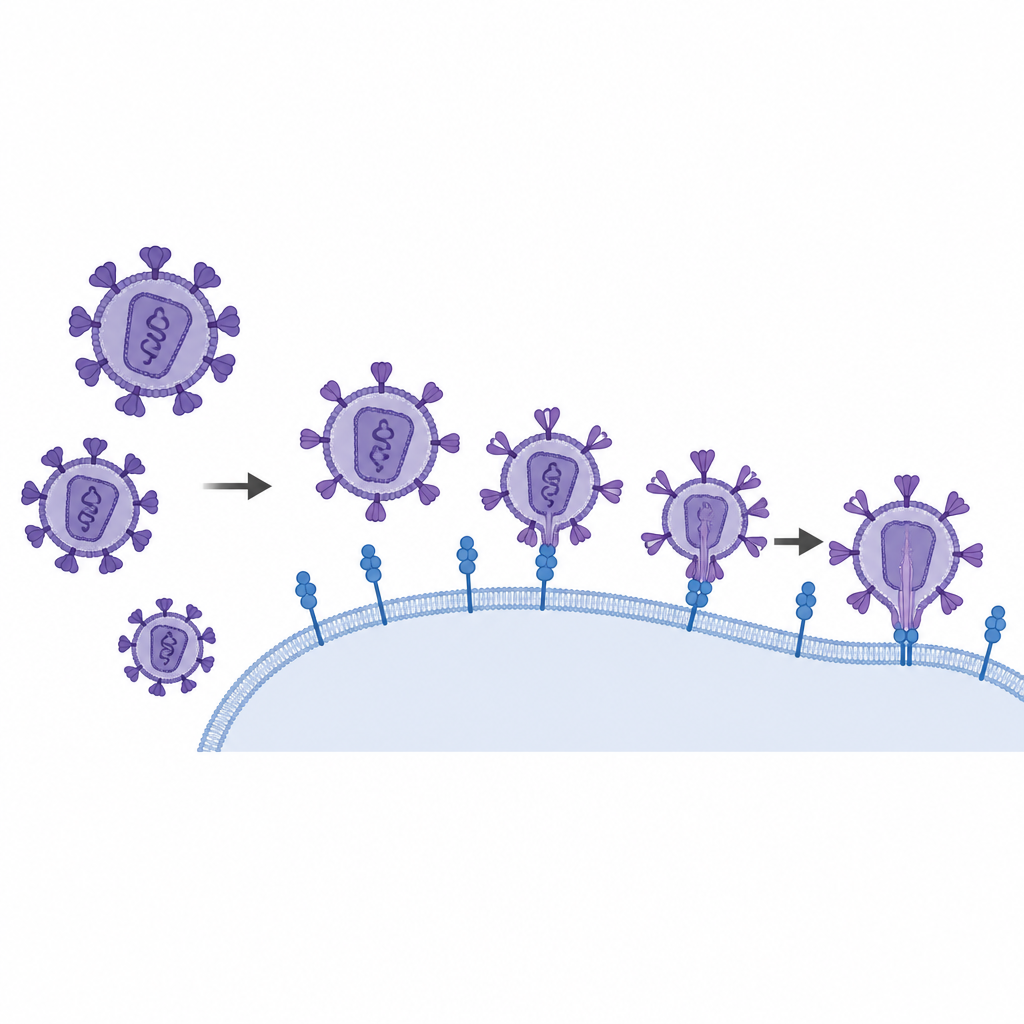
The Viral Lock and the Cell Key
HIV enters cells by attaching its Env spike to a receptor called CD4 on the surface of certain immune cells. Env is built from three copies of two parts: gp120, which grabs the CD4 receptor, and gp41, which helps fuse the virus with the cell. When gp120 first meets CD4, Env does not simply flip from off to on. Instead, it moves through a series of intermediate shapes that gradually bring the virus and cell membranes closer, eventually allowing the viral genetic material to enter the cell.
Catching Env in Mid-Motion
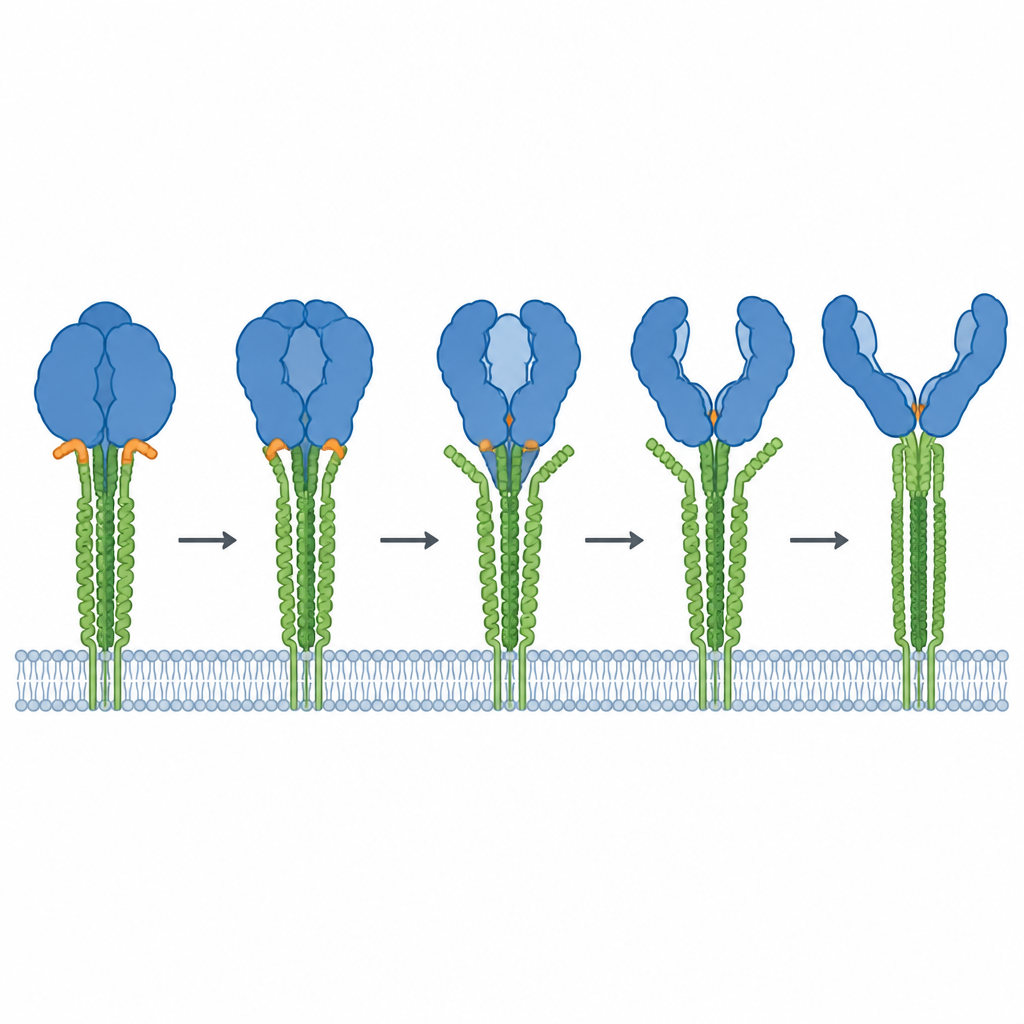
The researchers used high-resolution cryo-electron microscopy to freeze and image Env from a strain called AMC008 while it interacted with CD4 and several antibodies. By trapping Env with different partners, they captured multiple, previously unseen shapes between fully closed and fully open. One antibody, 3BC315, reshaped the lower part of the spike (the gp41 base) while leaving the top mostly closed, creating what the authors call a base-relaxed state. Another antibody, b12, and the CD4 receptor itself produced moderately open forms in which the upper region of Env had begun to spread, but key sites for the second cell receptor were still hidden.
A New Map of Opening Steps
From these snapshots, the team proposed a classification system for Env shapes that tracks how the spike opens. In the closed state, the three gp120 heads are tightly packed and the fusion peptide at the base is exposed. In the base-relaxed state, triggered by 3BC315, the fusion peptide tucks into a pocket while the top remains closed. Moderately open states appear when b12 or CD4 bind: the heads rotate outward a bit, and parts of the gp41 stalk compact and twist, yet the binding site for the coreceptor remains blocked. More open states, seen in earlier work and integrated here, include partially open and fully open forms where the fusion peptide and surrounding regions reorganize and the coreceptor site becomes accessible, setting the stage for membrane fusion.
Antibodies That Help Each Other
The study also reveals how two different antibodies can work together on the same spike. On their own, many Env trimers bind only one or two copies of 3BC315. When b12 is present, however, all three 3BC315 molecules can attach, and the spike adopts an asymmetric open shape in which each of the three units sits in a slightly different state along the opening path. Mass photometry and virus neutralization tests showed that this pairing of b12 and 3BC315 boosts their ability to block infection, even against some viral strains that resist b12 alone. This suggests that one antibody can reshape Env in a way that makes it easier for another to latch on.
What This Means for Future HIV Protection
By organizing Env shapes into a clear series of states, this work provides a structural roadmap for how the HIV spike moves from closed to fully open before fusing with a cell. For a layperson, this means we now have a more detailed picture of how the viral key turns in the cellular lock. Vaccine designers can use this roadmap to stabilize Env in specific shapes that best train the immune system, or to encourage antibodies like 3BC315 that nudge Env toward more weakly protected, open forms. Developers of antibody therapies can also exploit cooperative pairs such as b12 and 3BC315, combining antibodies that reshape Env with those that then bind more tightly and help shut down infection.
Citation: Cui, J., Lin, Z.J., Ghosh, S. et al. Conformational landscape of HIV-1 Env from closed to fully open. Nat Commun 17, 4273 (2026). https://doi.org/10.1038/s41467-026-69921-z
Keywords: HIV Env, viral entry, cryo-EM, neutralizing antibodies, vaccine design