Clear Sky Science · en
BRAHMA represses STOP1-NRT1.1 module to control plant rhizosphere alkalization and acid stress adaptation
Why sour soils matter for our food
Much of the world’s farmland sits on acidic, or “sour,” soils that stunt roots and make it harder for crops to take up nutrients. Farmers often respond by adding more nitrogen fertilizer, but that can worsen soil acidity and pollution. This study uses the model plant Arabidopsis to uncover how roots sense acidic conditions and actively shift the chemistry around them, pointing to new ways to breed crops that thrive in sour soils while using fertilizer more efficiently.
How roots quietly adjust their surroundings
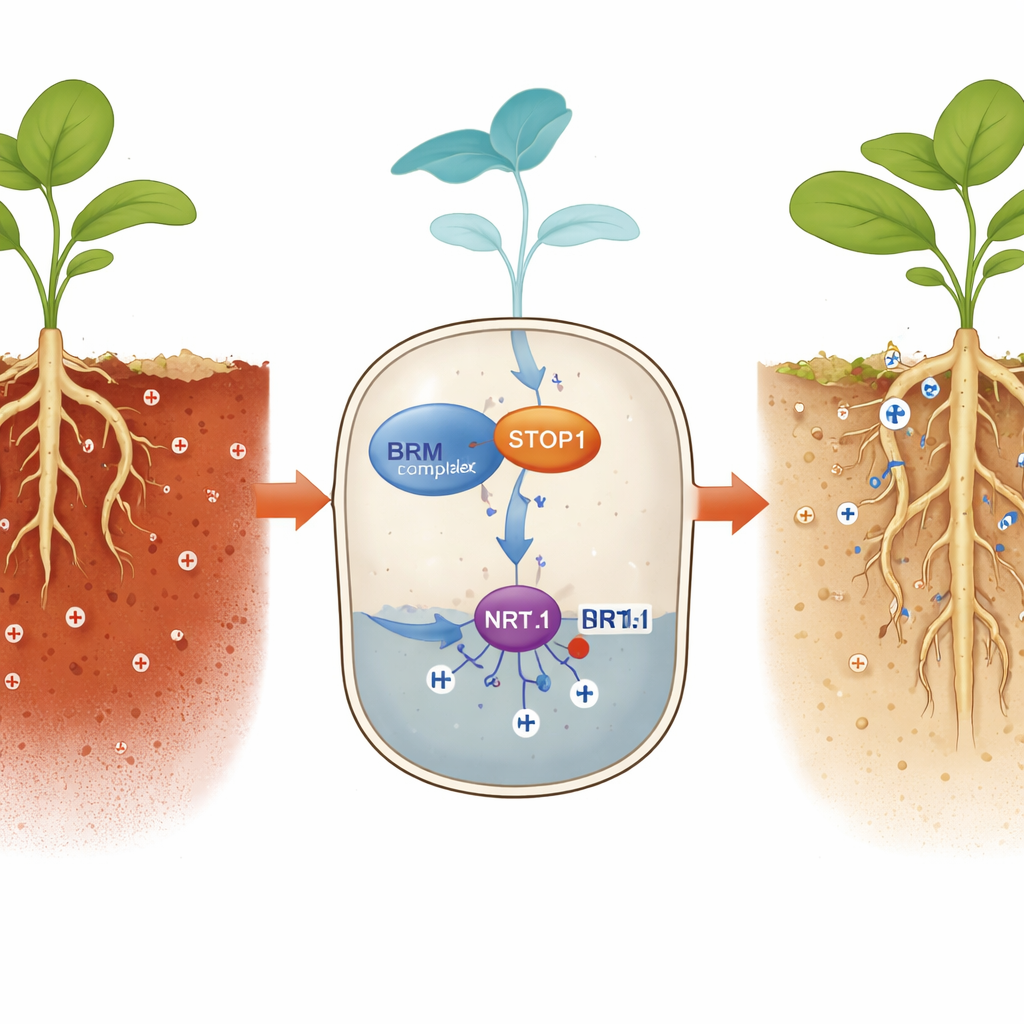
Plant roots do not passively endure harsh soil; they reshape it. Earlier work showed that a protein called STOP1 switches on a nitrate transporter, NRT1.1, in root cells. When NRT1.1 pulls nitrate into the plant, it couples this with uptake of positively charged hydrogen ions from the surrounding soil, subtly raising the local pH and easing acid stress. This process, known as rhizosphere alkalization, both protects root growth and improves how well plants use nitrogen. However, it was unclear what controls when STOP1 and NRT1.1 should be active, especially during prolonged exposure to low pH.
A molecular brake on root self-defense
The authors identified a powerful molecular “brake” on this protective pathway: a large chromatin‑remodeling protein called BRAHMA (BRM). BRM helps package DNA and controls which genes are accessible. Using protein–protein interaction tests and fluorescent microscopy, they showed that BRM physically binds to STOP1 inside the nucleus and sits directly on the NRT1.1 gene. In doing so, BRM keeps the DNA around NRT1.1 in a more closed state and weakens STOP1’s ability to switch this transporter on. Plants lacking BRM grew much better than normal plants in acidic conditions, but not when nitrate was scarce, indicating that BRM’s main role here is to restrain nitrate‑based defenses against acid stress.
Turning off the brake when soils turn sour
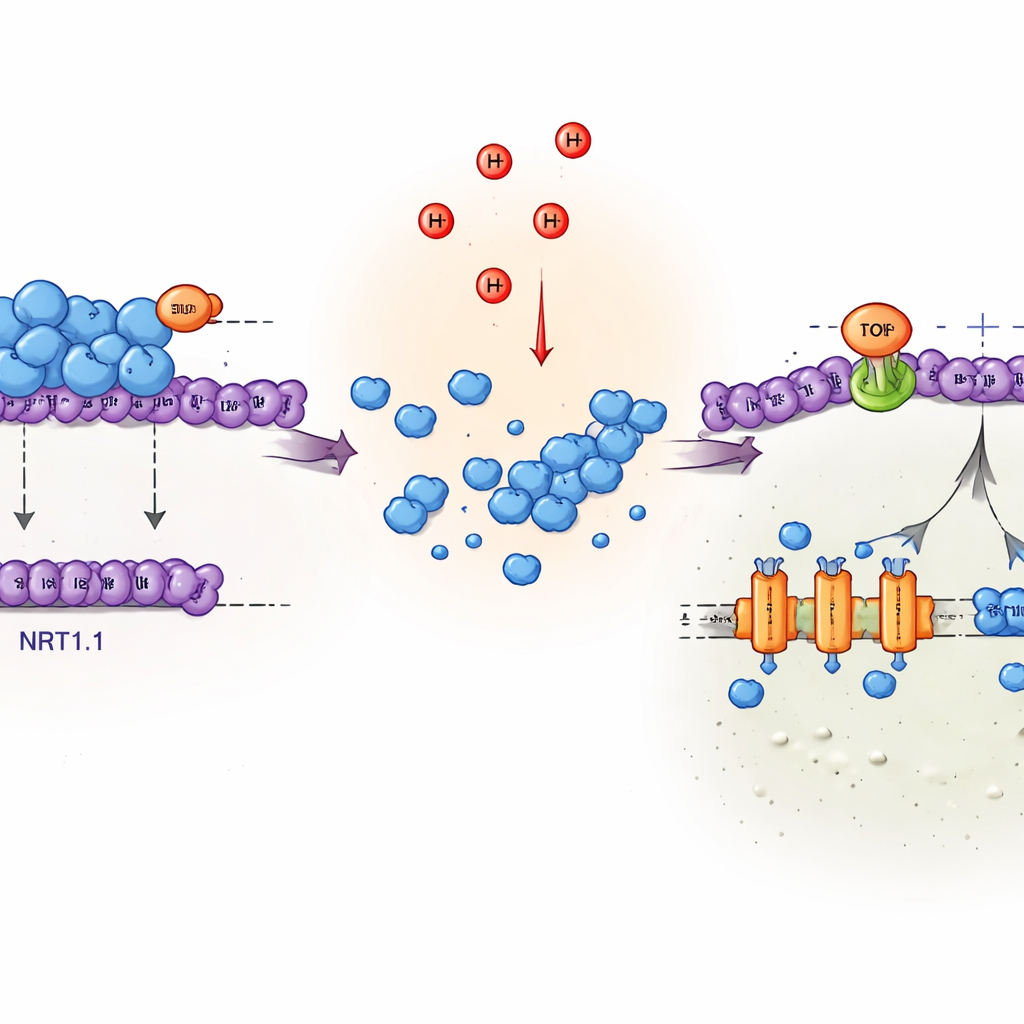
To understand what happens when soil turns more acidic, the researchers followed BRM and STOP1 over time in living roots. They found that simply lowering the pH around the roots rapidly triggered the breakdown of BRM protein in the nucleus, through the cell’s protein recycling machinery, without changing BRM’s gene activity. This loss of BRM occurred within a couple of hours and did not depend on nitrate supply, marking it as an early, direct response to acidity. Once BRM was removed, STOP1 could bind more strongly to the NRT1.1 gene, chromatin around this region became more open, and NRT1.1 was strongly activated. Roots of BRM‑deficient plants took up more nitrate and more effectively raised the pH of the thin soil layer touching the root surface, as seen with pH‑sensitive dyes.
Balancing growth, stress protection, and soil health
Genetic experiments combining loss of BRM with loss of STOP1 or NRT1.1 showed that STOP1 and NRT1.1 must be present for the acid‑tolerant, nitrate‑hungry behavior of BRM mutants. Without STOP1 or NRT1.1, removing BRM no longer improved root growth in acidic media, nor did it enhance nitrate uptake. This places BRM firmly upstream as a gatekeeper that normally holds the STOP1–NRT1.1 system in check. The study also suggests that BRM partners with a histone‑modifying enzyme, HDA6, to keep chromatin at NRT1.1 and other STOP1‑target genes relatively silent under comfortable conditions, preventing unnecessary energy use and potential growth penalties from constantly running stress responses.
What this means for future crops
In plain terms, the work reveals a switch that lets roots know when to fight back against acidity. Under normal conditions, BRM keeps the STOP1–NRT1.1 machinery idling at low speed. When soils become too acidic, BRM is selectively removed, allowing STOP1 to activate nitrate uptake and gently neutralize the soil around the root. By tuning this switch—especially BRM’s interaction with STOP1 and the NRT1.1 gene—plant breeders may be able to create crops that maintain strong root growth on acidic land while drawing more benefit from each unit of nitrogen fertilizer. Such crops could help break the current cycle where poor nutrient use drives further soil acidification, offering a path toward more sustainable farming on the world’s extensive sour soils.
Citation: Ye, J.Y., Tian, W.H., Zhang, D.R. et al. BRAHMA represses STOP1-NRT1.1 module to control plant rhizosphere alkalization and acid stress adaptation. Nat Commun 17, 3084 (2026). https://doi.org/10.1038/s41467-026-69905-z
Keywords: acidic soils, plant roots, nitrate uptake, chromatin remodeling, nitrogen use efficiency