Clear Sky Science · en
Topology optimization of thermoelectric generator for maximum power efficiency
Turning Waste Heat into Useful Power
Every day, huge amounts of heat from car engines, factories, and even computer chips simply vanish into the air. Thermoelectric generators can turn some of that lost warmth directly into electricity, with no moving parts. But their performance has long been limited not just by the materials used, but by something more familiar from everyday life: shape. This study shows how smart computer design and 3D printing can reshape thermoelectric devices in surprising ways, squeezing much more power out of the same amount of heat.
Why Shape Matters for Energy Devices
In nature, structure and function go hand in hand: the layered interior of seashells resists cracks, and the tiny hairs on gecko feet let them stick to walls. Engineered systems are no different. In thermoelectric generators, heat must flow through a solid “leg” while an electric current flows along the same path. Traditionally these legs are simple blocks because they are easy to design and manufacture. Yet heat and electricity spread through them in complicated ways that depend strongly on geometry. Simple blocks rarely provide the best route for heat, the right temperature difference, and the ideal electrical resistance all at once, so much of the potential energy is wasted.
Letting Algorithms Draw the Device
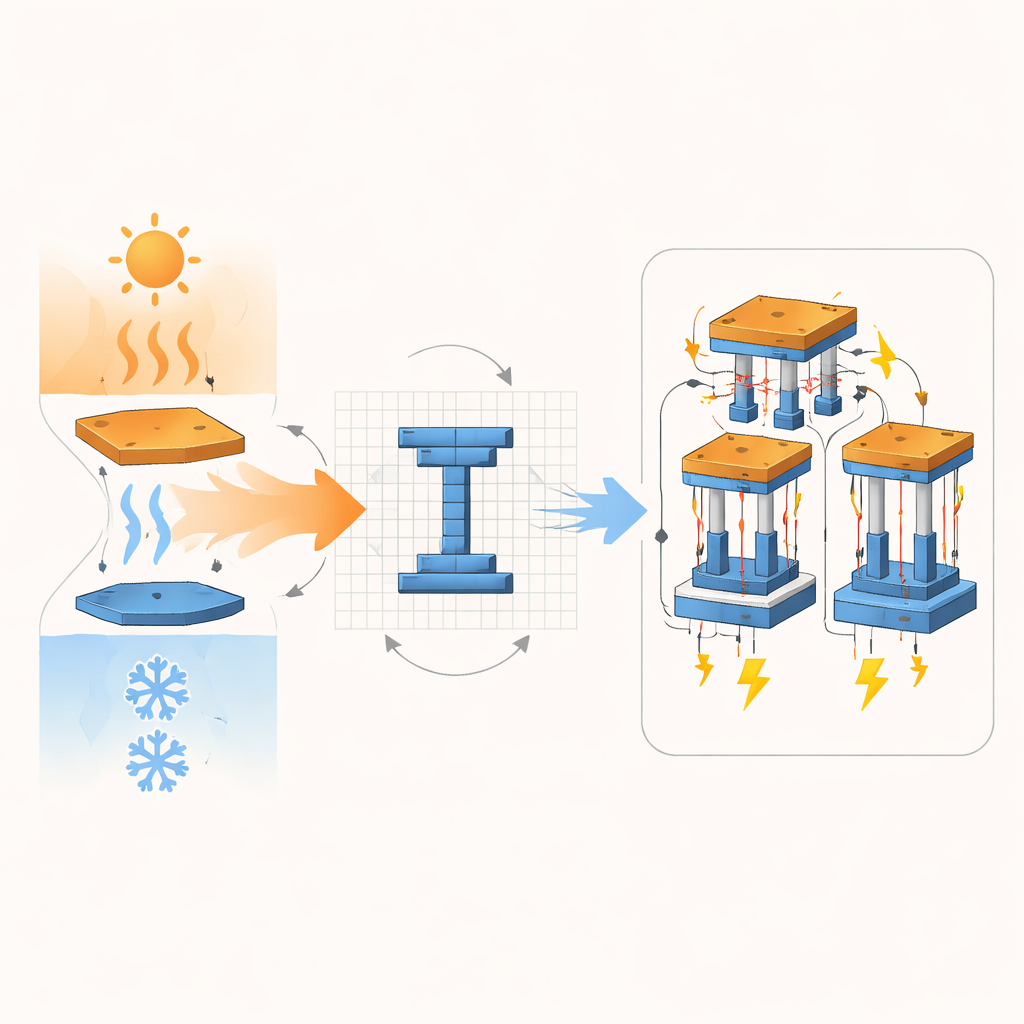
The authors use a powerful design method known as topology optimization to let a computer effectively “draw” the best shape of thermoelectric material inside a given volume. Instead of tweaking a few dimensions of a block, the algorithm can add or remove material almost anywhere inside a 3D region made of thousands of tiny elements. It solves the heat and electric equations repeatedly, shifting material around to improve a chosen goal—in this case, either raw electrical power or overall efficiency. Realistic factors such as interfaces, packaging limits, and mechanical stress are built into the same loop, so the final shapes are not just idealized but suitable for real devices.
Strange New Forms that Work Better
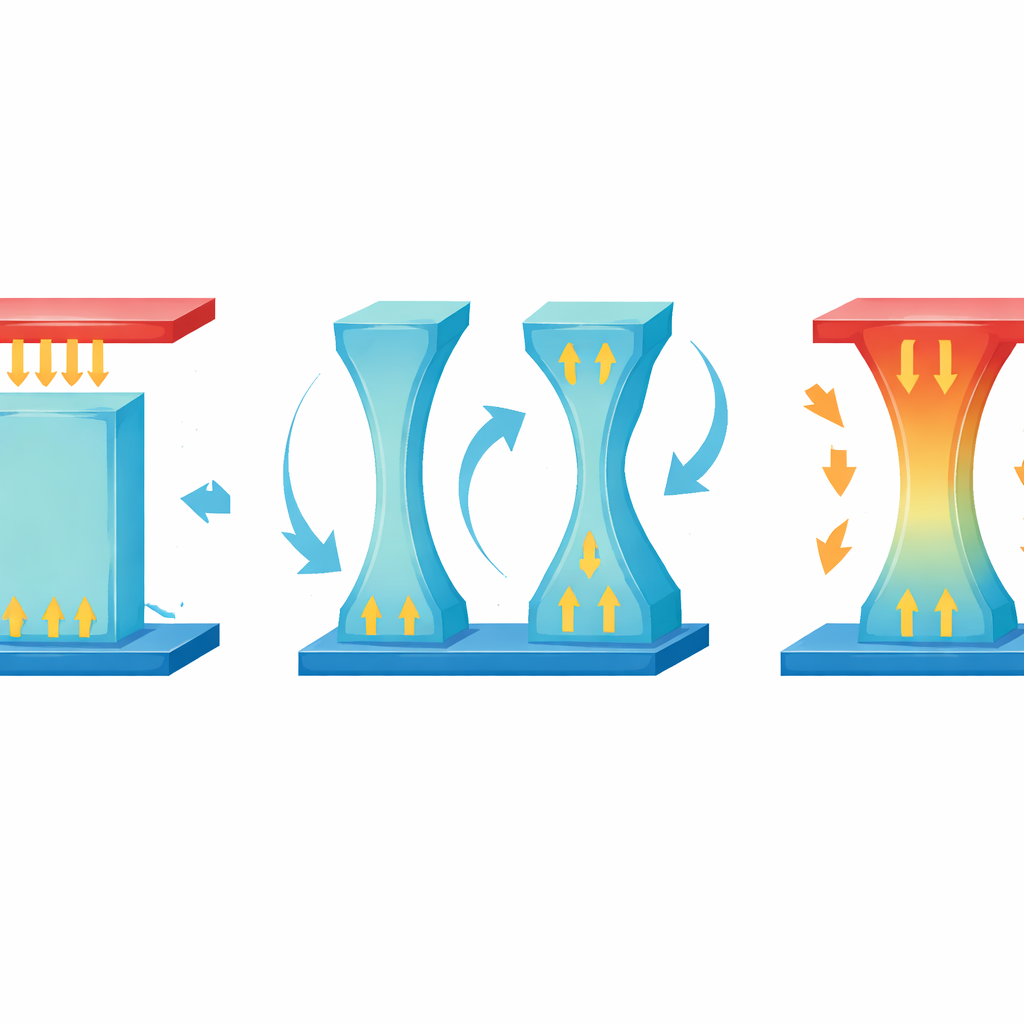
When this method is applied to a single thermoelectric leg between two copper plates, the resulting shapes look nothing like ordinary bricks. Under common cooling conditions, the best designs become slim “I-shaped” pillars that trim away material from the sides. Under other heat-flow conditions, they evolve into asymmetric hourglass forms that pile material near the cooler region to boost the temperature drop. Across a wide range of heat sources and cooling strengths, these optimized shapes consistently beat standard blocks, with efficiency gains up to nearly eightfold in extreme cases. The study also explores many different thermoelectric materials, from low-temperature bismuth compounds to high-temperature half-Heusler alloys, and finds that each material calls for its own tailored shape—yet the optimized versions almost always perform far better than their conventional counterparts.
From Computer Design to Printed Hardware
To test whether these intricate shapes work outside the computer, the team 3D-printed thermoelectric legs from three different materials and mounted them between metal plates, alongside traditional block-shaped devices made from the same volume of material. High-resolution 3D scanning confirmed that the printed parts closely matched the digital designs. When placed between a heater and a water cooler in a controlled chamber, the optimized legs produced more voltage and more power than the blocks, in some cases more than doubling or even octupling efficiency. The researchers extended the same approach to multi-leg modules and to alternative layouts such as planar, tubular, and Y-shaped devices, again finding large performance boosts and even improved mechanical robustness when strength was included as a design constraint.
What This Means for Future Energy Harvesting
In simple terms, this work shows that how we shape thermoelectric generators can matter as much as what they are made of. By letting algorithms search huge design spaces and by fabricating the resulting geometries with 3D printing, the authors demonstrate a practical route to much more efficient waste-heat harvesters. As thermoelectric materials improve and as manufacturing methods mature, this framework could help turn otherwise lost heat—from industrial plants, vehicles, and electronics—into a steady trickle of clean electricity, contributing to more sustainable energy systems.
Citation: Lee, J., Yang, S.E., Choo, S. et al. Topology optimization of thermoelectric generator for maximum power efficiency. Nat Commun 17, 2948 (2026). https://doi.org/10.1038/s41467-026-69901-3
Keywords: thermoelectric generators, waste heat recovery, topology optimization, 3D printed energy devices, energy harvesting