Clear Sky Science · en
Negative emissions to mitigate Earth system risks
Why planning for a cooler future just got harder
Most of us have heard that the world needs to reach “net‑zero” greenhouse gas emissions to keep global warming in check. This study argues that even net‑zero is not enough once we honestly account for how uncertain Earth’s response to our pollution really is. The authors show that to avoid dangerous surprises in the climate system, societies must cut emissions faster, pay more for carbon pollution in the near term, and plan for long‑lasting “net‑negative” emissions—removing more carbon dioxide from the air than we emit—for generations to come.

Two ways to plan in an uncertain world
The paper contrasts two basic mindsets for climate policy. In the usual “after‑the‑fact” approach, governments design an emissions pathway as if the climate system were known precisely, and only later ask how sensitive the outcome is to uncertain physics. By then, the strategy may miss its temperature goal if Earth turns out to warm faster than expected. The alternative “ahead‑of‑time” approach builds uncertainty into the plan from the start. Here, decision‑makers design a single global strategy that must perform acceptably across many plausible versions of how the climate and carbon cycle behave. This ahead‑of‑time planning acts like an insurance policy: it shifts effort forward to protect against bad climate surprises rather than reacting once they are already unfolding.
Bringing together economics and Earth system science
To explore these ideas, the authors couple a well‑known global economic model with a compact but state‑of‑the‑art climate and carbon‑cycle model. The climate model has been statistically tuned using the latest complex Earth system simulations and real‑world observations, producing hundreds of equally likely “states of the world” that capture uncertainties in key features such as how strongly temperatures respond to carbon dioxide or how quickly permafrost releases greenhouse gases as it thaws. For each of these states, the combined model simulates how the global economy grows, how costly it is to reduce emissions, and how the climate responds over centuries under different policy rules.
What happens when we plan cautiously
When climate policy is evaluated by balancing the costs of cutting emissions against the economic damages of warming, the ahead‑of‑time strategy is consistently more cautious. It reaches global net‑zero carbon dioxide roughly two decades earlier than the typical after‑the‑fact pathway and drives carbon prices in 2030 up to about twice as high. This extra push trims peak warming by only about a tenth of a degree Celsius on average, but that small difference significantly lowers the chance of ending up in high‑damage futures. Importantly, the cautious strategy does not simply stop at net‑zero. It maintains substantial net‑negative emissions for roughly two centuries, slowly drawing atmospheric carbon dioxide back down and allowing global temperatures to return toward pre‑industrial levels.
Targets, tipping points, and the value of knowledge
The team also asks what it takes to meet specific Earth system limits, such as keeping global warming below 1.5 or 2 degrees Celsius, limiting how much carbon locked in permafrost thaws, slowing sea‑level rise, or preventing severe ocean acidification. The more demanding and irreversible the impact—especially permafrost thaw—the higher the “insurance premium” in the form of near‑term carbon prices and earlier net‑zero dates. For a 1.5‑degree goal with a coin‑flip chance of success, the ahead‑of‑time strategy halves the remaining emissions budget and raises the 2030 carbon price by roughly two‑thirds compared with after‑the‑fact planning. Very stringent goals, such as a 1.5‑degree target with very high confidence, become infeasible under realistic technological limits, underscoring how narrow the remaining window is.
Negative emissions as a safety net, not a free pass
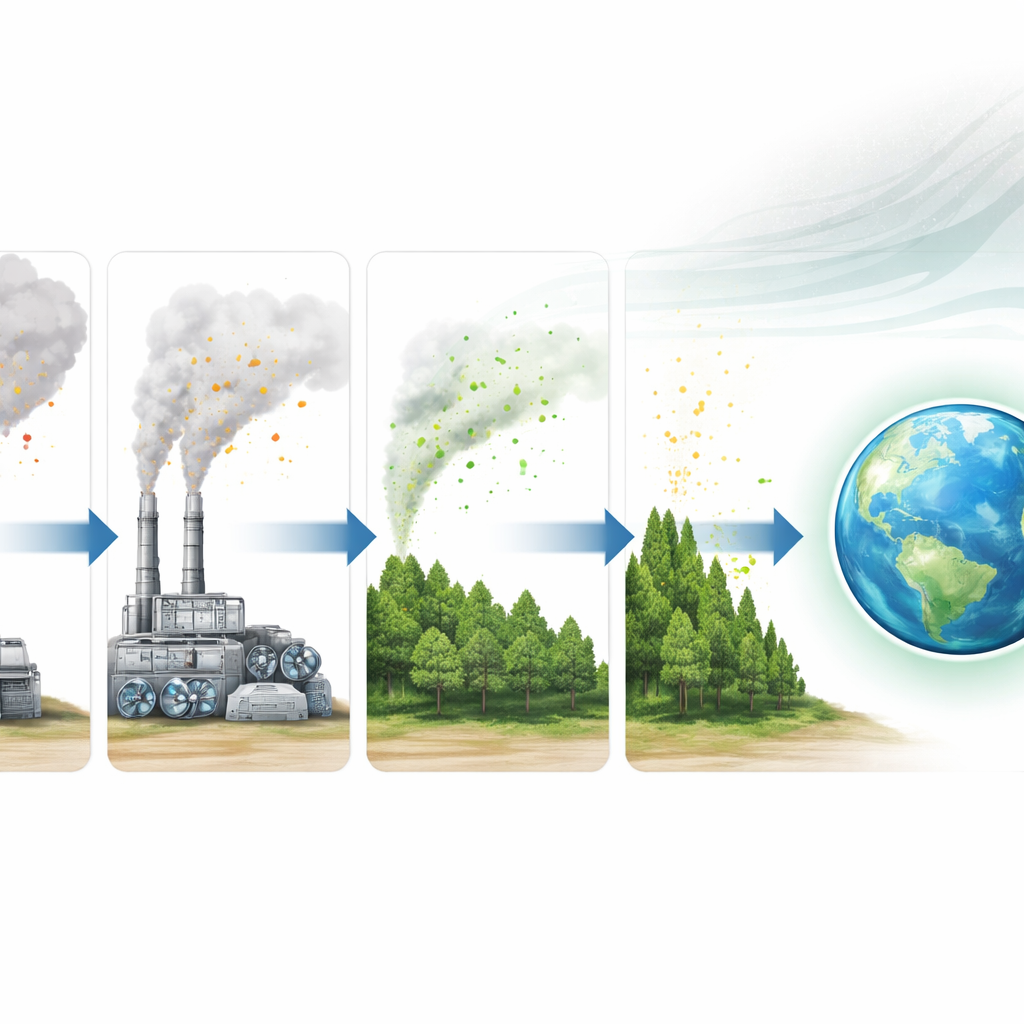
The study concludes that once we admit how little we truly know about the exact workings of the Earth system, responsible climate planning becomes more demanding. Societies need to cut emissions faster, pay more for emitting carbon today, and build durable capacity to remove carbon dioxide from the atmosphere for many decades—not to overshoot temperature limits and then coast back, but to keep the system away from dangerous thresholds in the first place. In this view, negative emissions are a safety net against unwelcome climate surprises, not a license to delay action. The sizeable costs implied by these precautionary strategies also highlight the economic value of better scientific understanding and the need for new financial and governance tools capable of sustaining a net‑negative carbon economy over the long haul.
Citation: Gasser, T., Rezai, A., Cheritel, C. et al. Negative emissions to mitigate Earth system risks. Nat Commun 17, 3212 (2026). https://doi.org/10.1038/s41467-026-69896-x
Keywords: negative emissions, climate risk, carbon removal, climate policy, Earth system uncertainty