Clear Sky Science · en
RORγt+ APCs require a distinct cis-regulatory element to instruct tolerance to dietary antigens
Why Our Guts Stay Calm Around Everyday Food
Every day, our intestines are flooded with proteins from food and trillions of friendly microbes. Yet, for most people, the immune system does not overreact to this constant onslaught. This peaceful state, called oral tolerance, is crucial for avoiding food allergies and chronic gut inflammation. The paper summarized here uncovers a hidden piece of DNA that helps a special group of immune cells teach the body to accept harmless dietary and microbial molecules instead of attacking them.
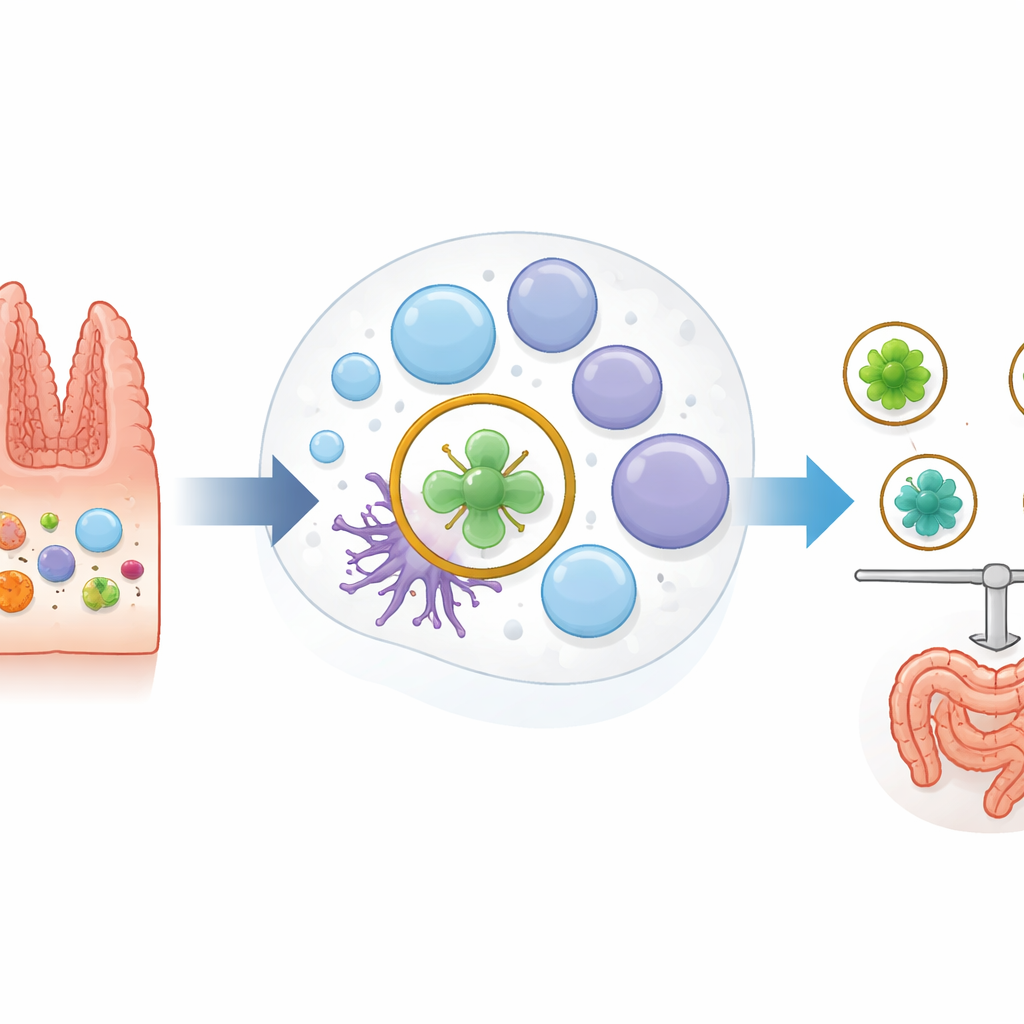
Guardians Living in the Gut’s Neighborhood
Much of the story takes place in and around the small intestine, especially in nearby lymph nodes that drain the gut. There, a family of cells known as group 3 innate lymphoid cells and related antigen-presenting cells act as sentinels. They sample material from food and from friendly bacteria and communicate with helper T cells, which can either fuel inflammation or become peacekeeping regulatory T cells. These sentinel cells share a key control protein, RORγt, that shapes their identity and behavior. Until now, scientists did not fully understand how these RORγt-positive antigen-presenting cells were turned on in just the right way to promote tolerance.
A Tiny DNA Switch with Big Consequences
The researchers used genome-wide maps of open chromatin—the parts of DNA that are accessible and active—to search the Rorc gene, which encodes RORγt, for control regions used specifically by these gut sentinels. They pinpointed a short stretch called OCR369 inside the gene’s first intron that was much more open in gut innate cells than in conventional T cells. Using CRISPR-Cas9 gene editing, they removed OCR369 in mice. Animals lacking this tiny segment showed sharply reduced numbers and activity of RORγt-positive innate lymphoid cells and related antigen-presenting cells in the intestine and its lymph nodes, while classic T cell development in the thymus remained largely intact. This showed that OCR369 acts as a selective switch that boosts RORγt in innate-type gut cells without disturbing T cells broadly.
How the Switch Works Inside Immune Cells
To understand the machinery behind OCR369, the team pulled out proteins that physically bind to this DNA region. They identified RUNX3, a transcription factor already known to be important for innate lymphoid cell development. RUNX3 bound strongly to OCR369 and to the Rorc promoter in these gut cells. Chromosome conformation assays revealed that OCR369 and the main Rorc promoter physically loop together in the nucleus, bringing RUNX3 and other factors into contact with the gene’s start site. In cells missing OCR369, RORγt messenger RNA levels dropped, and the chromatin loop between OCR369 and the promoter was weakened. Taken together, these findings suggest OCR369 functions as an enhancer that, with RUNX3, amplifies RORγt expression to the high levels needed for full development and function of these gut antigen-presenting cells.
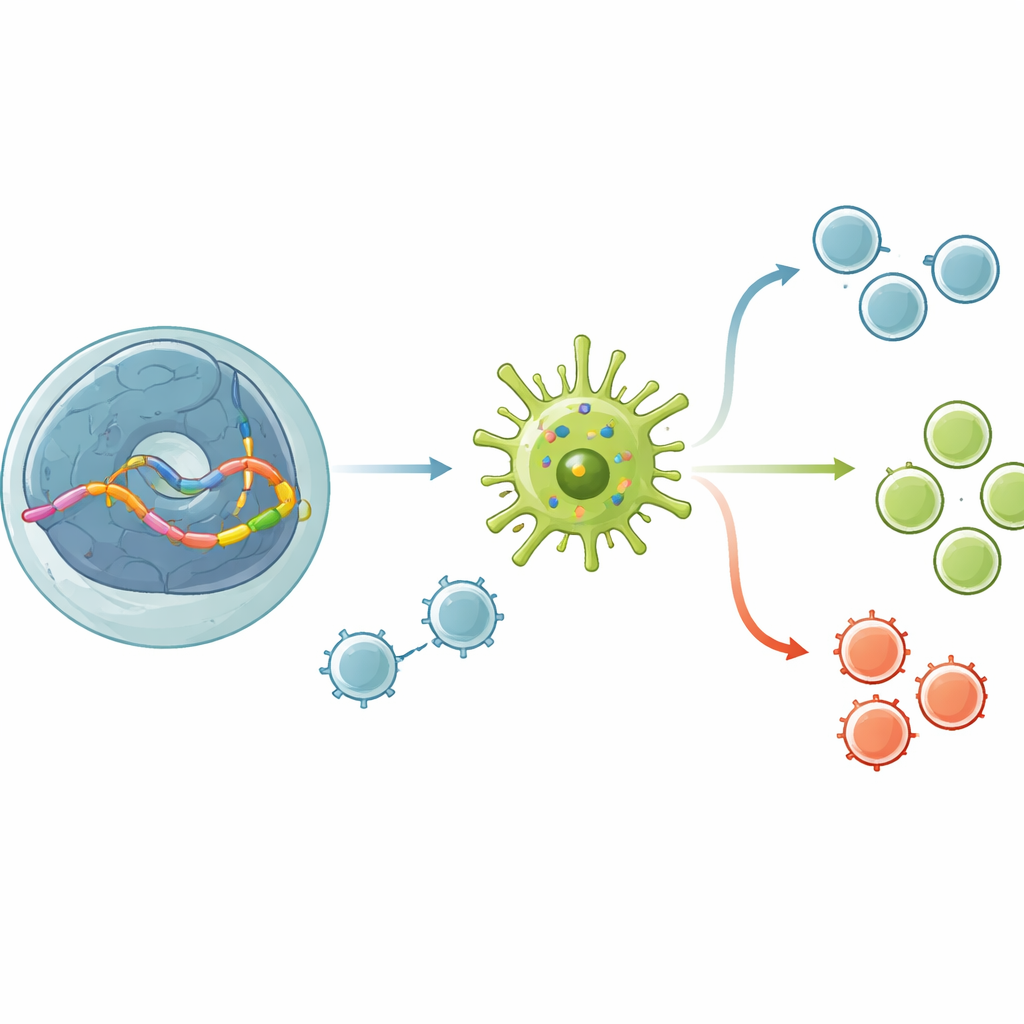
From Broken Tolerance to Allergy and Inflammation
What happens when this enhancer is missing in a living organism? Mice without OCR369 gradually developed changes in their small intestine resembling chronic, low-grade inflammation: elongated gut segments, more mucus-secreting goblet cells and tuft cells, and fibrous tissue buildup. Single-cell RNA sequencing showed that regulatory T cells marked by RORγt were reduced, while inflammatory Th2 and Th17 T cells expanded and produced higher levels of cytokines like IL-4, IL-5, IL-13, and IL-17. When these mice encountered a gut pathobiont bacterium or model food proteins, their antigen-specific T cells failed to become regulatory cells and instead became inflammatory. Experiments in which normal regulatory T cells were transferred back into these mice reversed many of the gut changes, underscoring that the loss of tolerance stemmed from a failure to generate and maintain the right T cell balance.
Why This Matters for Food Allergy and Gut Health
The breakdown of tolerance had direct consequences for allergy risk. In tests that normally induce desensitization to egg protein, OCR369-deficient mice instead developed exaggerated immune swelling, drops in body temperature, and high levels of IgE and IgG1 antibodies—hallmarks of allergic reactions. Blocking either dietary proteins or gut microbes, especially in combination, reduced the inflammatory skew, showing that both food and microbiota drive disease when tolerance fails. Overall, this work reveals that a single, small DNA enhancer, OCR369, is essential for equipping RORγt-positive antigen-presenting cells to turn incoming gut antigens into calming regulatory T cell responses. When this switch is missing, the immune system misreads everyday foods as threats, paving the way to chronic intestinal inflammation and food allergy.
Citation: Zhao, J., Hao, J., Chen, J. et al. RORγt+ APCs require a distinct cis-regulatory element to instruct tolerance to dietary antigens. Nat Commun 17, 3019 (2026). https://doi.org/10.1038/s41467-026-69886-z
Keywords: oral tolerance, gut immune cells, regulatory T cells, food allergy, intestinal inflammation