Clear Sky Science · en
Thin film lithium niobate on sapphire for integrated mid-infrared modulator
Why shaping invisible light matters
The mid‑infrared part of the light spectrum is invisible to our eyes, yet it is packed with information about gases, pollutants, and even our breath. It also slips through the atmosphere more easily than many other colors of light, making it attractive for secure, high‑speed wireless links through air. To fully tap this region, engineers need compact chips that can rapidly turn mid‑infrared light on and off or sculpt it in time and color. This paper reports a key missing building block: an integrated mid‑infrared modulator built from a special crystal, lithium niobate, bonded onto sapphire.

Light beyond what our eyes can see
Mid‑infrared light, stretching from about 3 to 14 micrometers in wavelength, is a sweet spot for both sensing and communication. Many important molecules—from greenhouse gases to industrial chemicals—have very strong absorption fingerprints there, allowing highly sensitive detection. At the same time, air is relatively transparent at certain mid‑infrared windows, with less scattering from dust and reduced distortion from turbulence. Scientists already have powerful lasers and detectors for this range, but the devices that actually imprint data or measurement signals onto the light—known as modulators—have lagged behind, often being bulky, lossy, or too slow.
Limits of existing mid‑infrared tools
Current approaches typically rely on directly driving mid‑infrared lasers or on chip technologies that absorb too much light. Quantum cascade and interband cascade lasers can be modulated quickly, but their internal physics ties phase and brightness together and demands large electrical swings, limiting modulation depth and efficiency. Other integrated platforms based on semiconductors like germanium or silicon can reach longer wavelengths, yet they suffer significant loss because the same charge carriers that enable control also absorb light. Even thin‑film lithium niobate devices—which have transformed near‑infrared telecom optics—are blocked in the mid‑infrared by an absorbing glass layer under the crystal. As a result, no existing integrated device had simultaneously offered low loss, high speed, strong contrast between “on” and “off,” and operation deep into the mid‑infrared.
A new chip built on sapphire
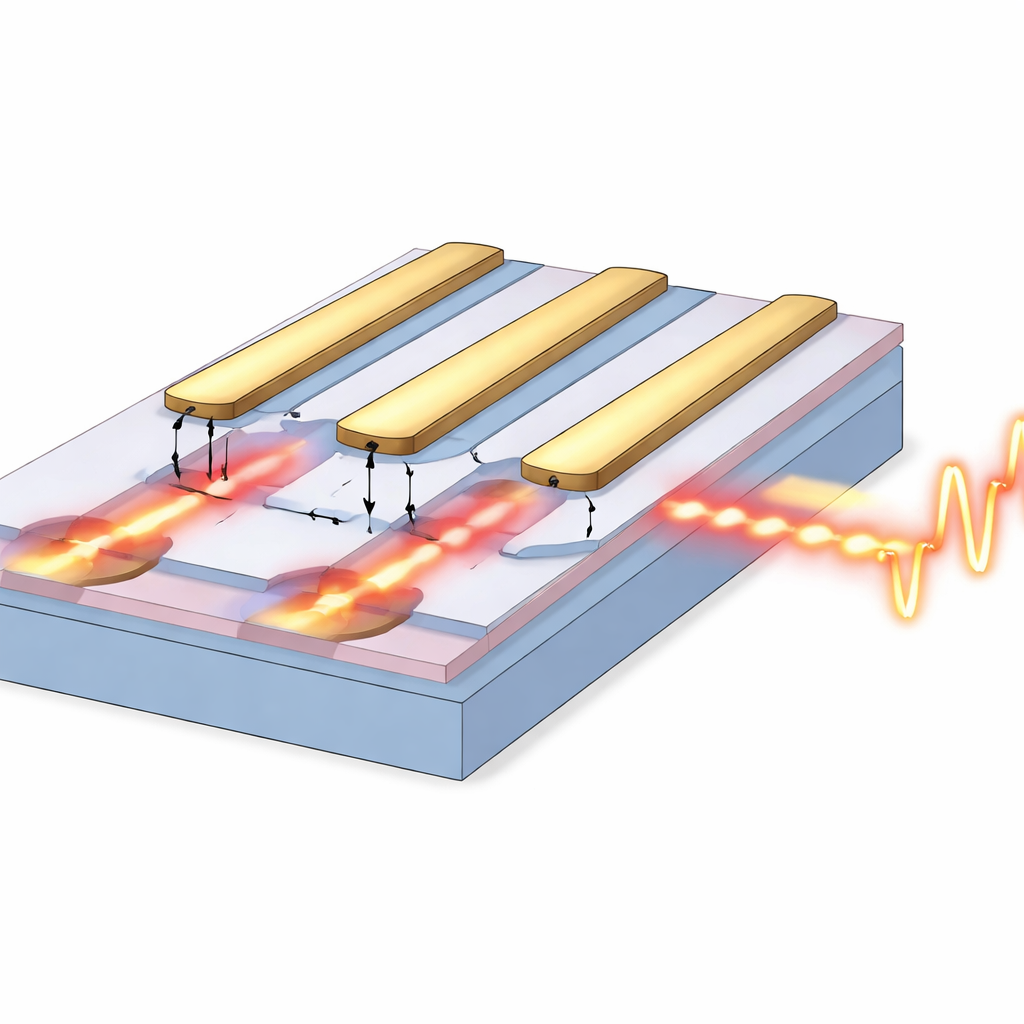
The authors solve this by placing a thin film of lithium niobate on a sapphire base instead of the usual glass. Sapphire is transparent up to about 4.5 micrometers and has good thermal and radio‑frequency properties. On this platform, they carve waveguides—the tiny tracks that guide light—and arrange them in a Mach–Zehnder interferometer layout, where light is split into two paths and then recombined. Gold electrodes run alongside the paths so that an applied voltage slightly changes the crystal’s refractive index via the Pockels effect, shifting the phase of the light in each arm. When the beams meet again, these small phase shifts translate into large changes in output brightness through interference. The team carefully optimizes film thickness, waveguide geometry, and electrode spacing to balance strong modulation against added loss from metal and rough edges.
Fast, clean control of mid‑infrared beams
On this sapphire‑based chip, the researchers demonstrate amplitude modulation around a wavelength of 4 micrometers, with operation spanning 3.95 to 4.5 micrometers—about half a micrometer of tuning range. The device reaches a 3‑decibel electrical bandwidth above 20 gigahertz, meaning it can switch light tens of billions of times per second, and shows a high extinction ratio of about 17 decibels, giving a clear difference between bright and dim states. The voltage–length product (a standard efficiency metric) is 22 volt‑centimeters, competitive for this difficult wavelength region. They use the device to send 10‑gigabit‑per‑second data through half a meter of air with a clean eye diagram and to create a mid‑infrared frequency comb—a spectrum made of many evenly spaced lines—stretching about 70 gigahertz wide, purely through electrical modulation on chip.
What this means for real‑world uses
To a non‑specialist, the key takeaway is that the authors have shown it is possible to build a compact, integrated “light dimmer and shaper” for mid‑infrared beams that is fast, relatively low loss, and compatible with realistic optical powers. While the device still needs fairly high drive voltages and losses grow at the longest tested wavelengths, the work proves that thin‑film lithium niobate on sapphire can host practical mid‑infrared modulators. With further refinements—such as resonant designs to lower operating voltage and improved fabrication to cut loss—this platform could underpin future chip‑scale sensors, environmental monitors, and free‑space communication links that use invisible infrared light to see what molecules are present and to move data through the air with high speed and resilience.
Citation: Didier, P., Jain, P., Bertrand, M. et al. Thin film lithium niobate on sapphire for integrated mid-infrared modulator. Nat Commun 17, 3050 (2026). https://doi.org/10.1038/s41467-026-69880-5
Keywords: mid-infrared photonics, electro-optic modulator, lithium niobate, spectroscopic sensing, free-space optical communication