Clear Sky Science · en
Structureless excitation and manipulation of dynamic holographic plasmonic slides
Light on a Tiny Playground
Imagine a light-powered slide so small that only nanoparticles can ride it. This paper describes a way to draw such "slides" directly on a smooth metal surface using light alone, with no etched grooves or tiny built-in structures. These invisible tracks can grab microscopic particles and carry them along winding paths, opening doors to future lab-on-a-chip devices, miniature conveyer belts, and ultra-compact tools for handling cells or molecules.
Waves That Hug a Surface
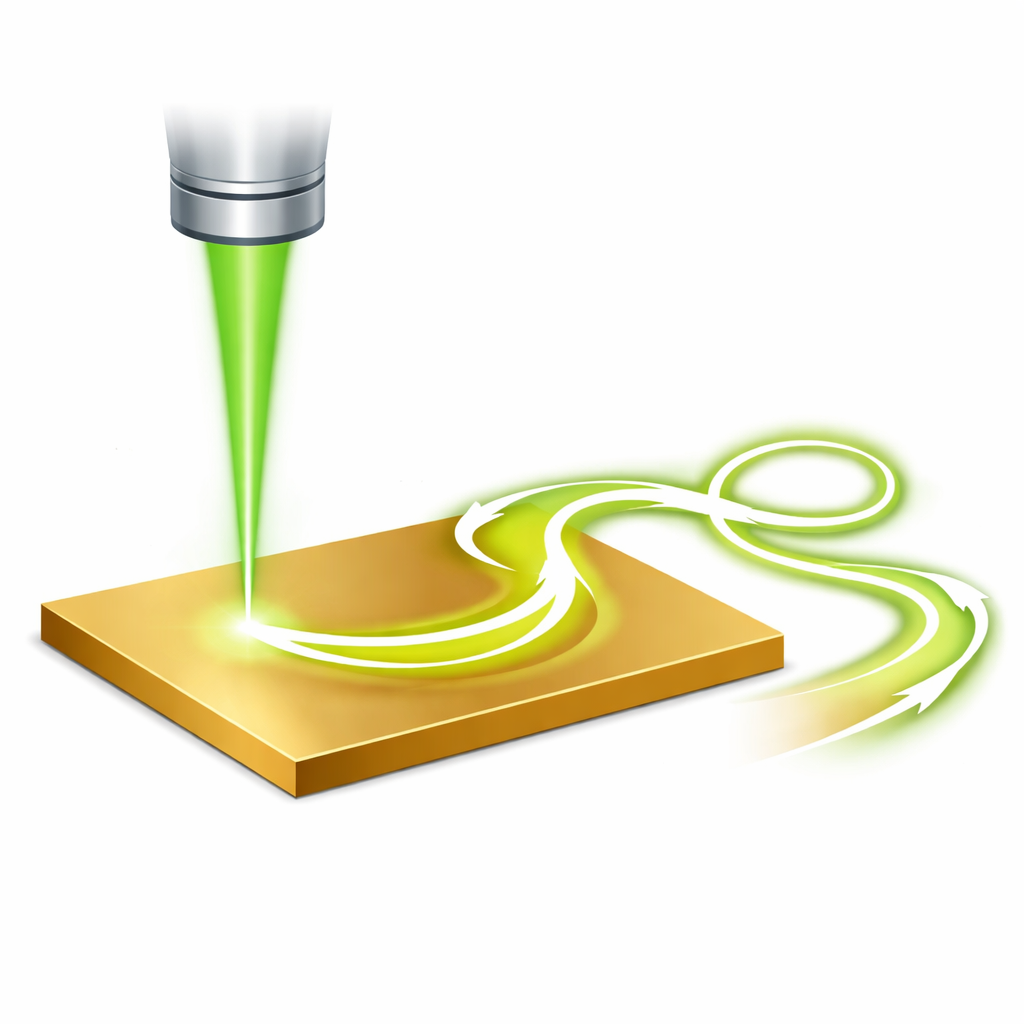
At the heart of this work are special waves called surface plasmons—ripples of electrons and light that cling tightly to a metal surface. Because they stay close to the surface and have very short wavelengths, they can pack light into spaces far smaller than a human hair. This makes them valuable for sensing, imaging, and trapping tiny objects. Traditionally, however, engineers have had to carve complex nanoscale patterns into metals to shape these waves, much like cutting riverbeds into rock. Those fixed structures create unwanted background light, waste energy, and cannot be easily reconfigured once fabricated.
Drawing Tracks with Light Instead of Etching Metal
The authors introduce a "structureless" way to sculpt these surface waves on a flat gold film. Instead of relying on rigid nanostructures, they carefully design the incoming laser beam so that, after being focused by a high-quality microscope objective, it naturally converts into a chosen pattern of surface waves. A reverse-design algorithm works backward from the desired pattern on the metal—an oval, arc, spiral, or more exotic shape—and calculates how the light’s brightness and phase must vary across the beam. This tailored pattern is then imprinted onto the laser using a spatial light modulator, a pixelated device that acts like a programmable hologram.
Cleaner, Stronger, and More Flexible Waves
Computer simulations and experiments show that this holographic approach excites the designed plasmon patterns more cleanly and efficiently than earlier structure-based methods. When the same spiral-shaped wave is generated with a cut ring in the metal, the rigid slit fixes the position, makes alignment finicky, and produces strong diffraction that muddies the background. In contrast, the structureless method forms a near-identical spiral with less noise and about 50 percent better coupling of light into the surface wave, all without any etched features. Because nothing is carved into the metal, the pattern can be moved or reshaped simply by updating the hologram, giving a high degree of freedom in both where and how the waves appear.
Turning Plasmon Tracks into Nano Slides
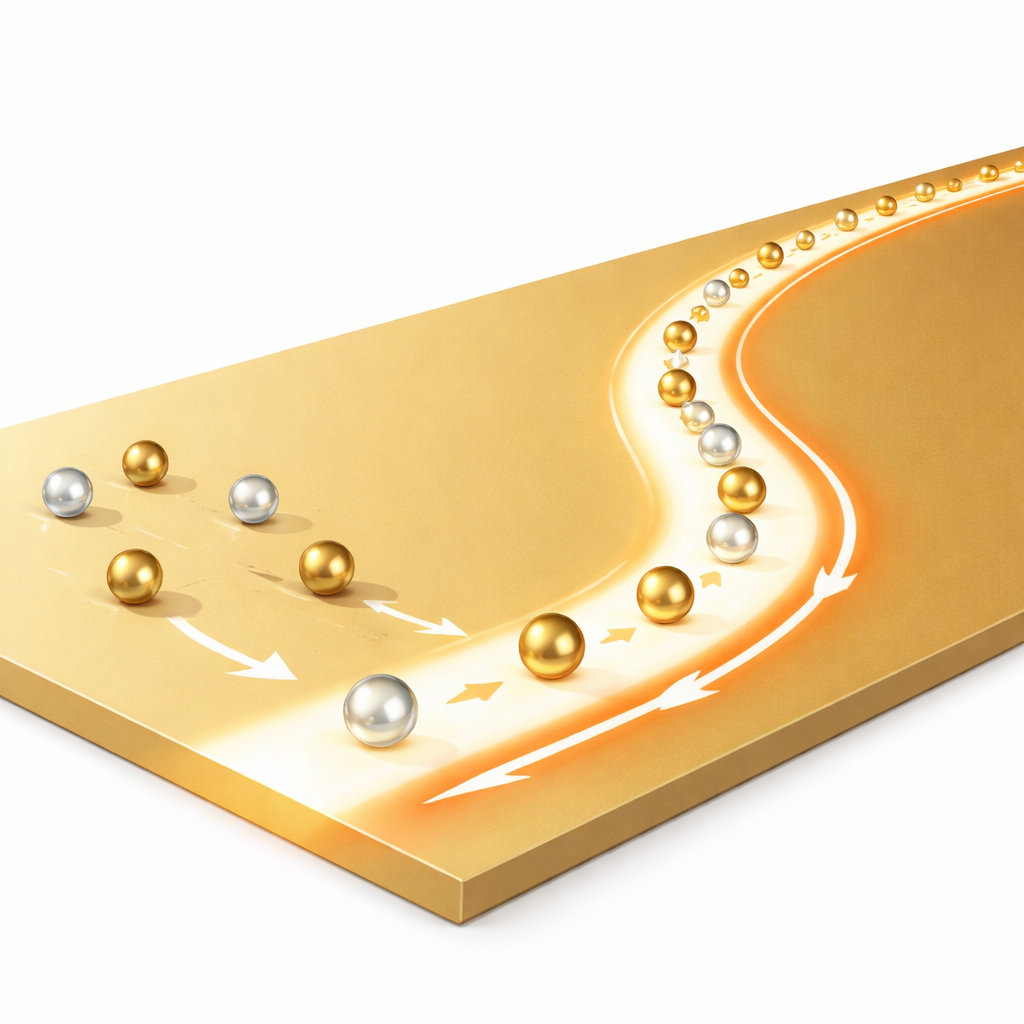
The team goes beyond static light patterns to control how energy flows along them. By giving the incoming beam a twisted phase, they load orbital angular momentum into the surface wave, causing the energy to stream along the curved path like water around a loop. Tiny gold or glass spheres floating in liquid above the metal feel two main forces: one pulls them into the bright track, and the other pushes them along the direction of energy flow. In experiments, single particles are first trapped on the luminous path and then carried along ovals, spirals, and even letter-shaped routes, closely following the designed plasmon tracks like children sliding along a glowing playground slide.
Shaping Moving Paths on Demand
Because the system is driven entirely by programmable light, the authors also demonstrate dynamic combinations of tracks. By switching between two simple patterns in time—such as arcs that together form a heart, or S-shaped paths that trace an infinity symbol—the time-averaged effect is a more intricate route. Particles are successfully guided along these composite trajectories, showing that complex journeys can be built from a sequence of simpler slides. This strategy greatly enhances the ability to route microscopic objects across a chip in a controlled and reconfigurable way.
What This Means for Tiny Machines
In practical terms, this research shows that you can shape and steer light-bound surface waves on a smooth metal surface with high precision, using only software-controlled holograms. The resulting tracks are clean, efficient, and easily reprogrammed, and they can act as tiny conveyor belts for nanoparticles and other small objects. Such "structureless" plasmonic slides could become key components in future on-chip laboratories, where light not only senses and processes information but also physically moves materials along designed paths without the need for mechanical parts.
Citation: Zhang, Y., Ma, H., Ju, Z. et al. Structureless excitation and manipulation of dynamic holographic plasmonic slides. Nat Commun 17, 2946 (2026). https://doi.org/10.1038/s41467-026-69879-y
Keywords: surface plasmons, optical tweezers, holographic beam shaping, nanoparticle transport, on-chip photonics