Clear Sky Science · en
High-throughput chiral copper foils by curved-surface confinement recrystallization
Twisting Metal for a World of Left and Right
Many of life’s most important molecules come in left- and right-handed forms that behave differently in the body. Technologies that can tell these twins apart are vital for making safer medicines, smarter sensors, and next-generation electronics. This study shows how to mass-produce copper metal surfaces that themselves are left- or right-handed, using nothing more exotic than heat and a carefully curved tube. The result is a simple route to “handed” metal foils that can steer chemical reactions and even imprint their twist onto atom-thin materials like graphene.
Why Handed Metal Matters
In chemistry and biology, handedness—known as chirality—can decide whether a drug heals or harms. Solid metal surfaces that are subtly asymmetric can favor one hand of a molecule over the other, making them valuable for catalysts, sensors, and devices that manipulate electron spins. Until now, these special metal surfaces have been hard to make in large, uniform pieces. Existing methods often rely on chiral molecules as templates or produce tiny particles whose surfaces are difficult to control and reproduce. Industry needs a way to make broad, continuous metal sheets with well-defined handed surfaces, quickly and reliably.
Bending Copper to Rebuild Its Inner Structure
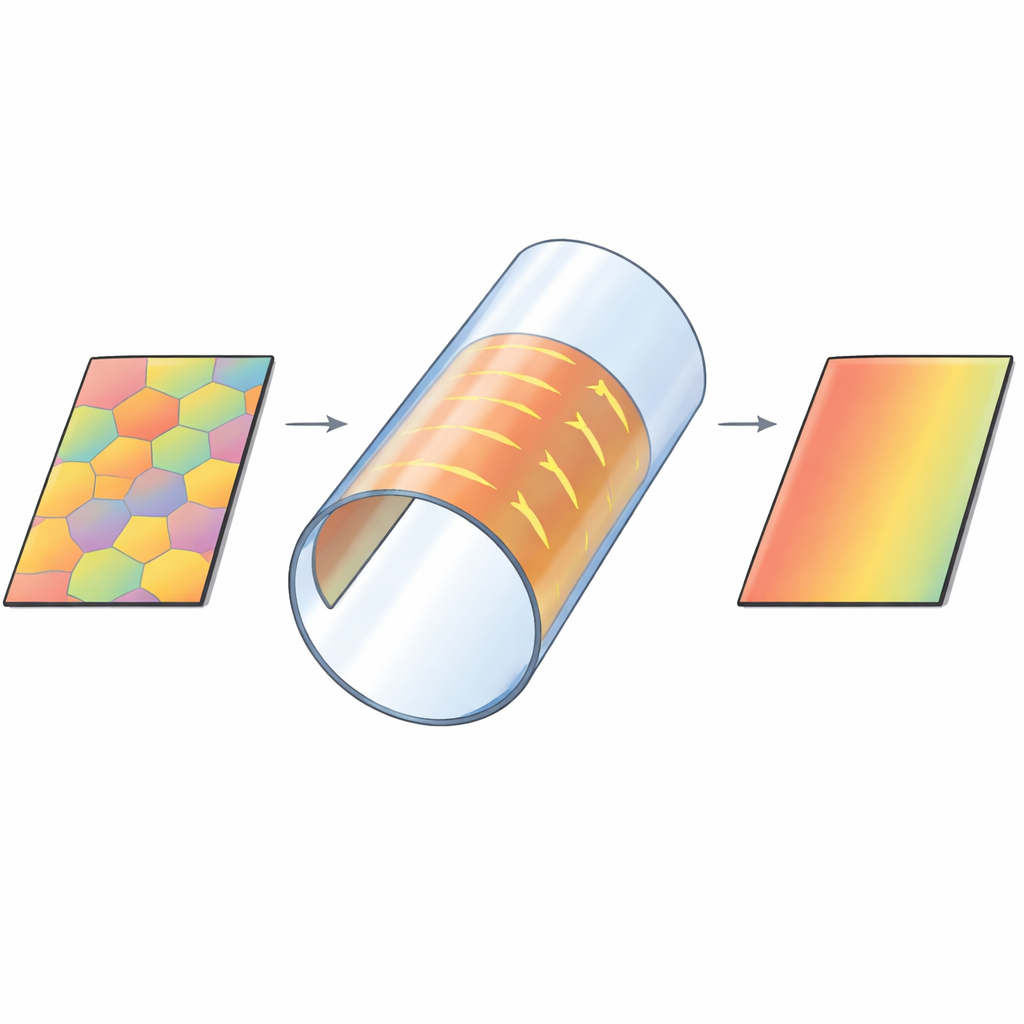
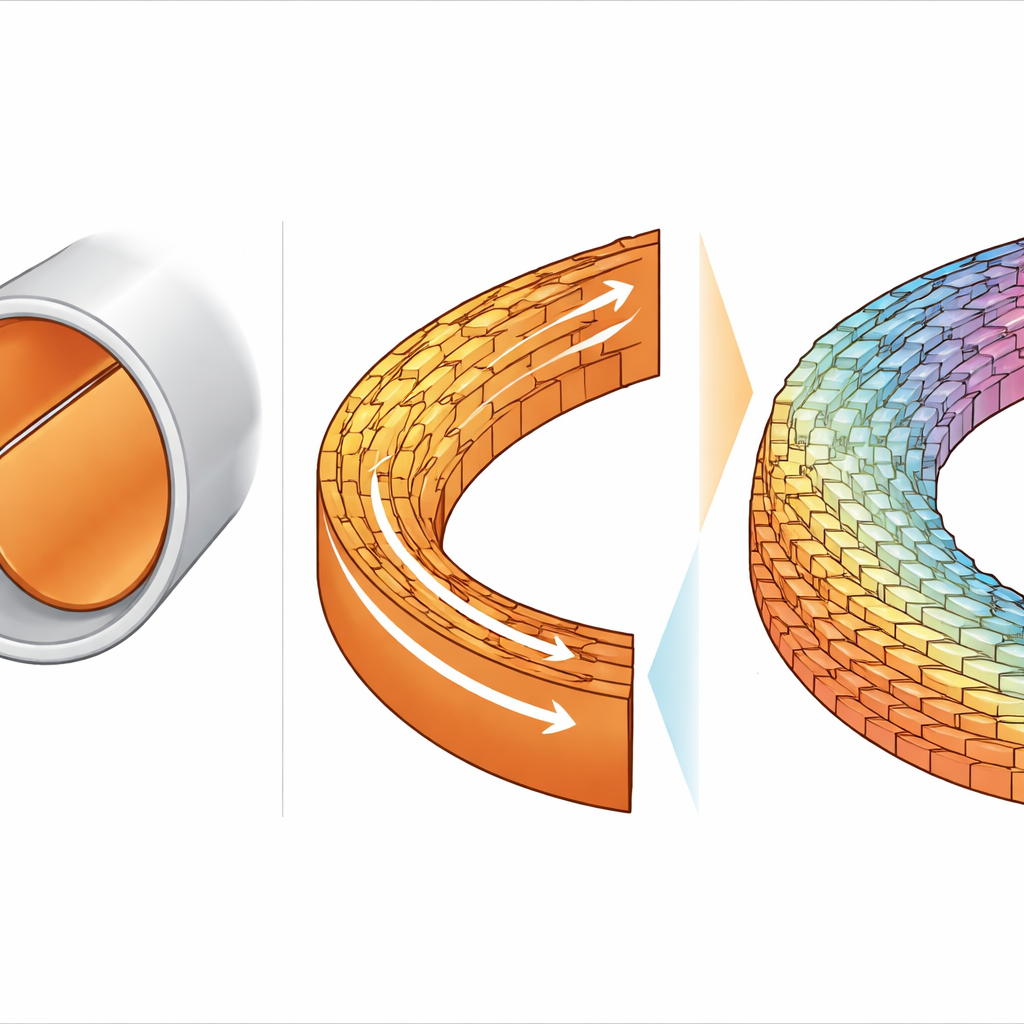
The authors discovered that simply bending a sheet of copper inside a curved quartz tube and heating it to high temperature triggers a remarkable internal reorganization. At first, the foil is made of many small crystal grains, each with a different orientation. Under curved confinement and heat, a few favored grains grow abnormally large and sweep through the foil. Because the foil must follow the tube’s arc, these growing crystals gradually rotate as they expand, creating a single, continuous crystal whose surface orientation changes smoothly from one side to the other. When the foil is later flattened, this rotation appears as a gentle gradient across the sheet, which can even be seen as a changing color pattern after light surface oxidation.
Tuning Curvature to Program Handedness
By systematically changing how strongly the foil is bent—using tubes of different diameters—the team showed that the angle over which the surface orientation rotates can be dialed in with precision. Stronger curvature produces steeper orientation gradients; weaker curvature approaches a uniform single crystal. Detailed electron diffraction measurements confirmed that the entire thickness of the foil shares this controlled gradient, not just the top layer. Atomic-scale models and microscopy further revealed that as one moves across the surface, the arrangement of atomic steps switches smoothly from left-handed to right-handed patterns, with regions in between showing intermediate degrees of chirality. In other words, a single curved-annealed foil becomes a built-in library of many chiral surfaces, all stitched together without grain boundaries.
From Master Foils to Custom Surfaces and Chiral Graphene
The gradient foils are more than curiosities; they serve as master templates. Small pieces cut from any chosen position act as “seeds” that can regenerate large single-crystal foils with that exact surface orientation when placed on ordinary copper and re-annealed. This turns one gradient experiment into a source of many tailored, handed surfaces. The researchers also used the gradient foil as a growth platform for graphene. They found that the shape and orientation of graphene flakes varied predictably along the gradient, mirroring the changing surface chirality of the copper beneath. Spectroscopic tests showed that the edges of these graphene grains carry chiral character, indicating that the metal’s handedness can be transferred to an atomically thin overlayer.
Handed Copper as a Working Catalyst
To test whether these surfaces can truly distinguish left from right in real chemistry, the team used a chiral copper foil to catalyze the oxidation of a common chiral alcohol. Compared with an otherwise similar but non-chiral copper surface, the chiral foil left behind an excess of one molecular hand, demonstrating genuine asymmetric catalytic behavior. While the degree of selectivity in this first demonstration is modest, it provides direct proof that the built-in twist of the copper surface can bias a chemical reaction without any added chiral molecules.
A Scalable Route to Designer Twists
The work establishes curved-surface confinement recrystallization as a powerful and scalable way to “program” the orientation and handedness of metal foils. By adjusting the geometry of the confining tube or cone and choosing suitable starting grains, manufacturers could generate nearly any desired surface orientation—and therefore chirality—across large areas. Such designer copper foils could speed the discovery of chiral catalysts, enable roll-to-roll fabrication of chiral membranes and electronics, and provide versatile platforms for growing chiral two-dimensional materials. For non-specialists, the key message is that a simple act of bending and heating metal can encode a controllable twist into its very surface, opening new possibilities wherever left and right matter.
Citation: Huang, D., Li, Z., Duan, Y. et al. High-throughput chiral copper foils by curved-surface confinement recrystallization. Nat Commun 17, 2796 (2026). https://doi.org/10.1038/s41467-026-69862-7
Keywords: chiral copper surfaces, curved annealing, single-crystal metal foils, chiral catalysis, graphene epitaxy