Clear Sky Science · en
Transforming disorder in the design of advanced high-entropy oxide electrocatalysts for zinc-air batteries
Turning Disorder into an Energy Advantage
Rechargeable zinc–air batteries are attractive for powering everything from electric cars to grid storage because they are safe, inexpensive, and use abundant zinc and oxygen from air. Yet their cathodes—the part of the battery that handles oxygen—have been too sluggish and too fragile, often relying on scarce noble metals like platinum and iridium to work well. This paper shows how embracing, rather than eliminating, atomic "messiness" in oxide materials can create a new kind of robust, efficient cathode that pushes zinc–air batteries closer to real-world use.
Why Zinc–Air Batteries Need Better Cathodes
In a zinc–air battery, two complementary reactions must run smoothly: one takes in oxygen from air while the battery discharges, and the other releases oxygen while it charges. Commercial designs usually split this job between different catalysts, or depend on noble metals, which drives up cost and limits durability. Oxide materials based on cerium (ceria) are chemically stable and can shuffle oxygen around, but in their usual, well-ordered form they conduct electricity poorly and have few truly active sites for these reactions. The challenge is to turn this sturdy but rather inactive oxide into a single, low-cost material that can handle both oxygen reactions efficiently and repeatedly.
Building a Purposefully Disordered Material
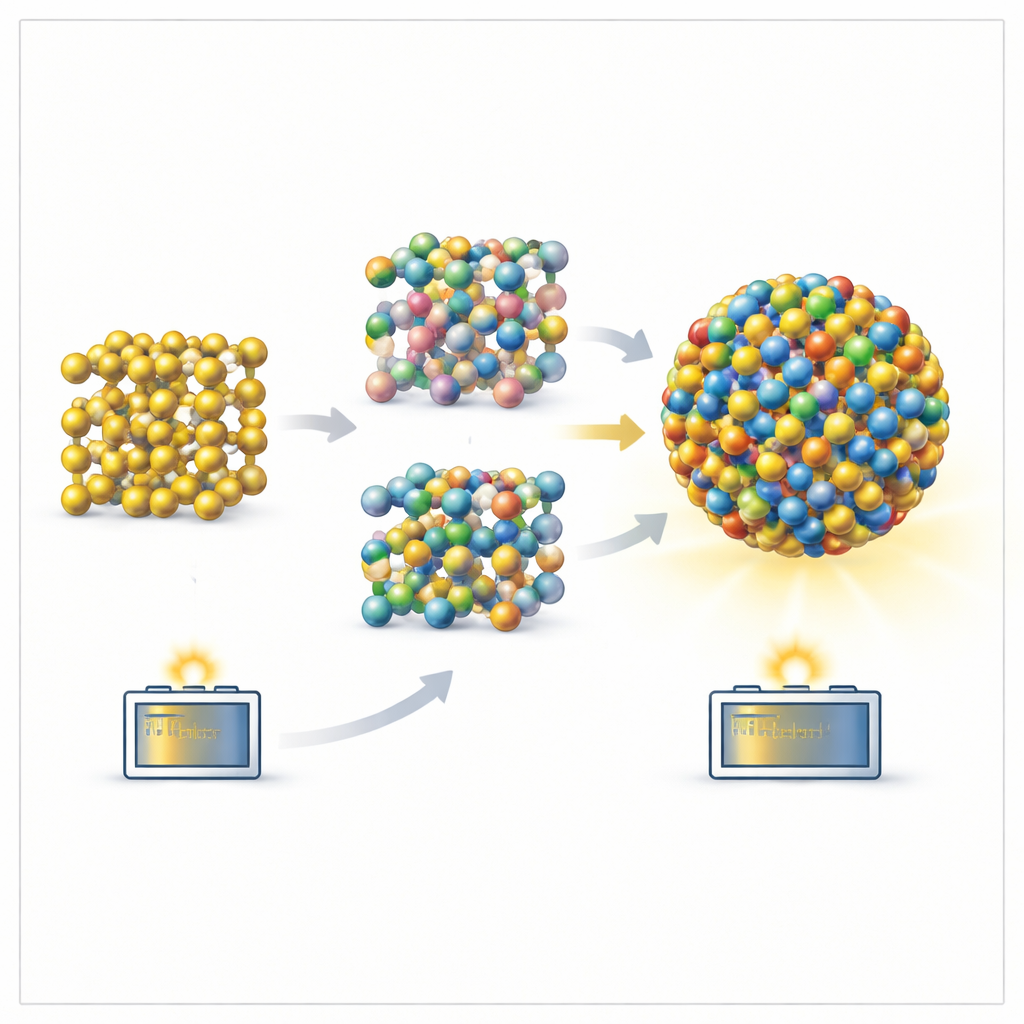
The researchers tackled this by creating a "high-entropy oxide"—a solid that mixes many different metal atoms into one uniform crystal. Starting from pure ceria, they progressively added manganese, nickel, cobalt, and finally iron into the lattice. As more metals were introduced, the crystal did not break into separate chunks; instead, it became a single, highly mixed phase where different-sized and differently charged atoms jostle for space. Detailed imaging and diffraction measurements show that once five metals are present, the lattice develops dense networks of extended defects such as stacking faults and dislocations, along with clusters of missing oxygen atoms. This is not random damage: it is a controlled, multilevel disorder that reshapes the structure from the atomic scale up.
From Insulator to Fast Conductor
These structural changes go hand in hand with a radical shift in how electrons move through the material. In pure ceria, electrons are localized and the material behaves like a typical semiconductor with a significant energy gap, which slows charge transport during battery operation. In the five-metal oxide, measurements and simulations reveal a much narrower gap and signatures of semimetallic behavior, where electrons can move more freely. Electron spin spectroscopy shows a surge of mobile, "unpaired" electrons spread across the surface, while tunneling experiments record over a hundredfold jump in current compared with pure ceria. In effect, the engineered disorder turns a reluctant conductor into a nearly metallic network that can funnel charge quickly to and from the reactive sites.
Creating Powerful Atomic-Scale Hotspots
At the heart of the new catalyst are cerium atoms in unusually low coordination—surrounded by fewer oxygen neighbors than in the perfect crystal. Advanced X-ray analyses show that in the high-entropy oxide, the single, symmetric cerium–oxygen environment of pure ceria splits into several distinct, distorted bond lengths, and the average number of surrounding oxygens drops. These under-coordinated cerium sites, enriched in a more easily oxidized form of cerium, provide open "hooks" for grabbing oxygen- and hydroxide-containing species during the battery reactions. Calculations of reaction pathways confirm that these cerium centers have the lowest energy barriers for the key steps in both oxygen evolution and oxygen reduction, while the other metals mostly act as electronic helpers that tune charge flow and stabilize the structure rather than serving as the main reaction seats.
Better Zinc–Air Batteries in Practice
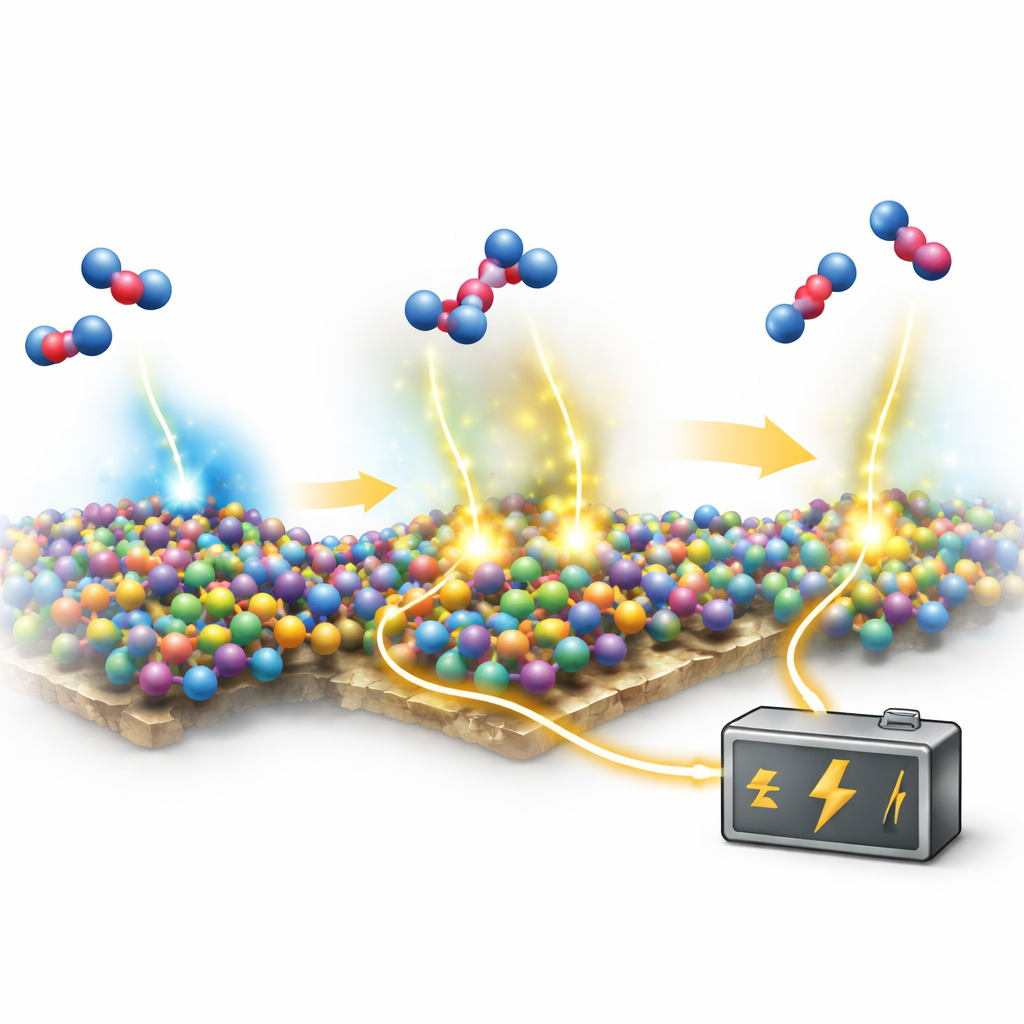
When used as the cathode in a real zinc–air battery, the high-entropy oxide dramatically outperforms both simpler ceria-based materials and conventional noble-metal benchmarks. It drives oxygen evolution at lower voltages than commercial iridium oxide and supports fast oxygen reduction with kinetics rivaling platinum on carbon, despite having a smaller electrochemically active surface area. The battery built with this disordered oxide delivers high specific capacity, strong power output, and can cycle for hundreds of hours with minimal performance loss—far exceeding the lifetime of a cell using platinum and iridium. Notably, the main failure point in long tests is the zinc anode corroding away, not the new cathode, which remains structurally and electronically stable.
What This Means for Future Energy Storage
To a non-specialist, the key message is that "disorder" at the atomic level can be a design feature, not a flaw. By carefully mixing multiple metals into ceria, the authors create a solid whose tangled lattice, rich in oxygen vacancies and distorted bonds, unlocks fast electron transport and numerous highly active cerium sites. This multilevel disorder enables a single, noble-metal-free material to handle both sides of the oxygen chemistry in zinc–air batteries with high efficiency and durability. The work offers a blueprint for using controlled atomic chaos to engineer better catalysts, potentially impacting not only metal–air batteries but a broad range of clean energy technologies.
Citation: Zheng, X., Mofarah, S.S., Webster, R.F. et al. Transforming disorder in the design of advanced high-entropy oxide electrocatalysts for zinc-air batteries. Nat Commun 17, 3082 (2026). https://doi.org/10.1038/s41467-026-69849-4
Keywords: zinc-air batteries, high-entropy oxides, electrocatalysts, ceria-based materials, oxygen reactions