Clear Sky Science · en
Nanoporosity-driven deformation of additively manufactured nano-architected metals
Tiny Metal Structures with Big Potential
Imagine building a skyscraper out of strands as thin as viruses, then squeezing it to see how and where it breaks. This study does something similar with nickel, a common metal, but built into intricate three-dimensional nano-architectures a thousand times thinner than a human hair. The work matters because it shows how to reliably 3D-print metals at these extreme scales and explains why such tiny structures can be both remarkably strong and surprisingly vulnerable in specific spots.
Why Small Metal Structures Behave Differently
At everyday scales, metals behave in ways engineers understand well. But when their key features shrink down to about 10–100 nanometers, familiar rules start to fail. In this regime, the size of the structural elements, the fine crystal grains inside the metal, and the tiny defects like pores all become comparable. The authors point out that we can no longer pretend there is a clean separation between “microstructure” inside the material and “structure” at the device level. Instead, what happens in each slender beam or thin shell directly controls how the entire miniaturized object responds when pushed, pulled, or bent.
Building Metals Like Nanoscale Architecture
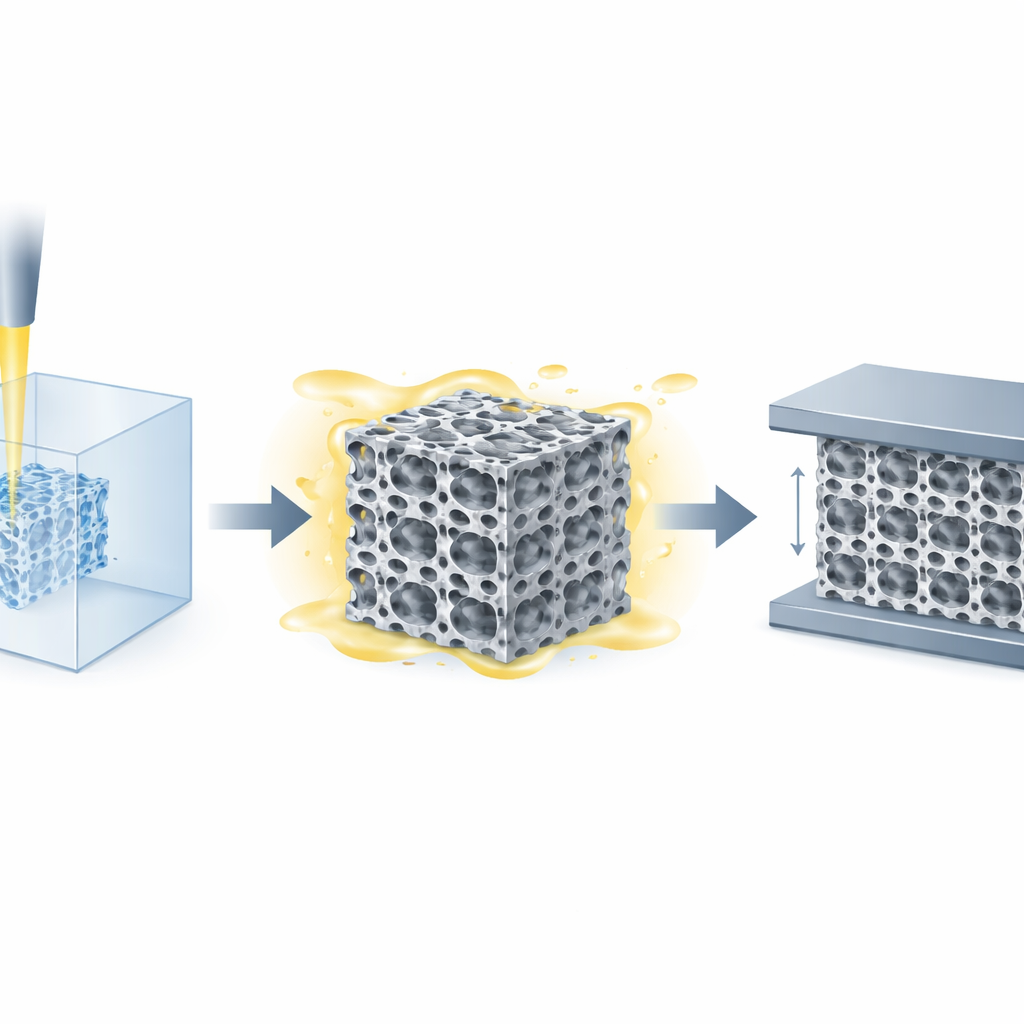
To explore this new regime, the researchers developed a nanoscale additive manufacturing approach called nano-HIAM that combines two-photon lithography—a kind of 3D laser writing in a soft material—with a hydrogel infusion process. First, they use a focused laser to draw a delicate polymer scaffold in three dimensions. This soft, patterned template is then soaked in a nickel-containing solution, dried, and heated in controlled steps so that the polymer burns away and nickel remains in its place. The result is a metal version of the original design, with beams and shells only hundreds of nanometers thick and surfaces smoothed down to just tens of nanometers. Using this method, they created several types of structures, including orderly lattices and more random, foamlike networks, all made of nanocrystalline, nanoporous nickel.
Putting Nano-Architected Metals to the Test
The team then compressed these nickel nano-architectures inside a scanning electron microscope, essentially watching them fail in real time while recording how much stress they could withstand. Most samples showed a clear pattern: they carried load elastically, sometimes with small jumps linked to minor defects, and then underwent a sudden, catastrophic collapse. Despite their fragility in appearance, many reached very high “specific strengths”—strength divided by weight—on the order of 10–100 megapascals per gram per cubic centimeter. This performance rivals or exceeds much larger metal lattices made by conventional 3D printing, even though these new structures are thousands of times smaller. The researchers also compared regular, repeating lattices with more disordered, spinodal-like geometries and found that the latter tended to fail in a more distributed, less defect-dominated way.
Hidden Voids Decide Where Failure Starts
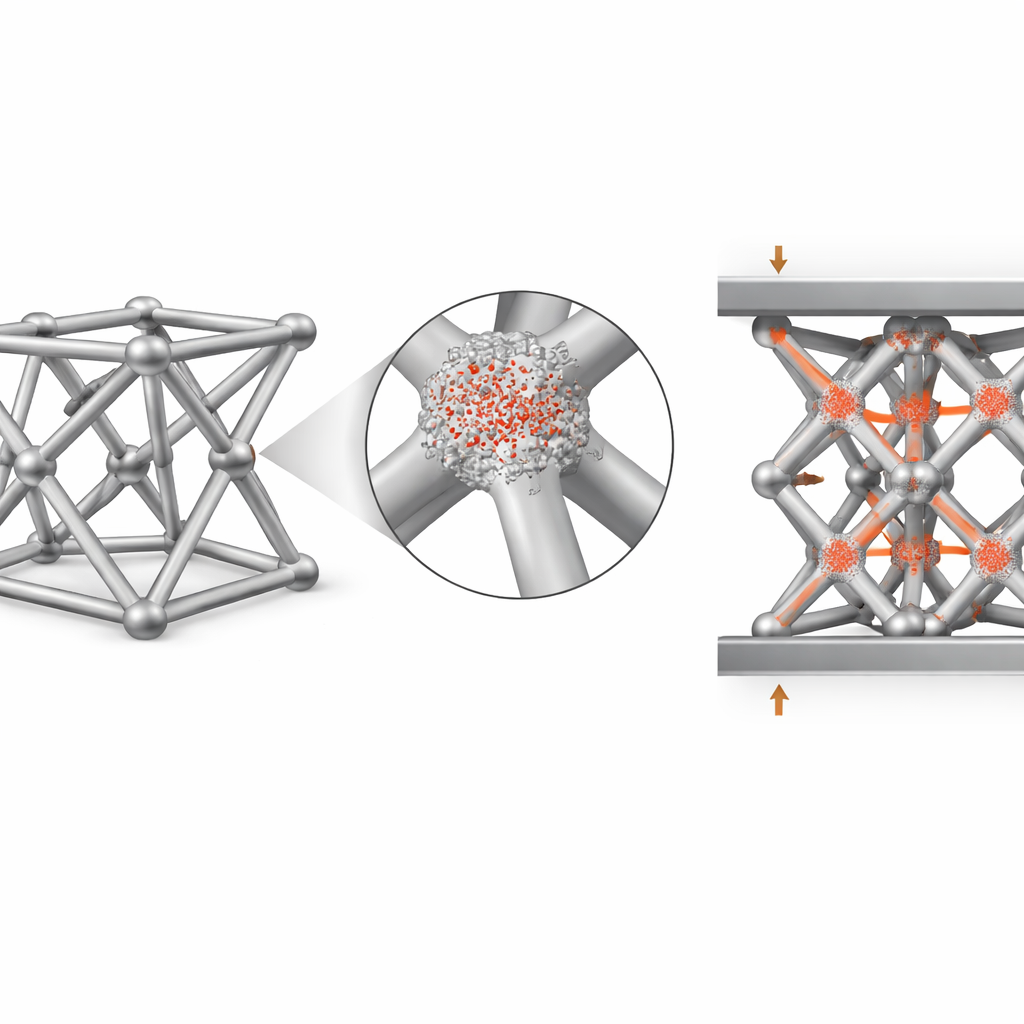
To understand why feature size matters so much, the authors examined cross-sections of the lattices and the behavior of individual nano-sized pillars made by the same process. They found that, at very small feature sizes, strength is governed largely by how dislocations—tiny defects that allow metals to deform—move within the nanocrystalline structure. As the beams and shells grow thicker, however, another effect takes over: concentrated clusters of nanometer-scale pores accumulate at the junctions where beams meet. These nodal regions become significantly weaker than the relatively cleaner beam segments. Statistical analysis shows that larger structures tend to host more and larger pore clusters at their nodes, and mechanical testing reveals a transition from a regime where the material’s internal structure controls behavior to one where these pores dominate and sharply reduce strength.
Simulations that Bridge Scales
To tie experiment and theory together, the team built computer models that incorporated both the measured response of the nano-sized building blocks and the observed distributions of pores. Finite-element simulations of unit cells and full lattices reproduced key features seen in the experiments: stress concentrating around nodal junctions, localized plastic deformation where pores cluster, and sudden global collapse initiated from a few weak spots. By adjusting how strongly the nodal regions were degraded—either uniformly according to pillar data or randomly according to the measured pore statistics—the simulations successfully predicted how overall strength scales with feature size and density for different architectures.
What This Means for Future Tiny Machines
For a non-specialist, the main takeaway is that 3D-printed metal structures at the nanoscale can be both extraordinarily strong and finely tunable, but only if we understand and control their hidden porosity. The study shows that “where the holes are” inside a tiny lattice can matter more than how perfect the metal is elsewhere, and that these defects are closely tied to the printing process and feature size. By revealing how nanoporosity drives deformation and failure, and by marrying careful experiments with physics-informed simulations, this work lays the groundwork for designing reliable nano-architected metals for future technologies—from ultralight mechanical components and tiny sensors to nanorobots and advanced medical devices.
Citation: Zhang, W., Li, Z., Gao, H. et al. Nanoporosity-driven deformation of additively manufactured nano-architected metals. Nat Commun 17, 3279 (2026). https://doi.org/10.1038/s41467-026-69845-8
Keywords: nano-architected metals, nanoscale 3D printing, nickel lattices, nanoporosity, mechanical metamaterials