Clear Sky Science · en
From the same supramolecular framework to distinct types of porous liquids via in-situ transformation
Liquids with Tiny Hidden Spaces
Imagine a liquid that flows like oil but hides countless tiny empty rooms inside it. Such “porous liquids” can soak up gases like carbon dioxide far more effectively than ordinary fluids, offering new tools for cutting greenhouse emissions and storing chemicals more efficiently. This study shows how to make two very different kinds of these unusual liquids from the same starting material, simply by changing the surrounding salt-like fluid.
Building Blocks That Click Together
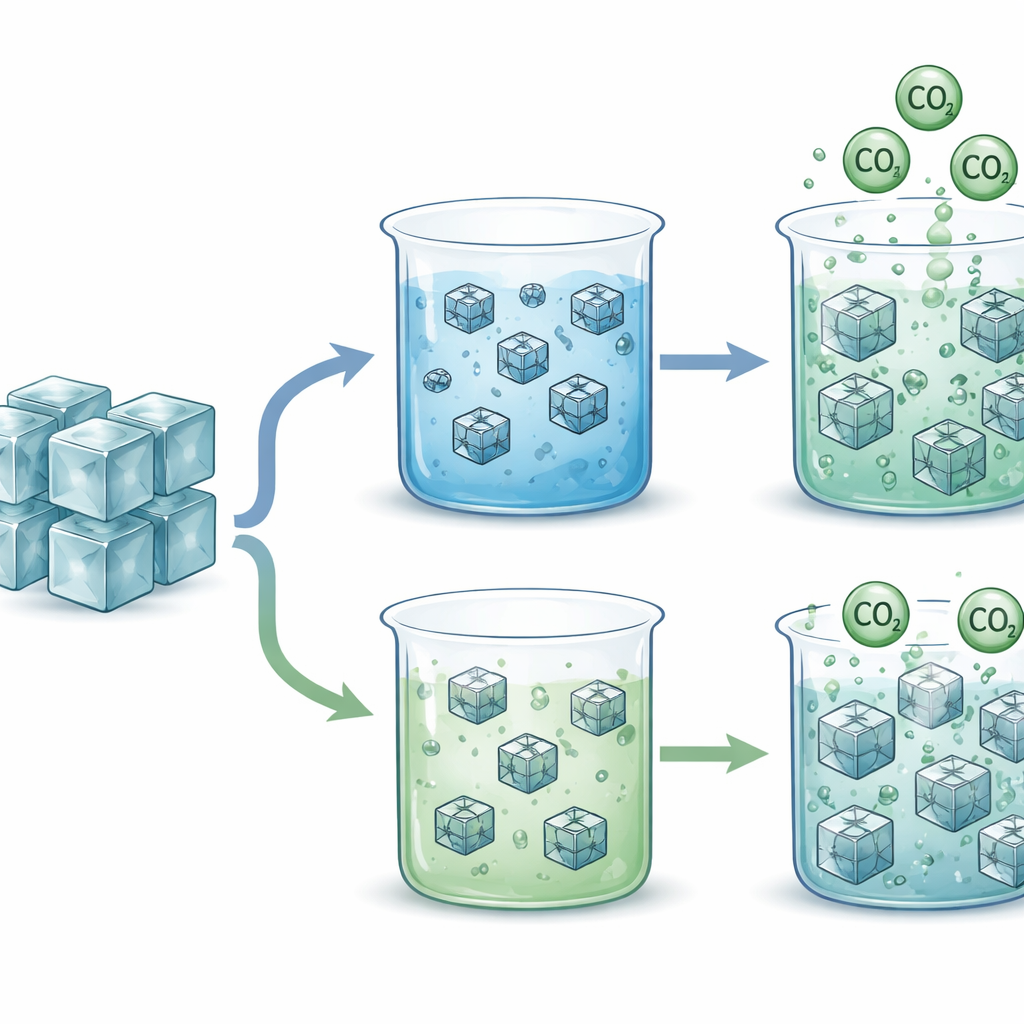
The researchers begin with a supramolecular framework, a solid built from metal–organic cages that click together like three‑dimensional puzzle pieces. Each cage is a hollow cluster with small triangular openings leading into an internal cavity. These cages are linked into a larger framework by relatively weak ionic bonds, similar to the attractions between charged particles in table salt. Because these bonds are easy to disrupt, the entire structure can be rearranged if placed in the right liquid environment.
Two Liquids, Two Outcomes
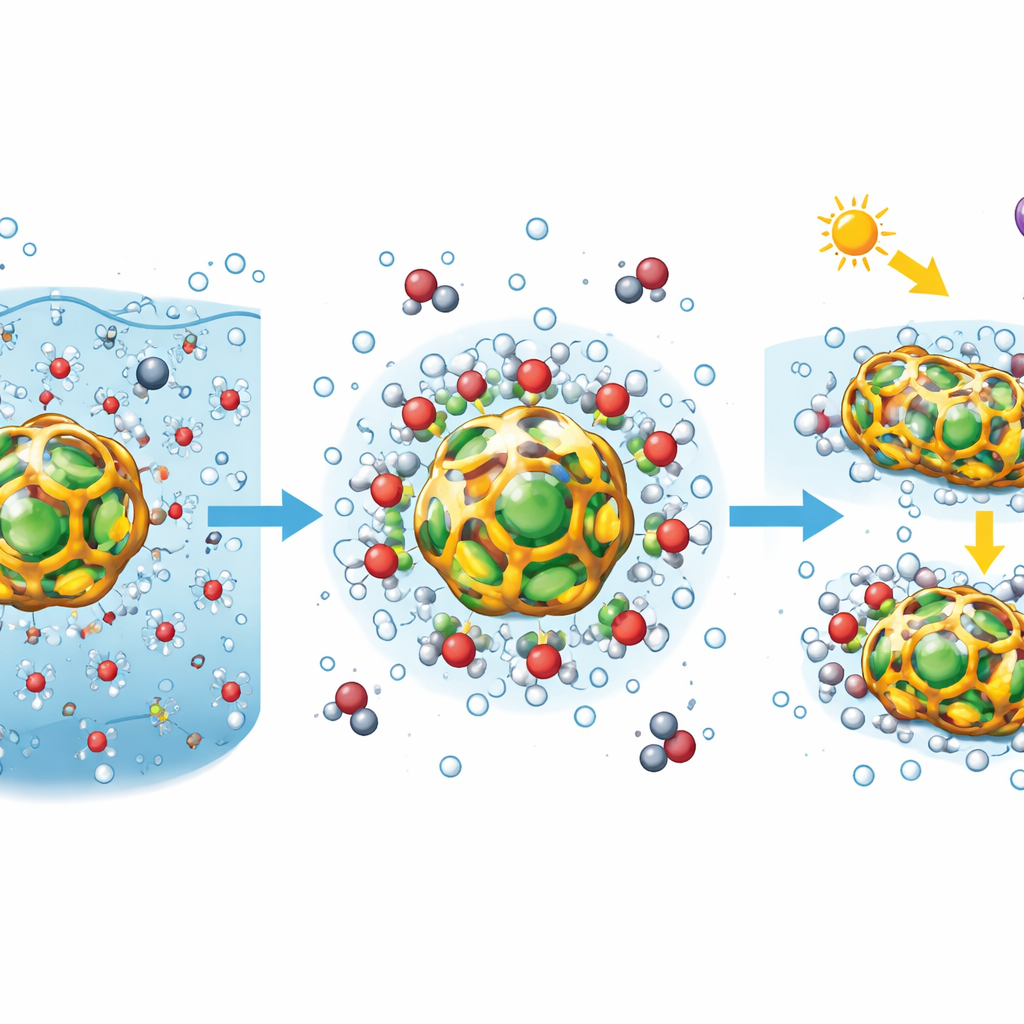
To control what happens to the framework, the team designed two nearly identical ionic liquids based on a flexible polyethylene glycol chain. The only difference is the negatively charged partner: one liquid carries bromide ions, the other carries bulkier NTf2 ions. Despite this small change, their behavior is opposite. In the bromide liquid, negative charges on the solvent strongly attract the positively charged framework, pulling apart the ionic bonds and freeing individual cages that fully dissolve. This creates a “type II” porous liquid, where isolated hollow cages float in the liquid. In the NTf2 liquid, both solvent and framework surfaces are positively charged, so they repel one another. The framework stays intact but becomes uniformly dispersed, forming a “type III” porous liquid where solid particles are suspended yet still create accessible cavities.
How the Tiny Cavities Trap Gas
Experiments and computer simulations confirm that in both liquids the bulky solvent molecules are too large to squeeze through the cage windows, so the internal rooms remain empty and ready to host gas molecules. Measurements of positron lifetimes, which are sensitive to nanoscale voids, show that both liquids contain more free volume than their pure solvents. Simulations further reveal “external cavities”: extra gaps that appear where solvent molecules pack around each cage. These additional pockets act like bonus storage lockers for gas. The type II liquid, with individually separated cages surrounded by solvent, forms more of these external cavities than the type III liquid, where cages aggregate within the framework.
Light Switch for Carbon Capture
A key twist is that the cage walls include azobenzene units, molecules that change shape when exposed to ultraviolet or visible light. Under ultraviolet light, they bend, subtly shrinking or reshaping the cavities; under visible light, they straighten again. In the type II liquid, where cages move more freely, this shape‑shifting is especially efficient and causes a large reversible change in how much carbon dioxide the liquid can hold. At low temperature and modest pressure, the bromide‑based type II liquid stores more than twice as much carbon dioxide as its type III cousin and dramatically more than the plain solvent. It also shows a record-high capacity compared with all previously reported type II porous liquids, while still preferentially taking up carbon dioxide over nitrogen and methane.
Why This Matters for Cleaner Gases
By delicately tuning the electrical interactions between a porous framework and its surrounding ionic liquid, the researchers have demonstrated a general recipe for making very different porous liquids from the same building blocks. One route yields dissolved cages with exceptional gas capacity and strong, light‑driven control; the other preserves an extended framework with more modest but still enhanced performance. This approach could help engineers design tailored, switchable liquids for capturing carbon dioxide from mixed gas streams and for other separations, combining the processing ease of liquids with the storage power of porous solids.
Citation: Liu, Y., Jin, HY., Li, MM. et al. From the same supramolecular framework to distinct types of porous liquids via in-situ transformation. Nat Commun 17, 3072 (2026). https://doi.org/10.1038/s41467-026-69837-8
Keywords: porous liquids, carbon dioxide capture, ionic liquids, gas separation, photoresponsive materials