Clear Sky Science · en
Orbital-selective band engineering realizes high zT in p-type Ru2Ti1−xHfxSi full-Heusler thermoelectrics
Turning Waste Heat into Useful Power
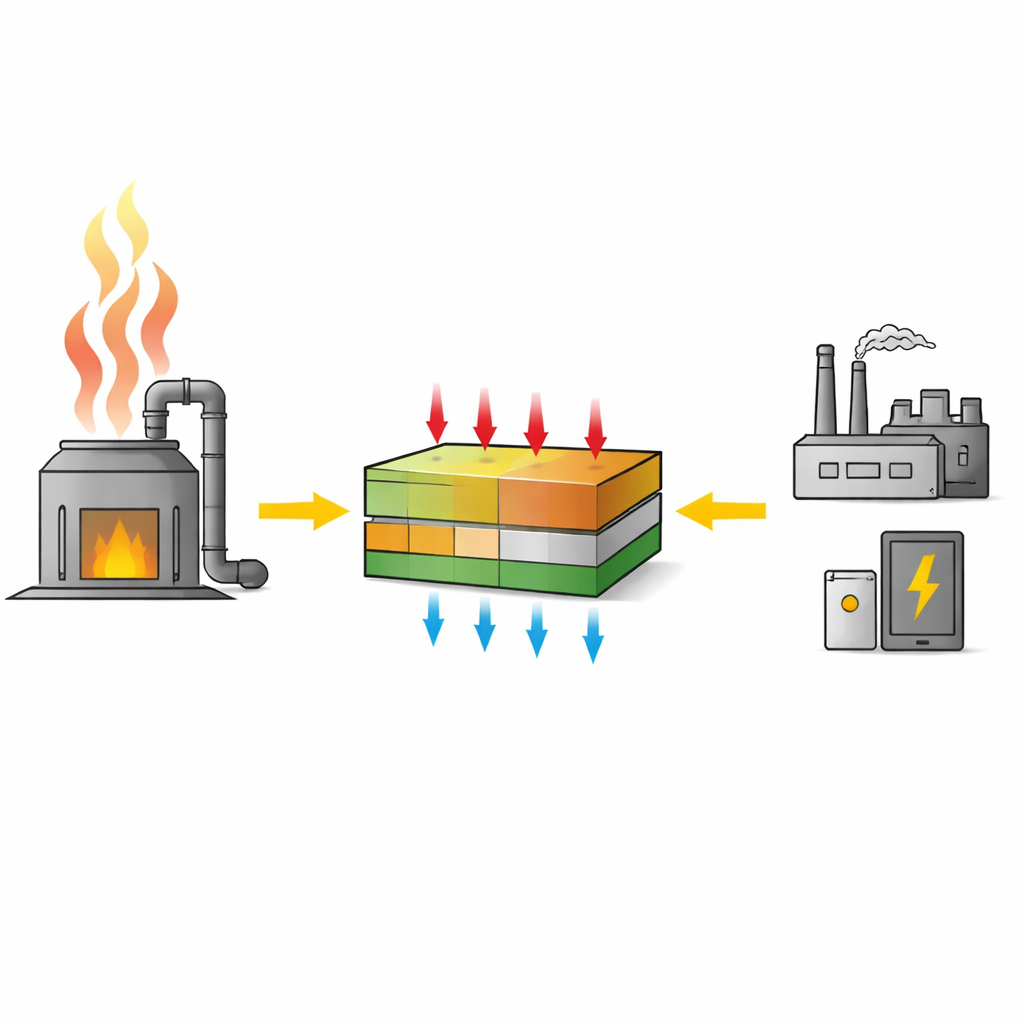
Every day, factories, power plants and even car engines pour vast amounts of heat into the air. Thermoelectric materials promise to capture some of this wasted warmth and directly turn it into electricity, with no moving parts and silent operation. This article explores a new family of rugged alloys based on ruthenium, titanium, hafnium and silicon that push the performance of a lesser‑known class of thermoelectric materials to record levels, opening the door to more durable devices for high‑temperature environments.
Why These Alloys Matter
Thermoelectric devices work on a simple idea: if one side of a material is hot and the other cold, a voltage appears between them. The efficiency of this conversion is captured by a single number, called zT, which bundles together how well the material conducts electricity, how strongly it responds to a temperature difference, and how poorly it carries heat. For decades, the best materials for practical devices have been compounds such as bismuth telluride and lead- or tin-based chalcogenides. They perform well but can be mechanically soft, contain toxic or scarce elements, and sometimes degrade at high temperatures. In contrast, Heusler compounds—ordered mixtures of metals and a main‑group element—are mechanically strong, chemically stable and made from more common elements, making them appealing for long‑lived generators that might sit on a hot pipe or exhaust stack for years.
A New Spin on a Promising Material
Among Heusler compounds, a particular system called Ru2TiSi had already drawn attention as a promising thermoelectric. Earlier work mainly explored it in an n‑type form, where the charge carriers are electrons. Theory, however, hinted that a p‑type version, where heat drives positive carriers (holes), could perform even better—especially if the internal energy landscape of the electrons and holes, the so‑called bands, could be tuned. In this study, the researchers did exactly that by gradually replacing some of the titanium atoms with heavier hafnium atoms, creating a series of compositions written as Ru2Ti1−xHfxSi. This subtle atomic swap allows them to probe how structure, heat flow and electrical response evolve together and to search for the sweet spot where all three align for maximum zT.
Finding the Sweet Spot in the Crystal
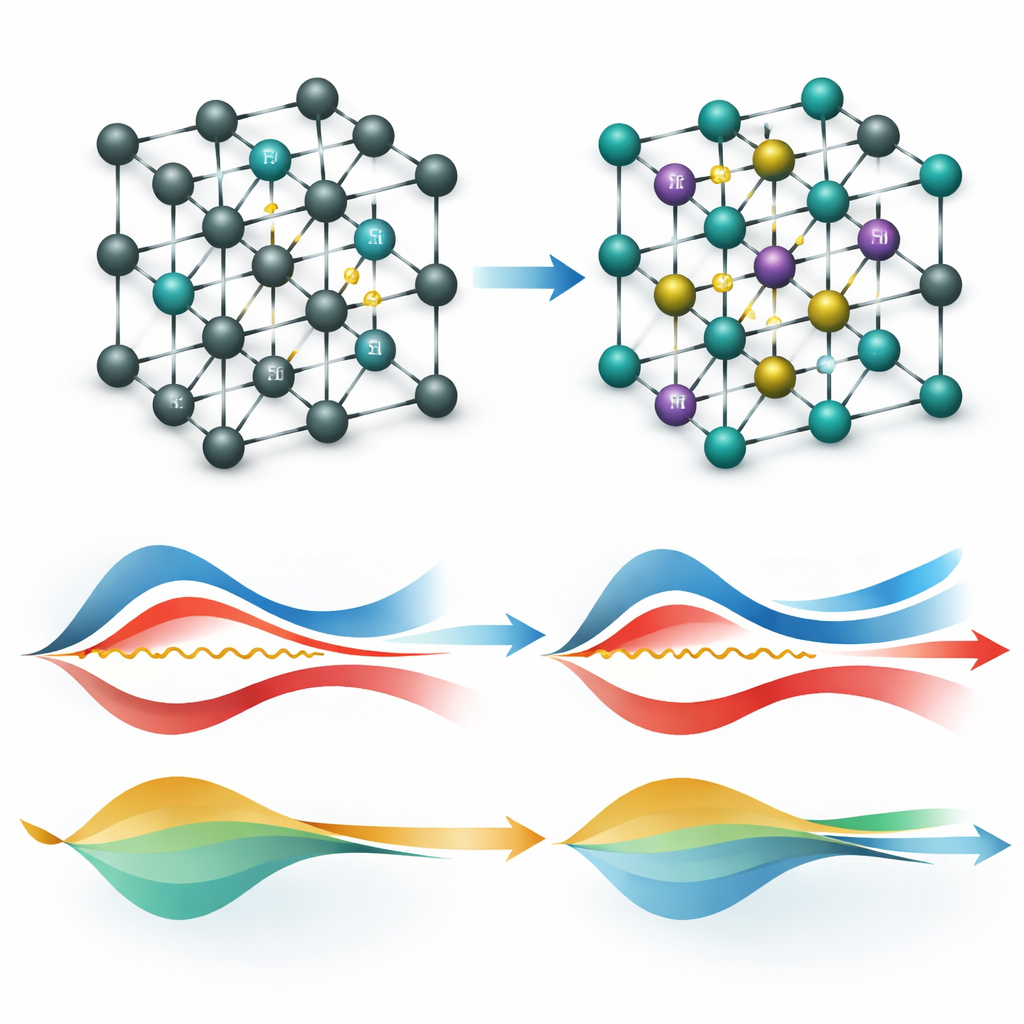
The team first mapped out how much hafnium the crystal structure could tolerate while remaining uniform. Using X‑ray diffraction and electron microscopy, they showed that up to about 20 percent hafnium, the material stays as a single, well‑ordered phase with a smoothly expanding crystal lattice. Beyond this limit, it breaks into multiple regions with different compositions, which harms thermoelectric performance. Within the safe range, the electrical behavior changes in a revealing way: the Seebeck coefficient, which measures how strongly a temperature difference drives a voltage, keeps a large value but peaks at slightly lower temperatures as more hafnium is added. At the same time, the electrical resistivity does not worsen—and even improves slightly—despite the added atomic disorder. This unusual combination arises because the main pathways for hole conduction are carried by ruthenium‑based states that are relatively insensitive to swapping titanium for hafnium.
Taming Heat Flow While Preserving Charge Flow
Where hafnium really earns its keep is in blocking the flow of heat carried by vibrations of the lattice. Being heavier and larger than titanium, hafnium introduces strong mass and strain contrasts into the crystal, which scatter these vibrations and sharply reduce the lattice contribution to thermal conductivity. Measurements show that this heat flow drops markedly as hafnium content increases, without sacrificing the electronic mobility that underpins good electrical conduction. Combining a suppressed thermal conductivity with robust electrical response yields a record zT of about 0.7 between 700 and 1000 kelvin for the composition Ru2Ti0.8Hf0.2Si. According to the authors, this is the highest figure of merit yet reported for any bulk full‑Heusler thermoelectric, surpassing well‑studied cousins such as Fe2VAl‑based alloys.
Peering Inside the Electronic Engine
To understand why hafnium substitution is so effective, the researchers turned to a simplified “two‑band” model of the electronic structure, supported by detailed quantum‑mechanical calculations. Their analysis shows that adding hafnium widens the energy gap between filled and empty states and nudges the Fermi level—the energy that separates mostly filled from mostly empty states—closer to the top of the valence band. At the same time, the character of the lowest empty states shifts from titanium‑dominated to ruthenium‑dominated as one moves toward the fully substituted Ru2HfSi compound. These changes rebalance how electrons and holes contribute to transport and help maintain strong thermoelectric response even as the lattice is disrupted. The modeling further suggests that modest adjustments to the number of carriers, for example by lightly substituting aluminum or other heavy elements at different atomic sites, could push the power factor higher and drive zT past 1 if the already low thermal conductivity can be reduced a bit further.
What This Means for Future Devices
In plain terms, this work shows that carefully choosing which atoms to swap in a robust alloy can selectively disturb heat flow while preserving or even enhancing electrical flow—exactly the combination thermoelectric engineers seek. The p‑type Ru2Ti0.8Hf0.2Si compound sets a new benchmark for full‑Heusler materials and validates earlier predictions that the p‑type versions of these systems can outperform their n‑type counterparts. With additional tuning and co‑doping, the authors argue that even higher efficiencies are within reach. For industries looking to reclaim energy from hot equipment or exhaust streams using durable, long‑lasting modules, these findings highlight a promising and relatively unexplored corner of the materials landscape.
Citation: Garmroudi, F., Serhiienko, I., Parzer, M. et al. Orbital-selective band engineering realizes high zT in p-type Ru2Ti1−xHfxSi full-Heusler thermoelectrics. Nat Commun 17, 2878 (2026). https://doi.org/10.1038/s41467-026-69799-x
Keywords: thermoelectric materials, Heusler alloys, waste heat recovery, band engineering, lattice thermal conductivity