Clear Sky Science · en
Supramolecular coupling of cylindrical micelles following seeded-growth
Building Tiny Chains from Tiny Rods
Many of the materials around us, from plastics to tissues in our bodies, rely on long, chain-like structures built from much smaller pieces. This study explores how scientists can coax soft, nanoscale building blocks—far thinner than a human hair—to hook together end-to-end on their own. Understanding and controlling this process could open doors to new kinds of smart fibers, sensors, and biomimetic materials that imitate the architecture of collagen and other natural fibers.
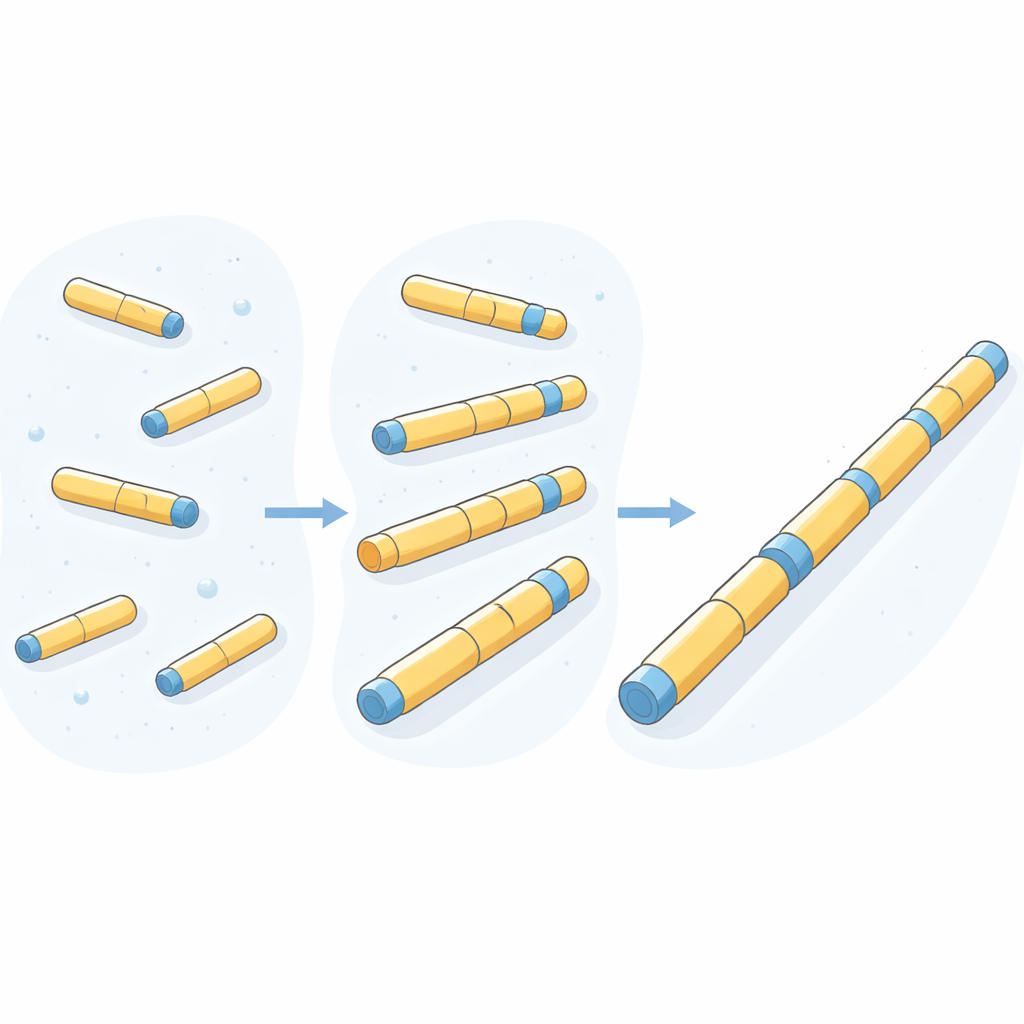
From Short Rods to Long Nano-Wires
The researchers work with special polymers made of two linked parts: one rigid and water-fearing, the other flexible and water-loving. When these blocky molecules are placed in a mixture of solvents, they spontaneously gather into tiny cylindrical structures called micelles, each with a stiff core wrapped in a softer outer shell. These cylinders, only a few hundred nanometers long, act as “seeds” that can grow longer when more free polymer chains are added to the solution, much like a crystal growing when more material is supplied.
Two-Step Growth: First Fuse, Then Link
Careful experiments revealed that the cylinders lengthen in two distinct stages. In the first stage, small loose clusters of polymer attach to the ends of the seed cylinders and fuse with them, making the rods longer. In the second, slower stage, entire long cylinders meet tip-to-tip and couple end-to-end, producing much longer “segmented nanowires” that show a telltale pattern of alternating thick and thin sections along their length. Electron microscopy and light-scattering measurements track this transformation over hours, confirming that short, mobile pieces grow first, while the bulkier cylinders connect later as they collide in solution.
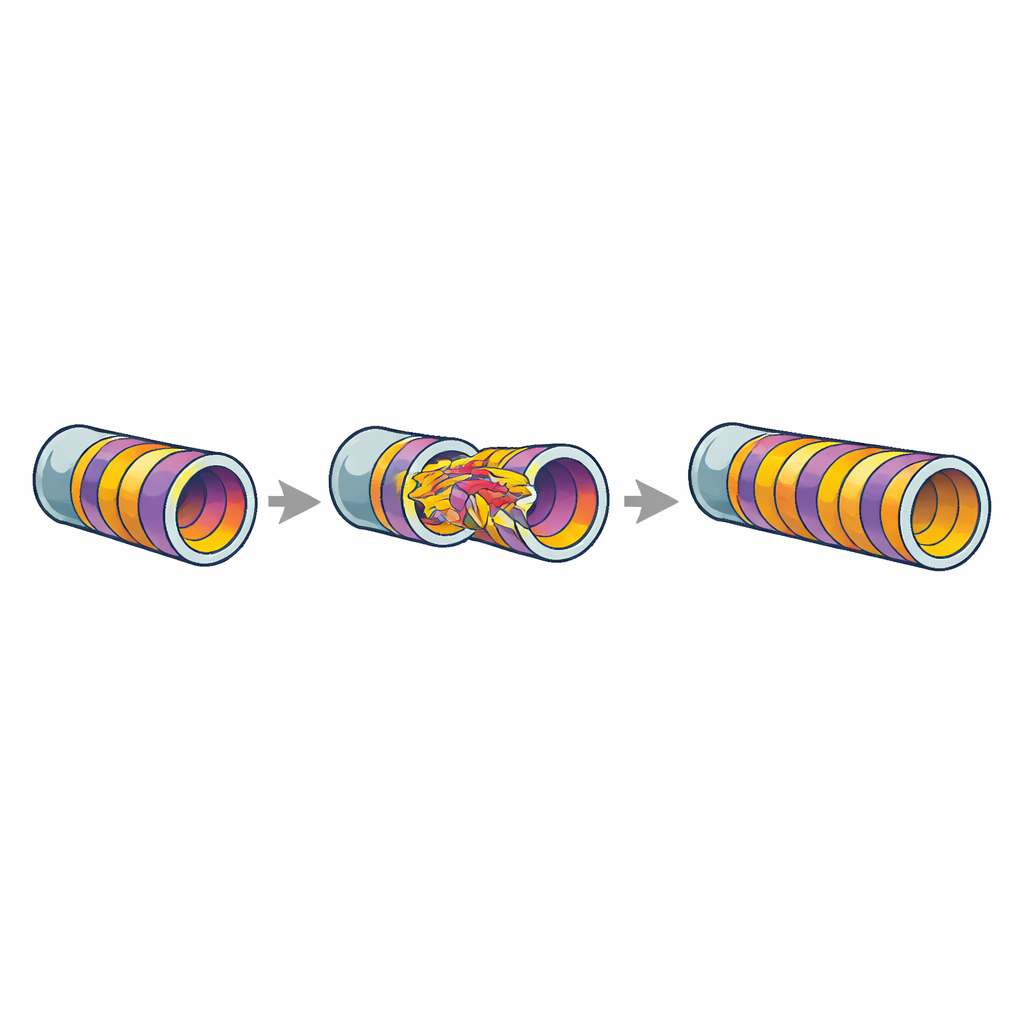
Liquid-Like Order at the Core
At the heart of this behavior is the way the rigid blocks pack together inside each cylinder. Instead of forming a hard, frozen crystal, they arrange into a liquid-crystal–like core: ordered, but still somewhat fluid. X-ray scattering shows that this internal order strengthens as small aggregates fuse with the seeds, suggesting that the drive to form a well-organized core helps power growth. Computer simulations back this up, showing small clusters first attaching and reorienting their chains to match the ordered core of the seeds, and only later do two full-length cylinders manage to rearrange their internal structure enough to lock together at their ends.
Solvent as a Hidden Control Knob
A key discovery is that the solvent mixture surrounding the micelles acts as a precise control knob for this process. Changing the proportion or type of alcohol in the solvent alters how strongly it interacts with the rigid, liquid-crystalline blocks. When the solvent holds these blocks too tightly, their mobility drops, and both growth and end-to-end coupling slow or nearly stop; the cylinders stay mostly separate and simply elongate a bit. In contrast, when the solvent is slightly less accommodating, the blocks can shuffle more easily, making it easier for small aggregates to fuse and for cylinder ends to reorganize and stick together. By tuning the solvent composition, the team can dial in how many seed segments end up in each nanowire and thus control the wire’s internal “segment” pattern.
Design Rules for Future Nano-Building
By combining experiments and simulations, the authors distill a set of practical rules for guiding such self-building nanowires. The internal liquid-crystal core must remain fluid enough to rearrange slowly, especially during the demanding end-to-end coupling step, and the two blocks of the polymer must have compatible solubilities so the chains can move without dissolving away. The ratio of rigid to flexible segments and the choice of solvents must be balanced so that ordering is encouraged but not frozen. Under these conditions, the system reliably produces long, segmented nanowires whose architecture can be tuned by changing how much extra polymer is fed in, how often it is added, and which solvents are used.
Why These Tiny Chains Matter
In everyday terms, this work shows how to let tiny “rods” in a liquid first grow and then click together into longer “strings” without any chemical glue—guided only by their internal ordering and the surrounding liquid. The resulting segmented nanowires resemble miniature, programmable fibers, with repeating thick and thin sections built in. Such control over nanoscale shape and hierarchy could be harnessed to design advanced soft materials that mimic the toughness of natural tissues, steer light or electricity along defined paths, or respond sensitively to changes in their environment, all by exploiting the quiet choreography of liquid-crystal ordering inside polymer chains.
Citation: Gao, W., Sun, K., Wang, X. et al. Supramolecular coupling of cylindrical micelles following seeded-growth. Nat Commun 17, 3247 (2026). https://doi.org/10.1038/s41467-026-69785-3
Keywords: self-assembly, nanowires, liquid crystals, block copolymers, supramolecular chemistry