Clear Sky Science · en
Climate models exaggerate greenhouse gas impact on recent interhemispheric temperature patterns and tropical climate
Why the Balance Between North and South Matters
We tend to think of global warming as a single number, like the average temperature of the planet. But where the warming happens can matter as much as how much warming there is. This study looks at the temperature difference between the Northern and Southern Hemispheres over the oceans and asks a simple question: do our best climate models capture what has actually happened since the 1950s? The answer turns out to be no—and that mismatch has important consequences for how we expect tropical rainfall and future climate change to unfold.
Seeing a Different Story in the Real World
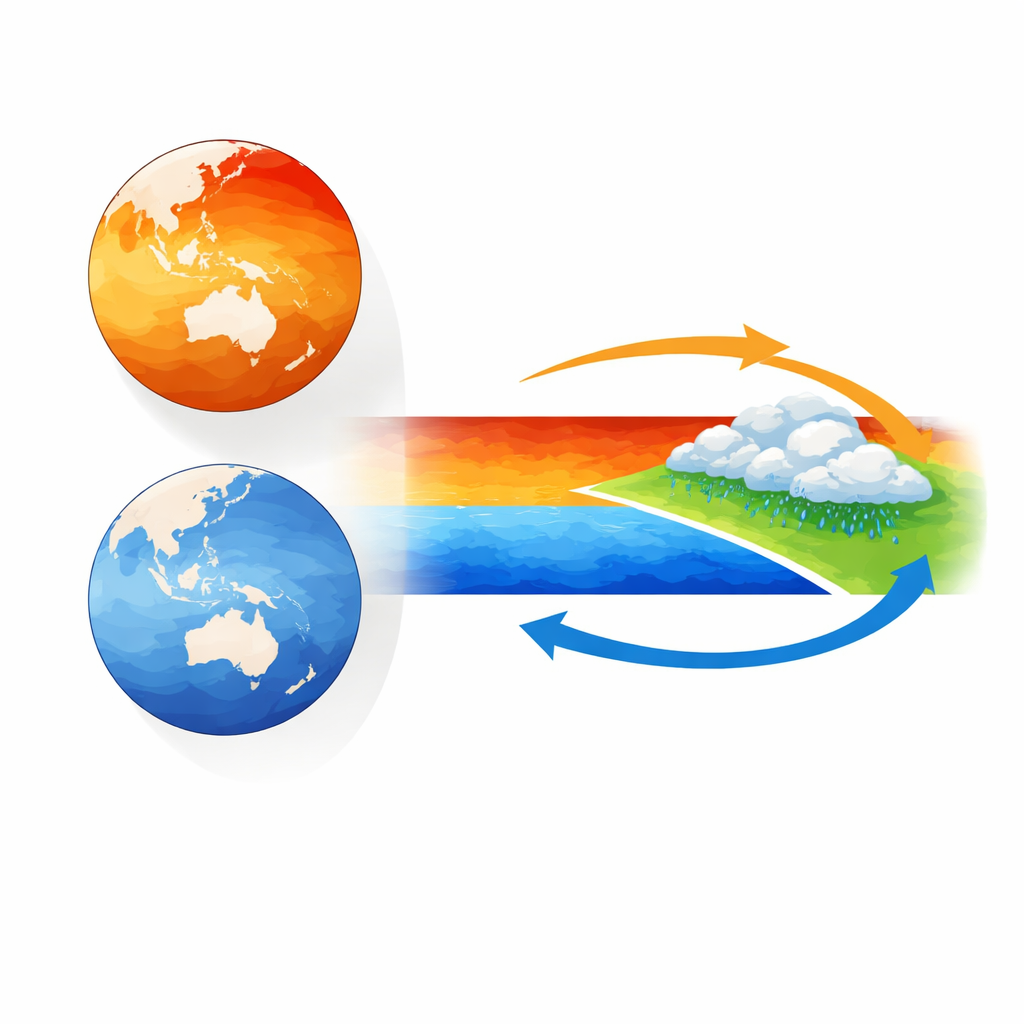
The key quantity in this work is the interhemispheric thermal contrast, defined as the average sea-surface temperature in the northern oceans minus that in the southern oceans. Observations since 1950 show that this contrast has slightly declined: the Southern Hemisphere oceans have warmed more than those in the north. At the same time, the pattern of tropical winds and rainfall has shifted in ways consistent with that south-favoring ocean warming. Yet when the authors examined more than 500 simulations from over 50 state-of-the-art climate models, they found the opposite behavior. In the models, northern oceans warm faster than southern ones, producing a steadily increasing contrast that is almost never seen in the real-world data record.
Greenhouse Gases Versus Tiny Particles
To understand why models and observations disagree, the researchers separated the roles of different human and natural influences. They analyzed special climate-model experiments in which only greenhouse gases, only human-made aerosol particles, or only natural factors such as volcanoes and changes in the Sun were allowed to vary. Using statistical techniques, they showed that in the real world, the recent north–south temperature evolution over the oceans is driven mainly by aerosols and natural forcings. Aerosols, which are emitted largely in the Northern Hemisphere, tend to cool the air above those oceans, helping keep northern waters from outpacing the south. Large volcanic eruptions further reinforce episodes of cooling. In contrast, in the models, the long-term trend in the hemispheric difference is dominated by greenhouse gases, with aerosols playing a weaker compensating role.
How Winds, Evaporation, and Warm Seas Interact
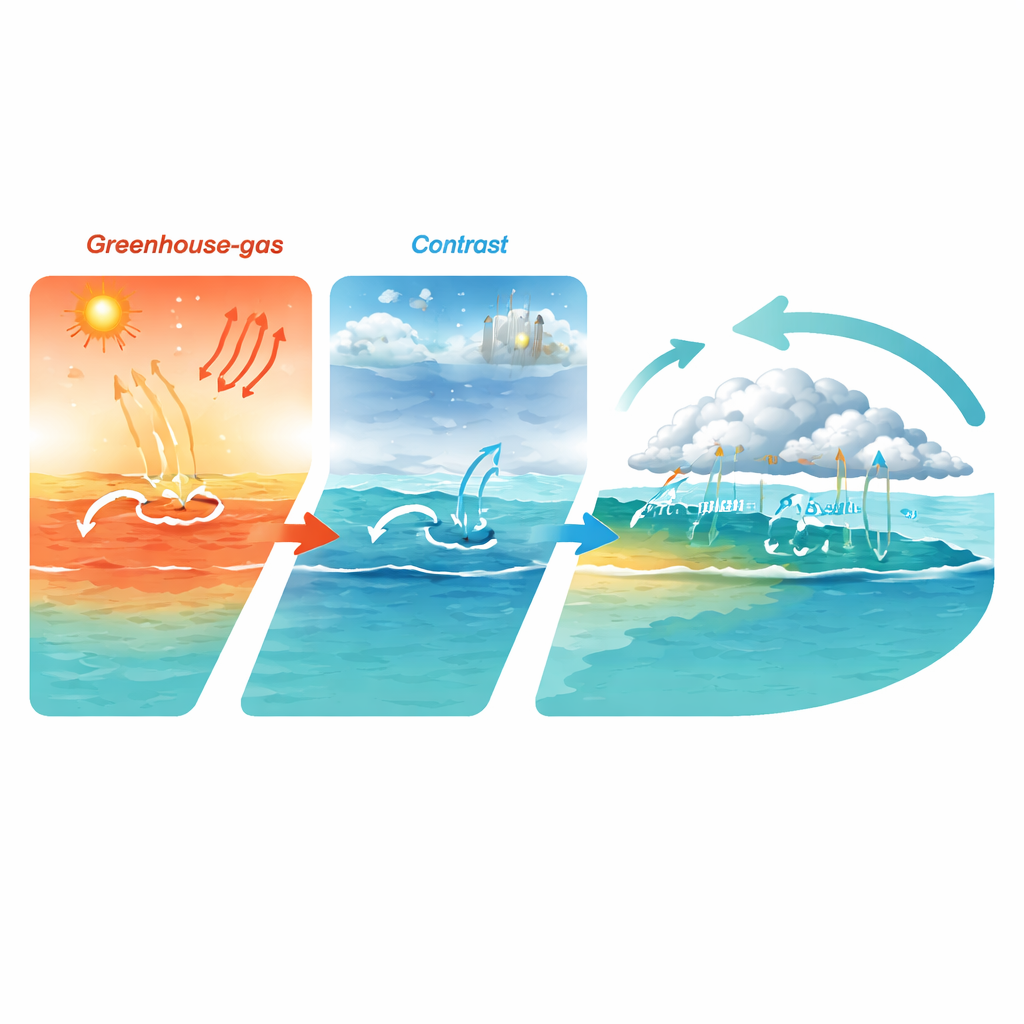
A central physical mechanism behind this discrepancy involves the link between surface winds, evaporation, and sea-surface temperature. When winds blow more strongly over the ocean, they increase evaporation, which removes heat and tends to cool the surface; weaker winds do the opposite, allowing waters to warm. This wind–evaporation–SST feedback amplifies any initial imbalance in heating between the hemispheres. In the greenhouse-gas–only simulations, models generate surface wind changes that systematically favor extra warming of the Northern Hemisphere oceans relative to the south. Observations show a more complex picture, with aerosol-driven changes and natural variability producing different wind and temperature patterns that do not match the modelled north-heavy warming.
What the Mismatch Says About Model Sensitivity
The team also explored how this problem relates to the overall sensitivity of climate models—how much they warm for a given increase in greenhouse gases. Models with higher equilibrium climate sensitivity tend to show a stronger, and incorrect, warming of the Northern Hemisphere oceans relative to the south. At the same time, the models do a much better job reproducing the slower, multidecadal swings in the hemispheric temperature contrast, which appear to be shaped largely by aerosols and natural forcings. By exploiting this partial success, the authors used the observed variability to narrow down how strongly aerosols are likely to cool the planet through their influence on clouds, reducing the uncertainty range compared with recent international assessments.
Implications for Future Rainfall in the Tropics
The balance of warming between hemispheres helps steer the tropical rain belt, the zone of heavy rainfall that feeds monsoons and influences hurricane formation. Because many models overstate Northern Hemisphere ocean warming, they also tend to predict a stronger northward shift of this rain belt than observations would suggest. When the researchers compared future projections from models with high and low climate sensitivity, they found that lower-sensitivity models—those that align better with the observed hemispheric pattern—produced a more modest northward shift in tropical rainfall. In everyday terms, this work implies that some of the most extreme model projections of how far tropical rain bands will move, and how dramatically certain regions will become wetter or drier, may be overstated if they rely on models that exaggerate greenhouse-gas–driven warming in the northern oceans.
Citation: He, C., Clement, A.C., Cane, M.A. et al. Climate models exaggerate greenhouse gas impact on recent interhemispheric temperature patterns and tropical climate. Nat Commun 17, 3265 (2026). https://doi.org/10.1038/s41467-026-69783-5
Keywords: interhemispheric temperature contrast, aerosols and climate, tropical rainfall shifts, climate model biases, ocean surface warming