Clear Sky Science · en
NEDAMSS syndrome-related truncating and missense mutations are associated with aberrant liquid-liquid phase separation of IRF2BPL
When Proteins Go Out of Place
NEDAMSS is a rare childhood condition that robs children of skills they once had, causing movement problems, loss of speech, and seizures. Until recently, doctors knew it was linked to changes in a mysterious gene called IRF2BPL, but not how these changes harmed brain cells. This study uncovers that the culprit is not simply a broken protein, but a protein that starts behaving strangely as tiny liquid droplets inside nerve cells, ultimately disrupting how neurons work and survive. 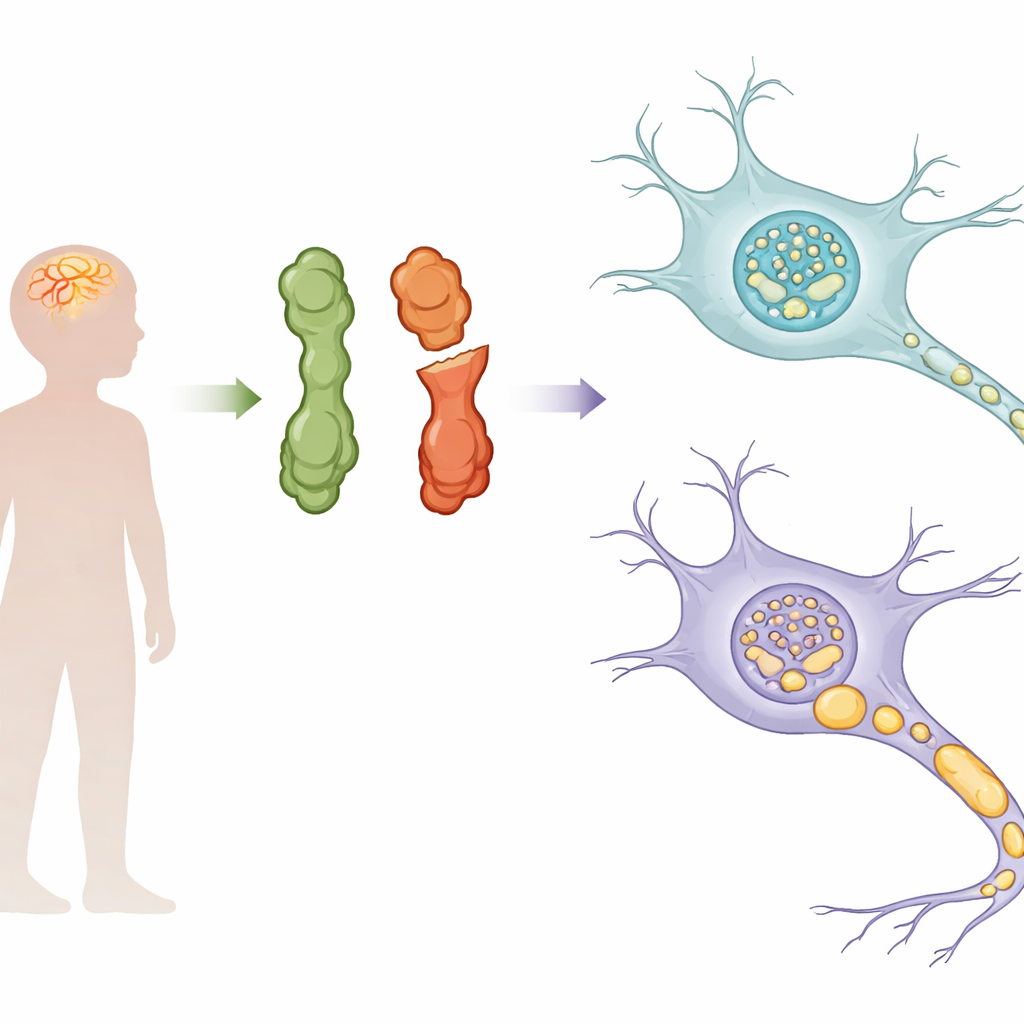
A Little-Known Gene with a Big Role
The IRF2BPL gene makes a protein that helps control which genes are turned on or off, especially in the brain. For years it sat in databases as an “understudied” protein with unclear function. Most patients with NEDAMSS carry changes that cut this protein short (truncating mutations) or swap one building block for another (missense mutations). Strikingly, these changes cluster in the long middle stretch of the protein, a region rich in simple amino acid repeats and previously written off as a featureless “low-complexity” segment. The authors show that this central region is actually divided into three simple segments and one more structured domain, and that this organization is conserved across hundreds of vertebrate species, indicating important biological roles.
Proteins That Behave Like Tiny Liquids
Inside cells, some proteins do not sit alone or inside membranes; instead, they gather into droplet-like condensates by a process called liquid–liquid phase separation, akin to oil droplets forming in water. The researchers discovered that IRF2BPL normally forms such droplets in many cell types, including human neurons grown from stem cells. Using high-resolution microscopy, they saw small, rounded condensates both in the nucleus, where DNA resides, and throughout axons and nerve endings. These droplets were sensitive to chemicals that disrupt weak interactions, recovered quickly after photobleaching, and could merge and dissolve over minutes, all classic signs of liquid-like behavior rather than rigid protein clumps. A zinc finger segment at one end of the protein, together with a nearby stretch rich in alanine and glutamine, turned out to be the key engine that drives this droplet formation. 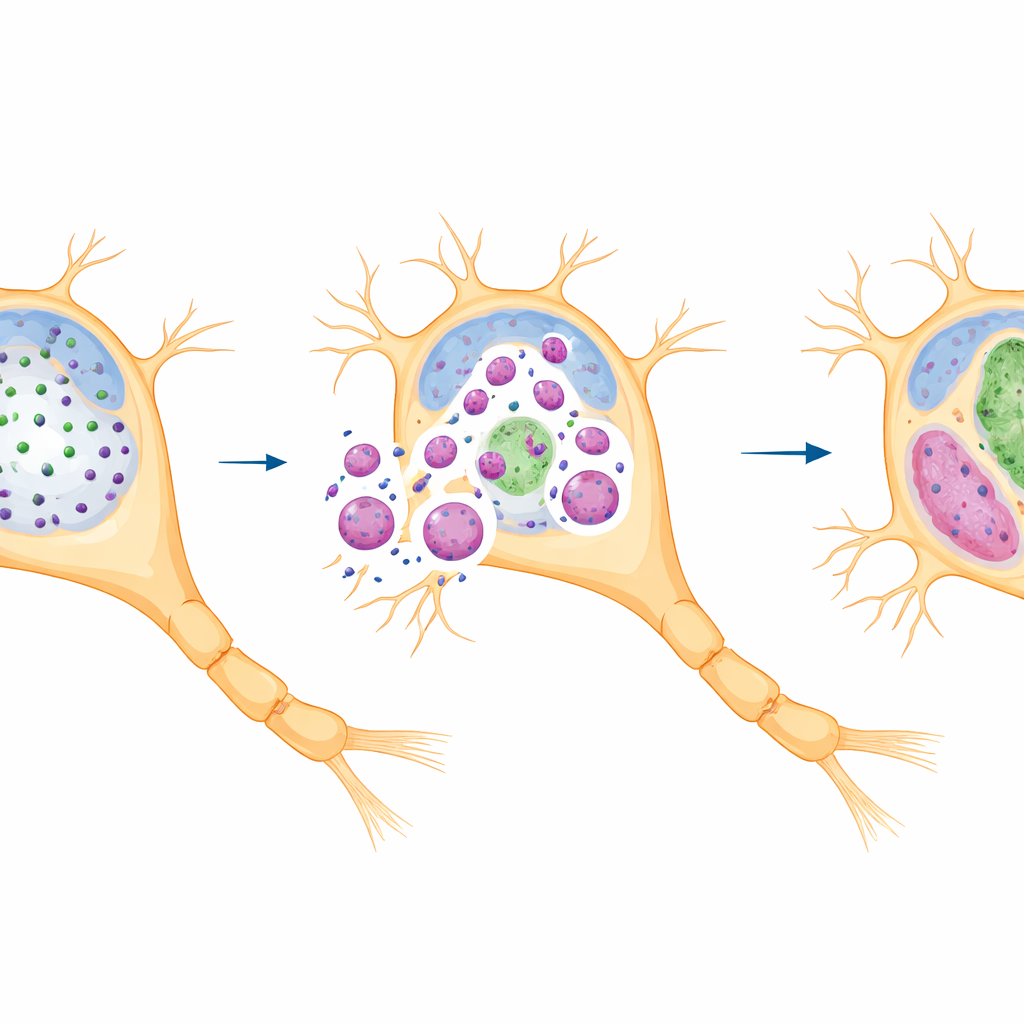
From Healthy Droplets to Harmful Globs
Patient-like mutations drastically reshaped this droplet landscape. Truncating mutations that chop the protein within its central repeat region produced shortened fragments that still formed condensates but with very different properties. Instead of many small, dynamic droplets, cells accumulated fewer, larger, often elongated structures that sat mainly in the cytoplasm rather than in the nucleus. These mutant condensates merged faster, were harder to dissolve, and exchanged molecules with their surroundings more slowly, suggesting a shift from a fluid to a more gel-like or fibrillary state. Under the electron microscope, these droplets contained ordered internal fibers instead of the amorphous interior seen in normal condensates, hinting at a dangerous progression from reversible droplets toward more solid, persistent assemblies.
Dragging the Healthy Protein to the Wrong Place
A crucial discovery was that these abnormal condensates act like molecular traps. The mutant IRF2BPL fragments, especially the shorter ones, pulled in the normal protein made from the healthy gene copy and held it in the cytoplasm. As a result, the nucleus and axons became depleted of functional IRF2BPL. Missense mutations in the structured central domain or in the zinc finger showed a related pattern: they did not change the total amount of condensate, but shifted droplets out of the nucleus and into the cytoplasm, again reducing the nuclear pool. The ability of mutants to recruit normal protein increased as the key repeat region was shortened, suggesting a length-dependent gain of harmful behavior rather than a simple loss of function.
From Misplaced Droplets to Faulty Genes and Neurons
When the team engineered human cells to carry a disease-like truncation in one IRF2BPL copy, they saw that the remaining normal protein was dragged into cytoplasmic condensates, and a known target gene, WNT1, became abnormally activated. Remarkably, the same rise in WNT1 occurred when IRF2BPL was completely knocked out, showing that sequestration of the normal protein can mimic full loss of its activity. In neuron-like cells, expressing mutant IRF2BPL altered the electrical resting state and reduced the size of nerve impulses, indicating compromised neuronal excitability and early signs of damage. Together, these results link misbehaving condensates directly to gene misregulation and impaired neuron function, providing a coherent chain from mutation to cell malfunction.
Why This Matters for Children with NEDAMSS
For families facing NEDAMSS and related IRF2BPL disorders, this work offers a unifying explanation: the disease stems not only from missing protein, but from a protein that forms the wrong kind of droplets in the wrong place. Mutations push IRF2BPL from forming small, flexible nuclear droplets to building large, stable cytoplasmic condensates that vacuum up the healthy protein, silence its normal duties in gene control, and disturb neuronal signaling. Recognizing aberrant phase separation as a central mechanism opens new avenues for therapy, such as drugs that reshape condensate behavior, prevent mutant–normal interactions, or restore proper nuclear localization of IRF2BPL, with the long-term goal of preserving brain function in affected children.
Citation: Dell’Oca, M., Boggio Bozzo, S., Vaglietti, S. et al. NEDAMSS syndrome-related truncating and missense mutations are associated with aberrant liquid-liquid phase separation of IRF2BPL. Nat Commun 17, 3301 (2026). https://doi.org/10.1038/s41467-026-69781-7
Keywords: NEDAMSS syndrome, IRF2BPL, liquid–liquid phase separation, protein condensates, neurodevelopmental disorders