Clear Sky Science · en
Ultramicroporous covalent organic framework membranes with fortified hydrogen-bond networks for high-performance desalination
Cleaner Water for a Thirsty World
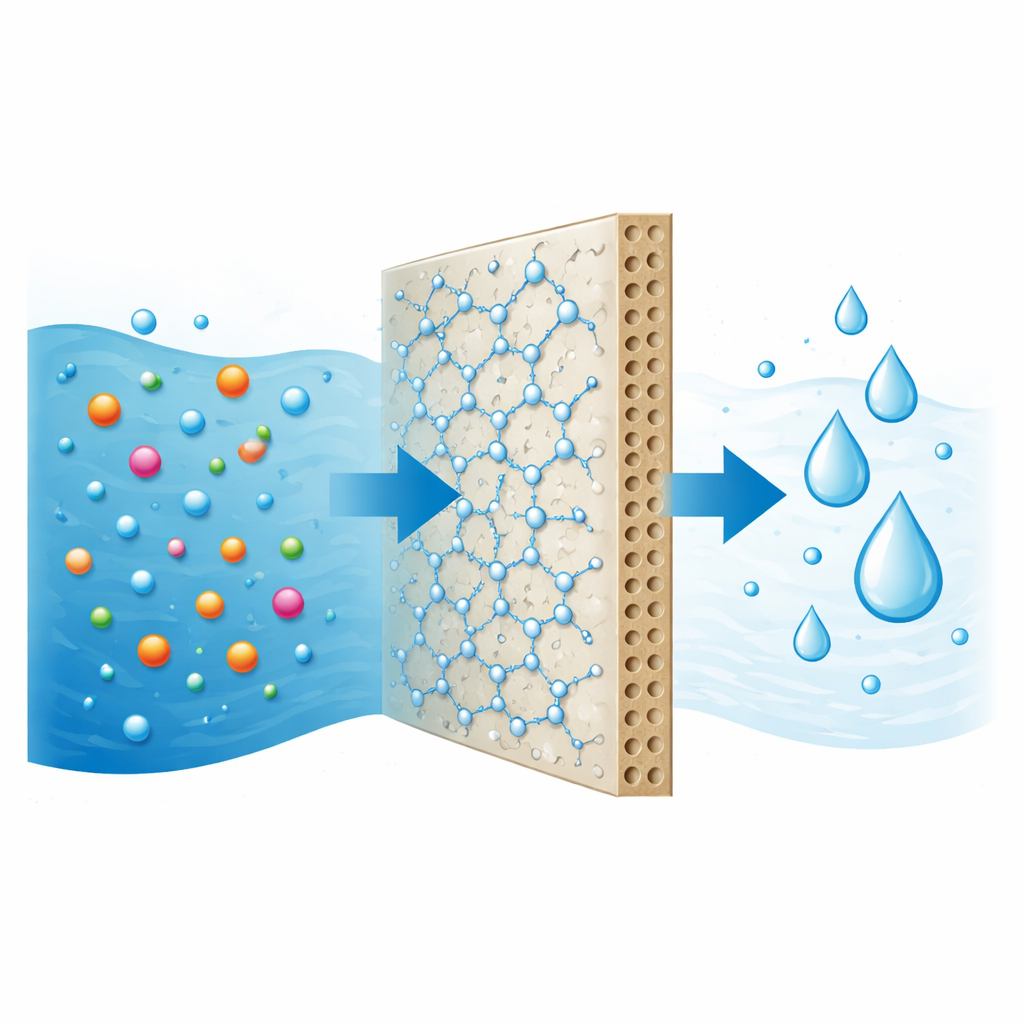
Fresh drinking water is becoming harder to secure as populations grow, pollution spreads, and climate change disrupts rainfall. Desalination plants that turn seawater into freshwater already help many coastal regions, but their core components—the membranes that separate salt from water—still waste energy and struggle with certain contaminants. This study introduces a new type of designer membrane built from highly ordered organic building blocks. By carefully strengthening invisible attractions called hydrogen bonds inside the material, the researchers created ultra-precise channels that let water rush through while almost all salt and other tiny impurities are left behind.
Why Today’s Desalination Membranes Fall Short
Most commercial desalination systems rely on reverse osmosis, which forces seawater through thin polymer films. These long-standing membranes balance a trade-off: if they are made more open to speed up water flow, they usually lose the ability to block salt efficiently. A newer class of materials known as covalent organic frameworks (COFs) promised a way around this limitation. COFs resemble molecular scaffolds with regularly spaced pores, in principle ideal for sorting molecules by size. But existing COF membranes typically have pores that are too large and irregular to stop the smallest dissolved ions found in seawater, so salt can slip through far too easily. The challenge has been to shrink and standardize the pores without destroying the material’s orderly structure or making it too fragile.
Building Tiny, Uniform Channels Inside a Solid
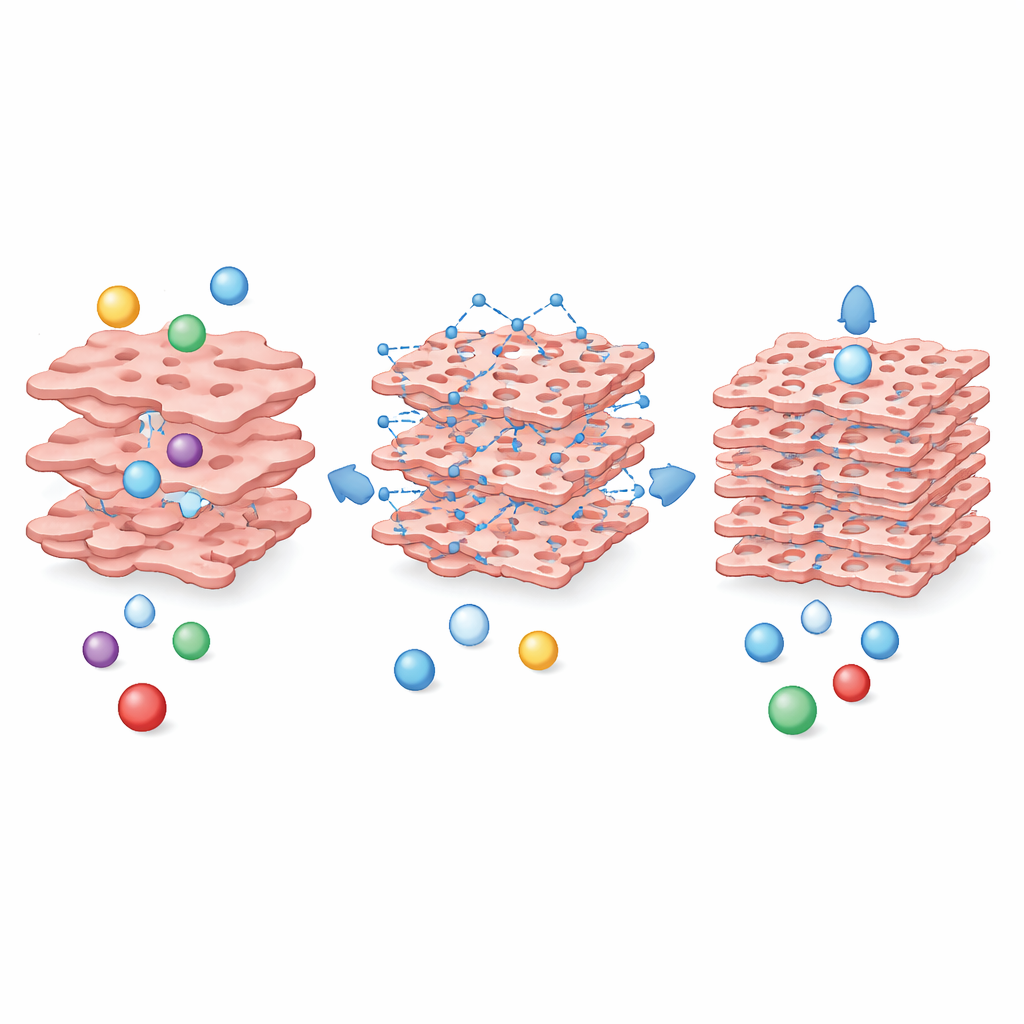
The researchers tackled this problem by rethinking how the COF layers lock together. They modified one of the molecular building blocks so that, when it reacts to form the framework, it naturally rearranges into a more stable form rich in sites that can form hydrogen bonds—weak but highly directional attractions between certain atoms. These added interactions act like extra fasteners within and between the stacked layers. As a result, the layers shift into a more favorable "AB" stacking pattern rather than simply sitting directly on top of each other. This shift squeezes the channels running through the material into smaller, more uniform passages, turning them into ultrafine sieves. Microscopy and X-ray techniques confirmed that the new membrane is more crystalline, with long-range order and highly regular, ultramicroporous channels.
How the New Membrane Performs in Real Water
When tested with salty water under relatively low pressure, the new membrane rejected 99.6% of dissolved table salt while still allowing water to pass at useful rates. The effective pore opening in water is slightly smaller than what dry measurements suggest, because parts of the framework attract a shell of water molecules that gently narrows the pathway—further helping to exclude salt ions. Compared with an otherwise similar COF membrane lacking the strengthened hydrogen-bond network, the new design shows much higher salt rejection, reflecting its tighter and more uniform channels and higher surface charge that repels positively charged ions. Remarkably, it also removes most of the boron naturally present in seawater in a single pass, beating a widely used commercial reverse osmosis membrane at both salt and boron removal, though at somewhat lower water throughput.
Staying Strong in Harsh and Dirty Conditions
Desalination plants expose membranes to acidic cleaning steps and organic matter that can clog their surfaces. Many advanced COF materials fall apart under such conditions, limiting their use. In this work, the strengthened framework endured a month in acidic water without obvious damage: its structure, chemistry, and desalination performance remained essentially unchanged. Tests with common foulants such as proteins and polysaccharides showed that the membrane’s relatively smooth surface and hydrated outer layer help resist build-up; most of the temporary loss in water flow could be reversed by simple rinsing. Long-duration filtration experiments demonstrated stable salt rejection over tens of hours of continuous operation, indicating that the architecture reinforced by hydrogen bonds is not only selective but also robust.
What This Means for Future Freshwater Supplies
By deliberately weaving dense hydrogen-bond networks into a COF membrane, the authors show that it is possible to combine very fine, uniform pores with high structural stability—two features rarely achieved together. Their membrane sets a new performance benchmark for this family of materials and rivals established commercial options in rejection of difficult contaminants like boron, all while operating at modest pressure. Beyond this specific design, the work offers a blueprint: use targeted internal bonding to guide how molecular layers stack, thereby tuning channel size and order from the inside out. If translated to larger-scale production and integrated into real desalination plants, such membranes could help deliver cleaner water more efficiently, bolstering water security in a drier, more crowded world.
Citation: Zhou, Y., Hu, G., Yuan, J. et al. Ultramicroporous covalent organic framework membranes with fortified hydrogen-bond networks for high-performance desalination. Nat Commun 17, 3272 (2026). https://doi.org/10.1038/s41467-026-69779-1
Keywords: desalination, covalent organic framework membranes, ultramicroporous filtration, hydrogen-bond networks, reverse osmosis