Clear Sky Science · en
Mixed-matrix membranes with molecular recognition windows for selective helium extraction from natural gas
Why this tiny gas matters
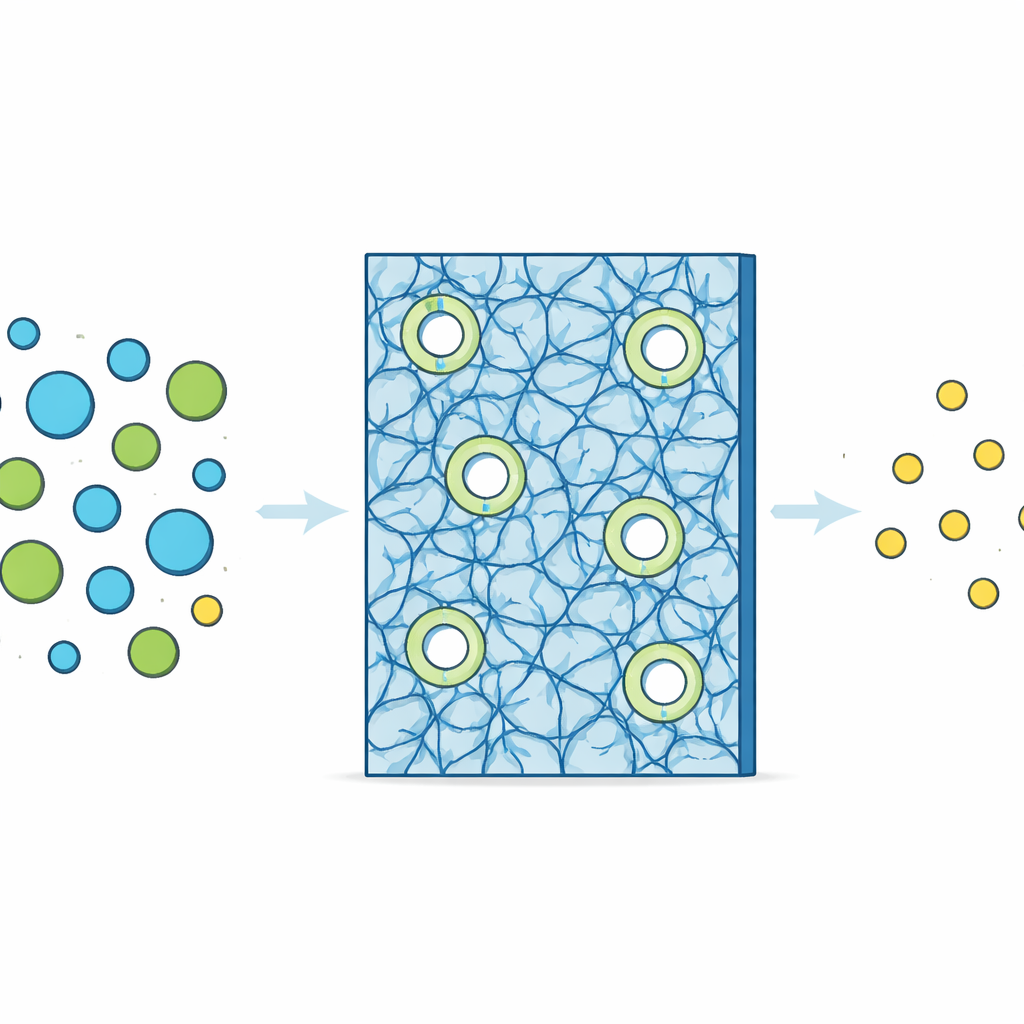
Helium is best known for party balloons, but its real importance lies in cooling MRI scanners, running particle accelerators, and enabling advanced electronics and space technologies. The problem is that helium on Earth is both rare and finite, and most of it is locked up in underground natural gas at very low concentrations. Current industrial methods to pull helium out of this mixture are energy-hungry and expensive. This study describes a new kind of filter-like membrane that can sift helium from natural gas with exceptional precision, potentially making helium recovery cleaner, cheaper, and more sustainable.
Finding a smarter way to filter gas
Today’s industrial helium recovery relies mainly on chilling gas to extremely low temperatures or cycling pressures in large adsorption units, both of which consume a lot of energy. Polymer membranes already help separate gases in some refineries, but they usually face a basic trade-off: materials that let gas through quickly often do a poor job of distinguishing one gas from another. For helium extraction, industry needs membranes that are not only reasonably fast but also extraordinarily selective, separating helium from methane—the main component of natural gas—by factors above a thousand. Very few commercial polymers come close to this standard. The authors target this challenge using a widely used engineering plastic called Matrimid and redesign its internal structure so it can recognize helium-sized molecules while slowing larger ones.
Building a membrane with tiny doorways
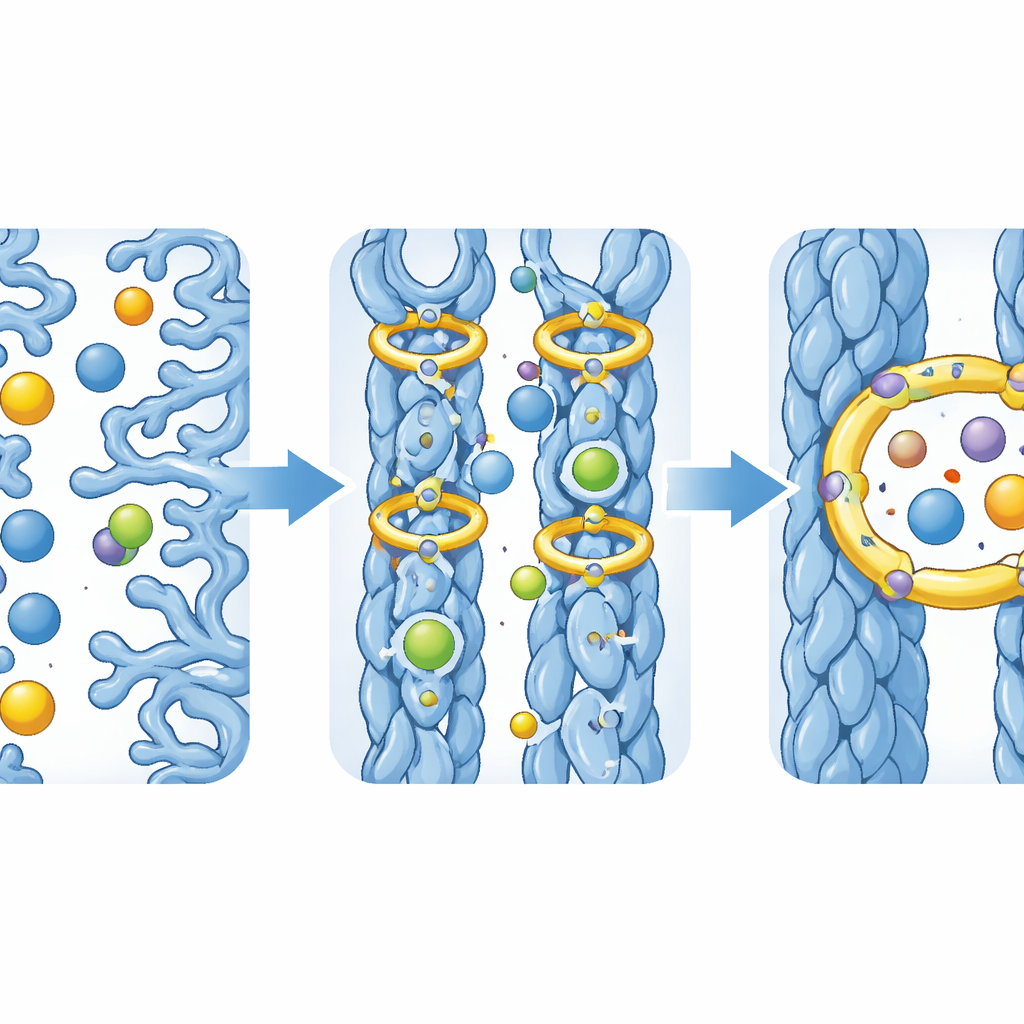
The team’s key idea is to create a “mixed-matrix membrane,” in which a normal polymer is blended with specially chosen small ring-shaped molecules. They use a macrocycle called Cyclen, whose internal cavity is just slightly larger than a helium atom but smaller than methane. When Cyclen is mixed into Matrimid, its nitrogen-containing groups form strong hydrogen bonds with the polymer backbone. These interactions pull the chains closer together, tightening the free spaces between them. At the same time, the Cyclen rings act as tiny doorways that favor the passage of very small gases. This dual action shrinks the random gaps that would let larger molecules leak through while carving out more direct escape routes for helium and similarly small gases.
Seeing inside the new material
To understand how this works at the nanoscale, the researchers used several complementary techniques. Electron microscopy shows that Cyclen is evenly dispersed throughout the membrane rather than clumping, which is vital to avoid defects that could short-circuit selectivity. X-ray diffraction reveals that adding modest amounts of Cyclen actually reduces the average distance between polymer chains, consistent with the idea of a denser, better ordered packing. Spectroscopic measurements confirm that abundant hydrogen bonds form between Cyclen and Matrimid. Computer simulations of the resulting structure show that as Cyclen content increases, a network of narrow, interconnected channels appears that small helium atoms can traverse, while bulkier gases like nitrogen and methane encounter many more dead ends and blocked routes.
Record-setting performance in separating helium
When tested with single gases, membranes containing about 5 percent Cyclen by weight stand out. They roughly double the rate at which helium crosses compared with pure Matrimid, while significantly suppressing the flow of methane and nitrogen. This imbalance boosts the helium-over-methane selectivity to around 1,660 at room temperature—a value that surpasses most polymer membranes and even challenges some advanced carbon-based molecular sieves. Remarkably, as the membrane ages over months, it slowly packs even tighter. Helium moves a bit more slowly, but the paths for larger gases constrict even more. After 110 days, the helium-to-methane selectivity climbs to nearly 6,800, far beyond long-accepted performance limits for polymers. The membrane also works across a range of temperatures and pressures resembling real natural-gas conditions and can be cast as thin films on porous supports suitable for industrial modules.
What this means for helium and beyond
In plain terms, the researchers have built a plastic filter that acts like a size-tuned sieve: it lets tiny helium atoms slip through quickly while forcing larger natural-gas molecules to take long, tortuous routes. By carefully choosing ring-shaped additives with just the right internal size and strong attraction to the host polymer, they transformed an ordinary commercial material into one of the most selective helium membranes reported so far. If scaled up, such membranes could lower the energy cost of helium recovery and extend the lifetime of this critical resource. The same design principles—using molecular “recognition windows” to reshape free space inside polymers—could also be applied to purifying hydrogen or capturing carbon dioxide, pointing toward a new generation of smart, highly selective gas-separation membranes.
Citation: He, W., Wang, X., Guan, J. et al. Mixed-matrix membranes with molecular recognition windows for selective helium extraction from natural gas. Nat Commun 17, 2942 (2026). https://doi.org/10.1038/s41467-026-69768-4
Keywords: helium separation, gas membranes, natural gas processing, mixed-matrix membranes, Cyclen macrocycle