Clear Sky Science · en
Pathways for sustainable reaction kinetics in Li-CO2 batteries
Turning a Climate Problem into Power
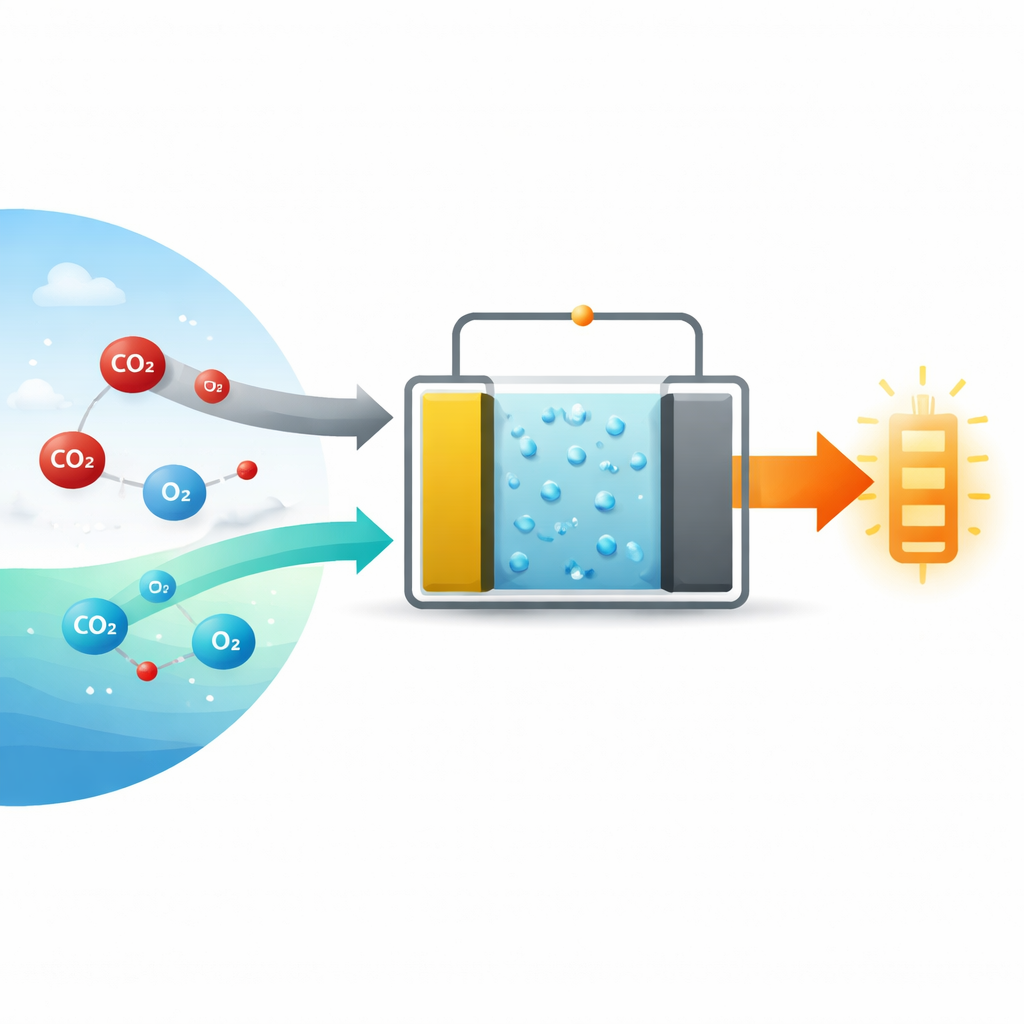
Lithium–carbon dioxide (Li–CO2) batteries aim to do two jobs at once: store a lot of energy and use up some of the carbon dioxide that drives climate change. This study explores how to make these batteries run efficiently and reliably, even under demanding conditions, by carefully controlling how carbon dioxide and oxygen take part in the reactions inside the cell. The findings point to design rules that could help future devices capture CO2 while powering our electronics and electric vehicles.
Why These New Batteries Matter
Conventional lithium‑ion batteries already power phones, laptops, and electric cars, but they are nearing their practical limit for how much energy they can hold. Li–CO2 batteries promise far higher energy density, meaning more miles or hours of use for the same weight. They work by reacting lithium with carbon dioxide to form lithium carbonate and carbon, and then reversing that reaction when the battery is charged. In theory, this not only stores energy but also helps remove CO2 from the air. In practice, however, today’s Li–CO2 cells usually work only at low currents, for short lifetimes, and with unclear reaction pathways that can waste energy and damage the battery.
A New Catalyst and Record Endurance
The researchers designed a robust catalyst made from copper, vanadium, bismuth, and selenium arranged in a so‑called mid‑entropy structure, processed into thin nanoflakes. Paired with a specially chosen electrolyte that includes an ionic liquid and a tin‑based additive, this catalyst lets Li–CO2 cells run at unusually high current densities while remaining rechargeable for hundreds to more than a thousand cycles. Under pure carbon dioxide, the team achieved up to 1200 stable charge–discharge cycles at moderate current, far exceeding many earlier reports. They confirmed with a suite of imaging and spectroscopy tools that the main discharge products are lithium carbonate and solid carbon, and that these products can be fully removed on charge without major side reactions in the electrolyte.
Oxygen as a Hidden Performance Tuner
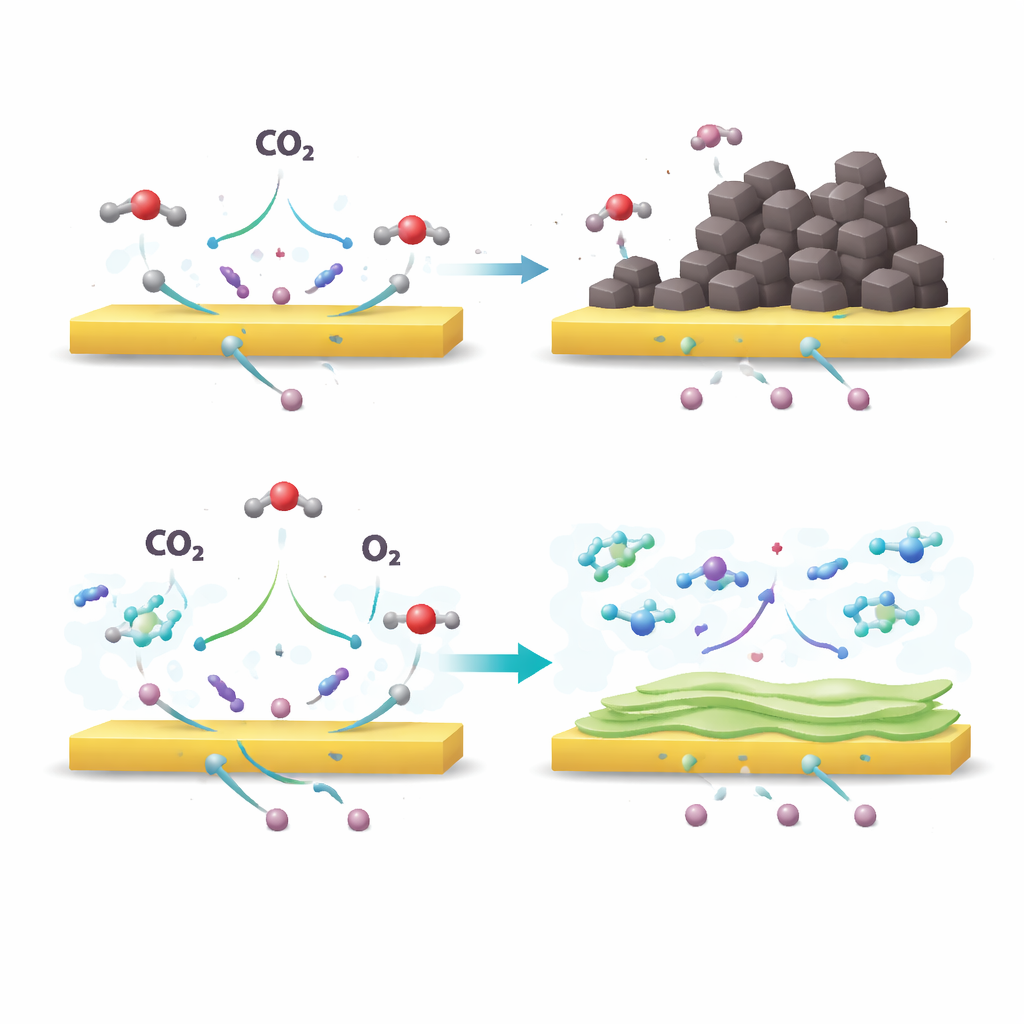
A key surprise is how strongly small amounts of oxygen reshape the battery’s behavior. When the cell runs in pure CO2, its discharge voltage drops sharply at high current, lowering the usable energy. The team traced this to sluggish formation of solid carbon, which tends to build up as dense, blocking flakes on the catalyst surface. Introducing oxygen into the gas mix changes the picture. With just 5% oxygen, the discharge voltage jumps by more than a third; at 20% oxygen and high current, it rises by more than half compared with the pure‑CO2 case. Structural measurements show that as oxygen is added, the amount of carbon formed shrinks, and the main solid product becomes lithium carbonate in a more open, sheet‑like form that is easier to make and remove.
Two Competing Pathways Inside the Cell
To understand why oxygen has such a strong effect, the authors combined in‑situ gas analysis with computer simulations. Under pure CO2, the reactions mostly occur right on the catalyst surface: CO2 adsorbs, reacts with lithium, and eventually produces both lithium carbonate and carbon. This surface pathway is where the slow carbon‑forming step drags down the voltage, especially at high current. When oxygen is present in sufficient amount, the mechanism shifts. Oxygen is first reduced on the surface, then its reactive forms dissolve into the liquid electrolyte and react with CO2 in solution. This “solution‑phase” route efficiently builds lithium carbonate without making carbon, and the product then precipitates back onto the surface. Calculations show that these solution reactions are energetically favorable, and experiments confirm that carbon nearly disappears at 20% oxygen.
Keeping Oxygen in the Sweet Spot
The study also shows that oxygen is gradually consumed during cycling and cannot simply be recycled inside the closed cell. As oxygen is used up, the discharge voltage slowly drifts back toward the lower values seen with pure CO2, and the carbon‑forming surface pathway takes over again. However, when the researchers purge the cell with fresh CO2/O2 gas, the higher voltage immediately returns, even when using a different, more conventional carbon catalyst. This suggests that maintaining a small, steady supply of oxygen is a general strategy to keep Li–CO2 batteries operating in the fast, carbon‑free regime.
What This Means for Future Energy Storage
For non‑specialists, the central message is that the exact mix of gases feeding a Li–CO2 battery can make or break its performance. In pure CO2, the battery tends to form energy‑wasting carbon deposits that lower voltage at practical power levels. Add a modest amount of oxygen, and the chemistry reorganizes into a cleaner, more efficient pathway that mainly makes lithium carbonate, raising the energy output and extending useful operation. By clarifying when and how these two pathways appear, and by demonstrating a durable catalyst–electrolyte combination, this work lays out engineering guidelines for future Li‑gas batteries that could both store large amounts of energy and help turn a greenhouse gas into a resource.
Citation: Papailias, I., Namaeighasemi, A., Ncube, M.K. et al. Pathways for sustainable reaction kinetics in Li-CO2 batteries. Nat Commun 17, 4048 (2026). https://doi.org/10.1038/s41467-026-69751-z
Keywords: lithium–carbon dioxide batteries, carbon capture, electrochemical energy storage, oxygen-enhanced kinetics, battery reaction mechanisms