Clear Sky Science · en
Doublet microtubule-associated tektins and enzymes differentially regulate sperm flagellar integrity and motility
Why tiny tail parts matter for fertility
For sperm, the ability to swim is everything. Each sperm cell relies on a long, whip-like tail to power its journey to the egg, and when that tail is built incorrectly or beats in the wrong way, infertility can result. This study zooms deep inside the tail’s microscopic scaffolding to ask a deceptively simple question: which specific molecules keep sperm tails intact and moving properly, and which ones quietly regulate their motion from within? By answering this, the work helps explain different forms of poor sperm motility seen in men and points toward more precise diagnoses of male infertility.
The inner skeleton of the sperm tail
At the core of every sperm tail is a highly ordered scaffold made of hollow tubes arranged in a classic “9+2” pattern: nine paired outer tubes encircling two central ones. These doublet tubes are not empty; they are lined and decorated with dozens of specialized proteins that stiffen the structure and coordinate its beating. The authors focus on four such proteins found in mouse sperm: two filament-forming “tektins” that reinforce the inside of the tubes, and two enzymes—a kinase and a phosphatase—that attach to the same framework. Using high-resolution cryo-electron microscopy, they map where these proteins sit and show how sperm tails are more structurally complex than similar beating structures in airways, with extra components tuned specifically for reproduction. 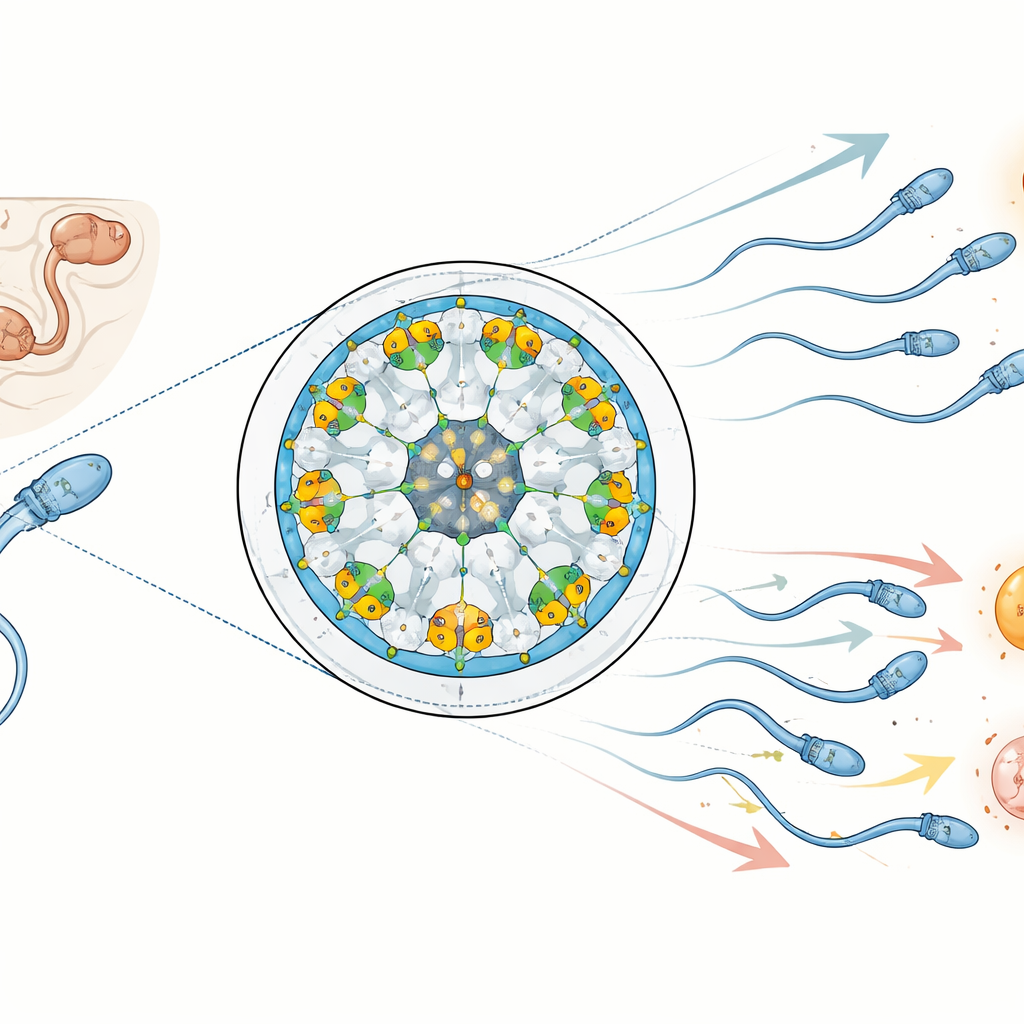
Switching off key genes in mice
To see what each of these proteins actually does in a living animal, the team created four lines of knockout mice that completely lack one of the target genes: Tekt1, Tekt5, Tssk6, or Dusp21. They then examined fertility, sperm counts, tail shape, and swimming ability. Males missing Tekt1 or Tssk6 were completely infertile, despite having normal-looking testes and normal numbers of sperm. In contrast, males lacking Tekt5 or Dusp21 produced litters similar to healthy mice, though subtle changes in tail behavior appeared in some cases. This split result shows that not all seemingly similar tail proteins are equally important: some are essential for fertility, others are more expendable or can be backed up by other molecules.
How structural filaments keep the tail stable
Tektins act like reinforcing rods running inside the doublet tubes. In sperm lacking TEKT1, cryo-electron microscopy revealed that the entire inner bundle of tektin filaments was almost completely missing, along with several partner proteins that depend on this bundle for anchoring. The overall tube pattern was still present, but more often misaligned or partially disorganized, and the tails were more likely to appear bent or coiled. Mechanical tests using ultrasound to shake the structures apart showed that these tektin-deficient tails broke down into free building blocks more readily, indicating weaker, more fragile scaffolds. Mice missing the sperm-specific TEKT5, by contrast, showed loss of only a smaller subset of inner proteins and much milder effects on tail architecture and swimming, reinforcing the idea that the conserved TEKT1-based bundle is the real backbone of motility.
How internal enzymes fine-tune motion
The two enzymes studied sit on or near the same doublet tubes but work in a different way: they adjust the chemical “on/off” state of many tail proteins by adding or removing phosphate groups. The kinase TSSK6 proved crucial. Sperm from Tssk6 knockout mice often lacked tails entirely or had severely bent ones, and their movement was highly abnormal. Detailed analysis of protein phosphorylation patterns showed that hundreds of sites across many tail components were mis-regulated, including ones important for connecting the head to the tail. In other words, when this single enzyme is missing, the entire internal signaling network that coordinates beating and structural integrity goes awry. By contrast, removing the phosphatase DUSP21 produced surprisingly normal sperm, suggesting that other phosphatases can compensate for its loss.
Linking mouse genetics to human infertility
By pairing deep structural imaging with global protein and phosphorylation measurements, the study shows that some inner tail proteins mainly serve as physical reinforcements, while others act as control knobs for the beating machinery. Loss of TEKT1 leads to sperm that look mostly normal but swim poorly—a pattern resembling certain patients whose sperm tails are intact yet sluggish. Loss of TSSK6, on the other hand, causes dramatic tail deformities similar to a severe condition in men where many sperm have absent, bent, or coiled tails. 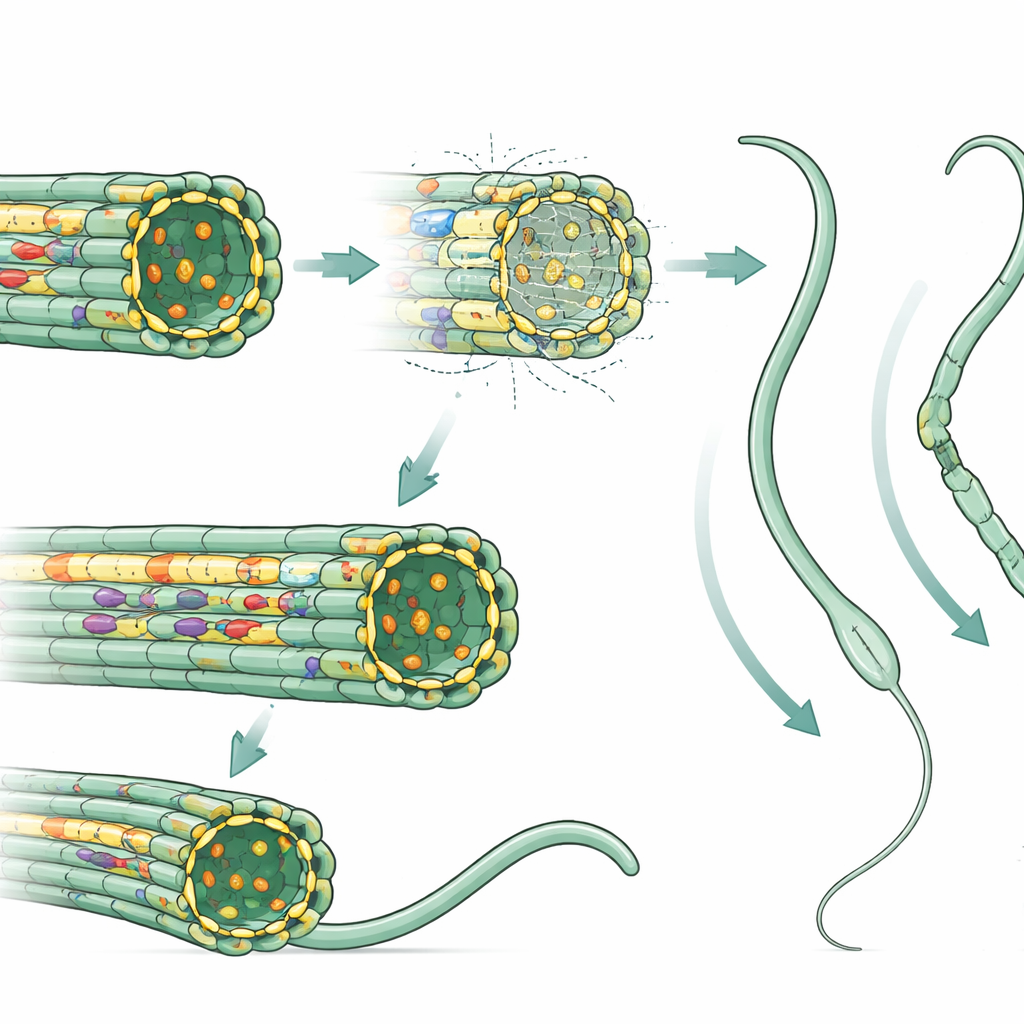
Citation: Liu, Q., Zhou, L., Liang, X. et al. Doublet microtubule-associated tektins and enzymes differentially regulate sperm flagellar integrity and motility. Nat Commun 17, 3316 (2026). https://doi.org/10.1038/s41467-026-69714-4
Keywords: sperm flagellum, male infertility, microtubule structure, protein phosphorylation, mouse genetics