Clear Sky Science · en
Synergistic non-bonding diatomic Pt sites for efficient hydrogenation of nitro compounds
Turning Harsh Chemistry into Gentle Reactions
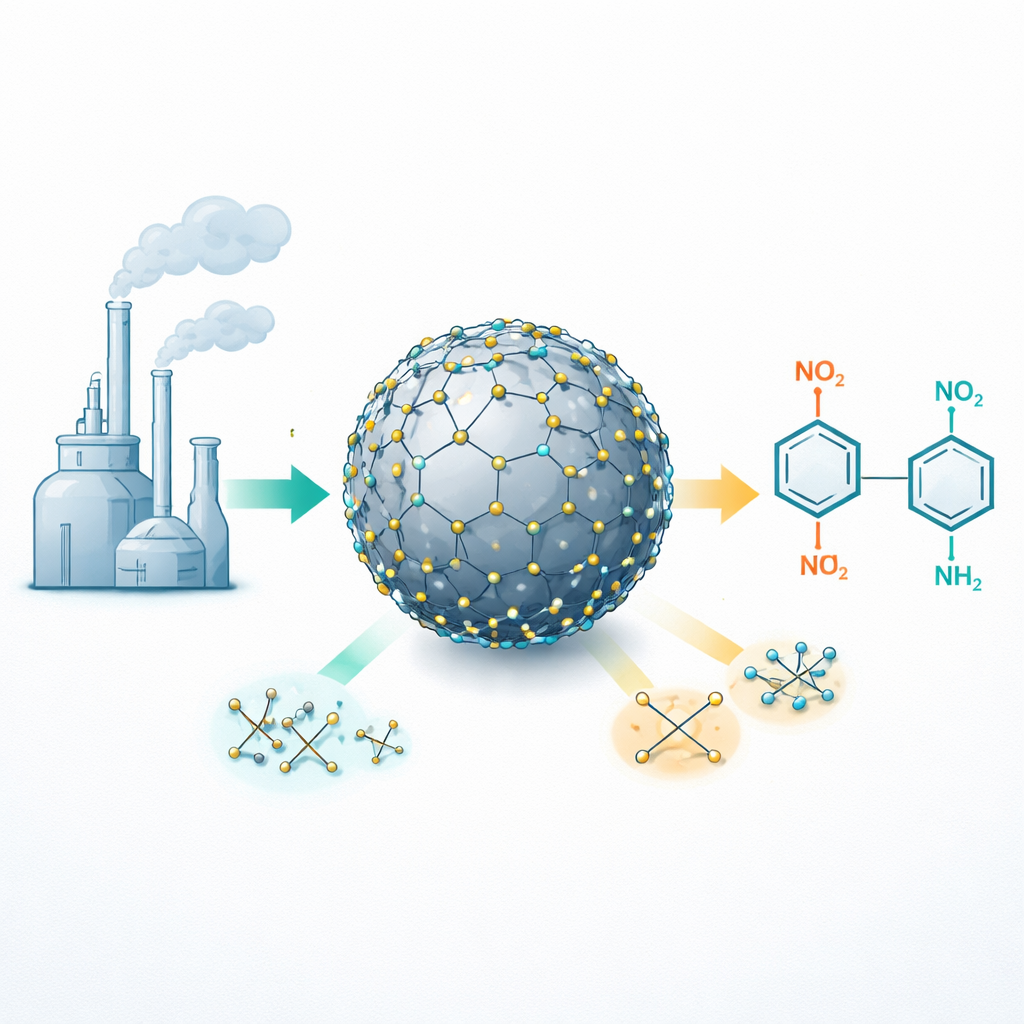
Chemical plants make countless useful products by carefully adding hydrogen to particular parts of complex molecules. Doing this cleanly and selectively saves energy, reduces waste, and lowers costs, but it is surprisingly hard: the same metal particles that speed up useful reactions often trigger unwanted side reactions. This study shows how arranging precious metal atoms two at a time on a carbon support can deliver fast, gentle, and highly selective chemistry for important industrial building blocks.
Why This Reaction Matters for Everyday Materials
One key target in this work is m-phenylenediamine, a starting material for high-performance plastics, heat-resistant fibers, dyes, and some medicines. It is usually made by hydrogenating another chemical called m-dinitrobenzene. That transformation happens in several steps, and after the first nitro group is reduced, the electronic structure and shape of the molecule change in ways that make the second step harder. At the same time, many side products can form and stick to the catalyst surface, blocking it and creating extra separation costs. Industry has long relied on platinum-based catalysts for this job, but conventional particles waste much of the precious metal and still struggle to combine high speed, high selectivity, and long life.
Placing Platinum Atoms in Just the Right Pairs
The researchers tackled this problem by engineering a new type of catalyst where platinum atoms sit mainly in closely spaced pairs on a tiny carbon support made from nanodiamond coated with a thin layer of graphene. Using a precise technique called atomic layer deposition, they first anchor single platinum atoms at defects in the graphene shell, then, in a second step, deposit additional platinum so that a nearby partner atom is captured at a controlled distance of about four-tenths of a nanometer. Advanced electron microscopy and X-ray measurements confirm that, at this spacing, the two atoms do not form an ordinary metal–metal bond, yet they are electronically linked through the carbon network, creating what the authors call non-bonding diatomic sites.
How Paired Atoms Outperform Single Atoms and Clusters
To understand why this arrangement works so well, the team compared four kinds of platinum on the same nanodiamond–graphene support: isolated single atoms, the new diatomic pairs, small clusters, and larger nanoparticles. In hydrogenation tests, only the diatomic catalyst achieved complete conversion of m-dinitrobenzene to m-phenylenediamine with more than 99% selectivity under mild conditions, and it maintained this performance over at least five reaction cycles. Single-atom catalysts used the metal efficiently but struggled to split hydrogen and complete the full multi-step reaction, while clusters and nanoparticles were very active but bound products and intermediates too strongly, which encouraged unwanted coupling reactions that formed heavy byproducts.
Watching Molecules React and Simulating Their Journey
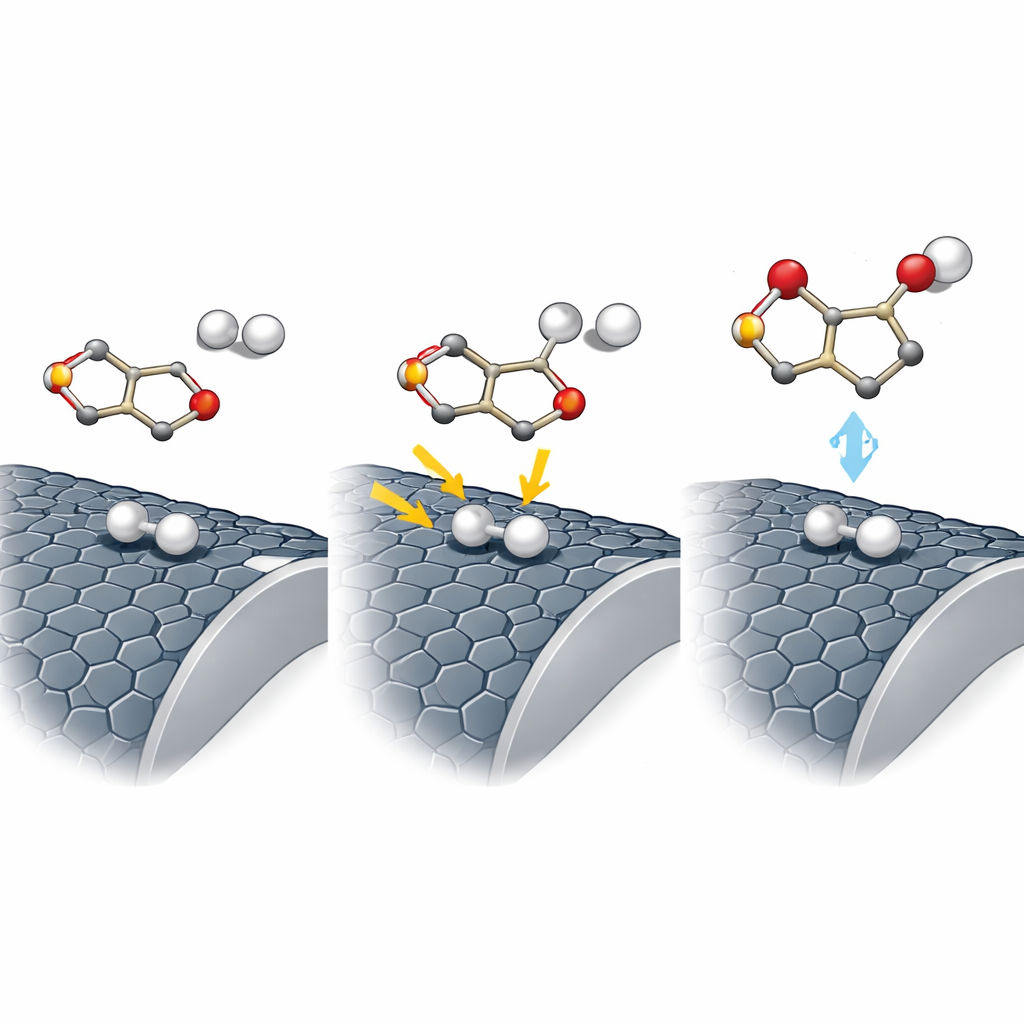
The authors combined in situ infrared spectroscopy with detailed computer simulations to watch how molecules interact with the different platinum arrangements. On single atoms, nitro groups from the reactant could attach, but hydrogen did not split easily, stalling the reaction. On the platinum pairs, one atom mainly held the nitro-bearing molecule while the neighboring atom remained available to grab and split hydrogen, allowing both to be activated side by side. Importantly, the electronic interaction between the two atoms weakened the grip on the final diamine product just enough for it to leave the surface promptly. On clusters and extended metal surfaces, by contrast, both reactants and products lay flat and stuck strongly, crowding the surface and favoring the formation of complex byproducts through nitrogen–nitrogen coupling.
From One Reaction to a Broad Catalytic Strategy
Beyond this single industrial reaction, the platinum-pair catalyst proved versatile, rapidly and selectively hydrogenating a range of nitro-containing aromatic molecules, including a key precursor for polyurethane foams, under gentle conditions and with excellent recyclability. The work demonstrates that carefully spaced pairs of metal atoms can bridge the gap between highly dispersed single-atom catalysts and more conventional metal particles, combining efficient use of precious metals with finely tuned reactivity. For non-specialists, the main takeaway is that the way we arrange atoms on a surface can dramatically change how cleanly and efficiently a chemical reaction runs, offering a path to greener, more economical production of many everyday materials.
Citation: Chen, M., Jing, Y., Ge, X. et al. Synergistic non-bonding diatomic Pt sites for efficient hydrogenation of nitro compounds. Nat Commun 17, 3199 (2026). https://doi.org/10.1038/s41467-026-69701-9
Keywords: selective hydrogenation, nitroaromatics, dual-atom catalysts, platinum catalysis, nanodiamond graphene