Clear Sky Science · en
Enhanced superconductivity in the compressively strained bilayer nickelate thin films by pressure
Why squeezing these materials matters
Superconductors are materials that can conduct electricity with zero resistance, promising ultra-efficient power lines, faster electronics, and powerful magnets. But most known superconductors only work at very low temperatures, making them hard to use in everyday technology. A new class of materials based on nickel, called bilayer nickelates, have recently shown superconductivity at temperatures above the boiling point of liquid nitrogen when squeezed under high pressure. This study asks a simple but important question: can we get even better superconductivity by combining the effects of a carefully chosen substrate strain with external pressure in ultra-thin nickelate films?
Building a delicate sandwich of atoms
The researchers engineered a thin "sandwich" of two closely related nickelate layers on a crystal substrate. One layer contains lanthanum, praseodymium, and nickel; the other adds a small amount of strontium. This structure naturally feels an in-plane compressive strain from the underlying SrLaAlO4 substrate, which slightly squashes the film sideways and stretches it vertically. X-ray measurements confirmed that the film lattice is about 2% compressed in-plane and about 1.5% elongated along the vertical direction, forming a stable bilayer structure only a few unit cells thick. Transport measurements showed that at ambient pressure these films are metallic and become superconducting with onset temperatures between roughly 21 and 34 kelvin, remarkably stable even after a month in air.
Turning the pressure dial to boost performance
To see how pressure tunes superconductivity, the team pressed on the films using two types of high-pressure cells, reaching up to 13 gigapascals, more than 100,000 times atmospheric pressure. At modest pressures up to about 2.6 GPa, the electrical resistance in the normal (non-superconducting) state dropped and the superconducting onset temperature rose steadily from around 29 K to about 35 K. 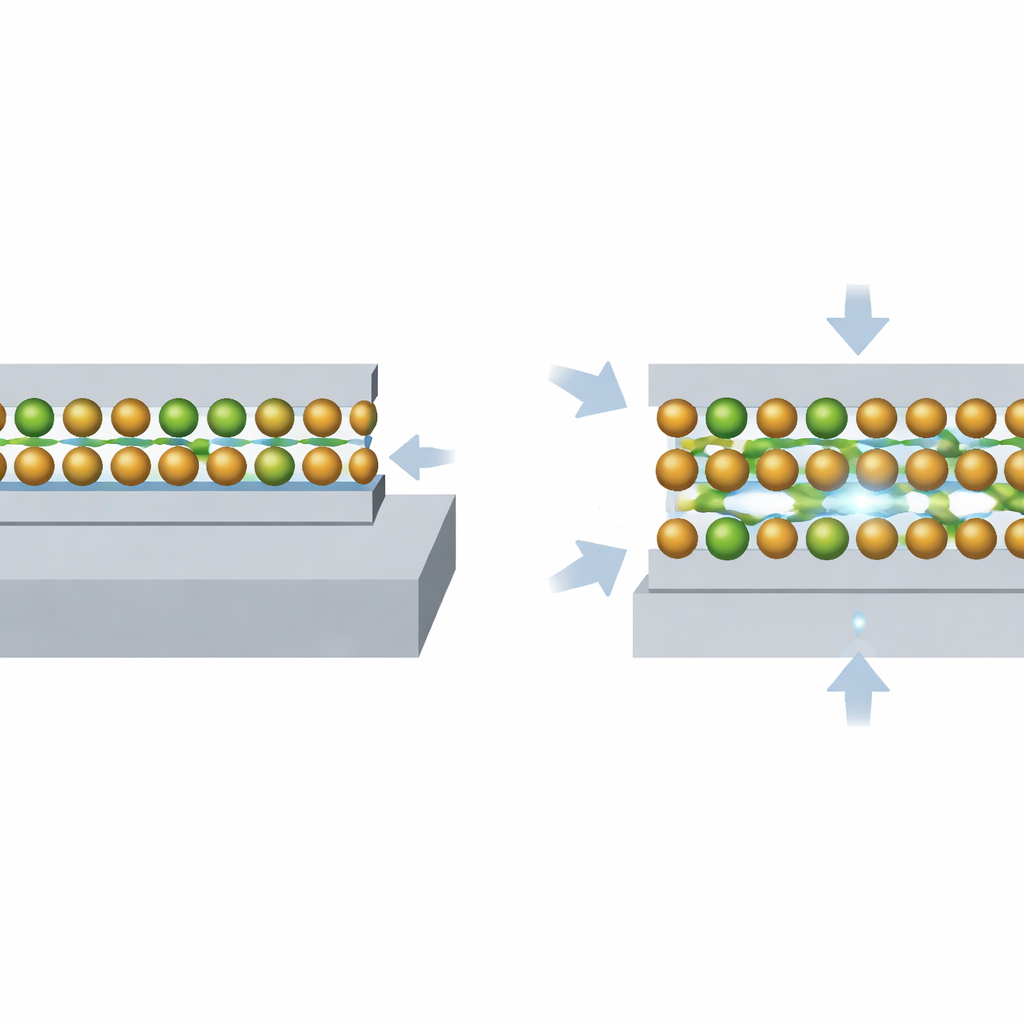
From good metal to weak insulator
Pressure also changed how the films behaved just above the superconducting transition. At lower pressures, the films showed metallic behavior, with resistance increasing smoothly with temperature. As pressure grew beyond roughly 9 GPa, the low-temperature normal state began to look weakly insulating: resistance started to creep upward as temperature fell, following a slow logarithmic trend. This crossover from metallic to weakly insulating behavior happened at nearly the same pressure where the superconducting temperature reached its maximum and then turned downward. The authors argue that this unusual insulating tendency is an intrinsic feature of the strained bilayer films under strong compression, likely linked to emerging electronic instabilities such as a density-wave-like order, rather than simply defects or damage caused by the pressure medium. 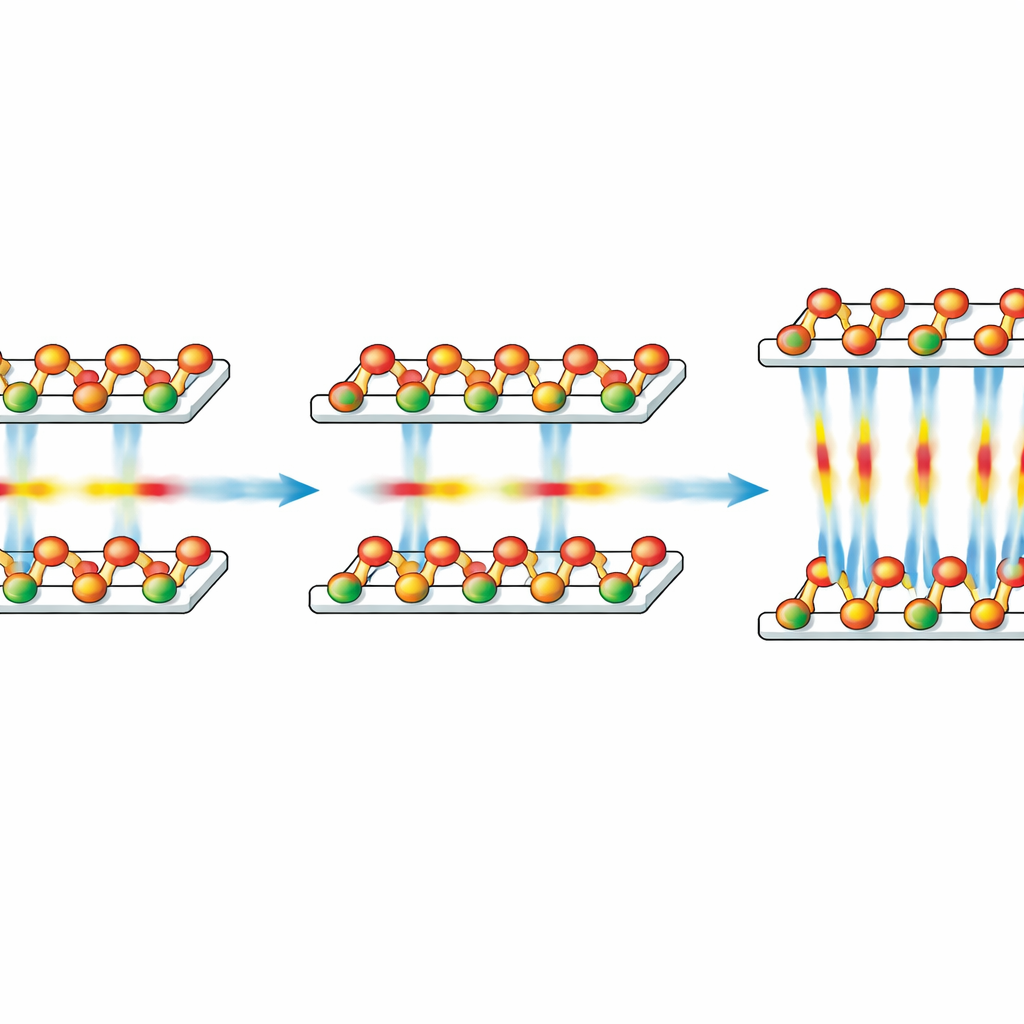
What theory says is happening inside
To understand the microscopic origin of these changes, the team carried out advanced electronic-structure calculations tailored to a film whose in-plane lattice is clamped by the substrate. Applying pressure in this model mainly shortens the distance between the two nickel-oxygen layers, rather than changing the in-plane bond angles as in bulk crystals. As the vertical spacing shrinks, a flat energy band with strong out-of-plane orbital character (the so-called γ pocket) moves closer to the Fermi level and gains bandwidth, while electrons move between different nickel orbitals. This enhances the hybridization between in-plane and out-of-plane orbitals, increases the overall metallic character, and strengthens magnetic spin fluctuations both within each layer and between the two layers. These cooperative effects are known to provide the “glue” for electron pairing in unconventional superconductors, naturally explaining why the superconducting temperature rises with pressure and then saturates once these changes level off.
What this means going forward
In simple terms, this work shows that pressing on already strained bilayer nickelate films gives nature a more favorable geometry for superconductivity: the two active layers move closer together, their electrons mix more strongly, and magnetic fluctuations become more effective at binding electrons into lossless current-carrying pairs. The result is a significant boost of the superconducting onset temperature from about 30 K to nearly 50 K, along with clear clues about how the electronic structure evolves under pressure. These insights suggest that by carefully controlling both strain and pressure—or mimicking their effects through chemical design—it may be possible to push nickelate superconductors to even higher operating temperatures and move them closer to real-world applications.
Citation: Li, Q., Sun, J., Bötzel, S. et al. Enhanced superconductivity in the compressively strained bilayer nickelate thin films by pressure. Nat Commun 17, 3276 (2026). https://doi.org/10.1038/s41467-026-69660-1
Keywords: nickelate superconductors, thin films, high pressure, strain engineering, electronic correlations