Clear Sky Science · en
Shrinkage-transfer-assisted printing of microcircuits on fibers
Lighting up clothing threads
Imagine if the very threads in your T‑shirt or safety vest could act like tiny circuit boards, powering lights, sensors, or displays without bulky gadgets sewn on top. This paper describes a new way to print microscopic electronic circuits directly onto thin fibers, so that ordinary-looking yarns can quietly hide sophisticated electronics for smart clothing, medical monitoring, and visual communication.
Why putting circuits on threads is so hard
Modern electronics are built on flat, rigid boards, where tiny metal lines can be patterned with great precision. Fibers, by contrast, are long, narrow, and curved. Standard printing and photolithography methods that work beautifully on wafers or plastic sheets struggle to wrap around a cylinder only a few hundred micrometers across. As a result, most “electronic textiles” today still rely on attaching small rigid components or coating fibers along their length, which limits how dense, complex, and comfortable these systems can be.
A shrink-and-wrap approach
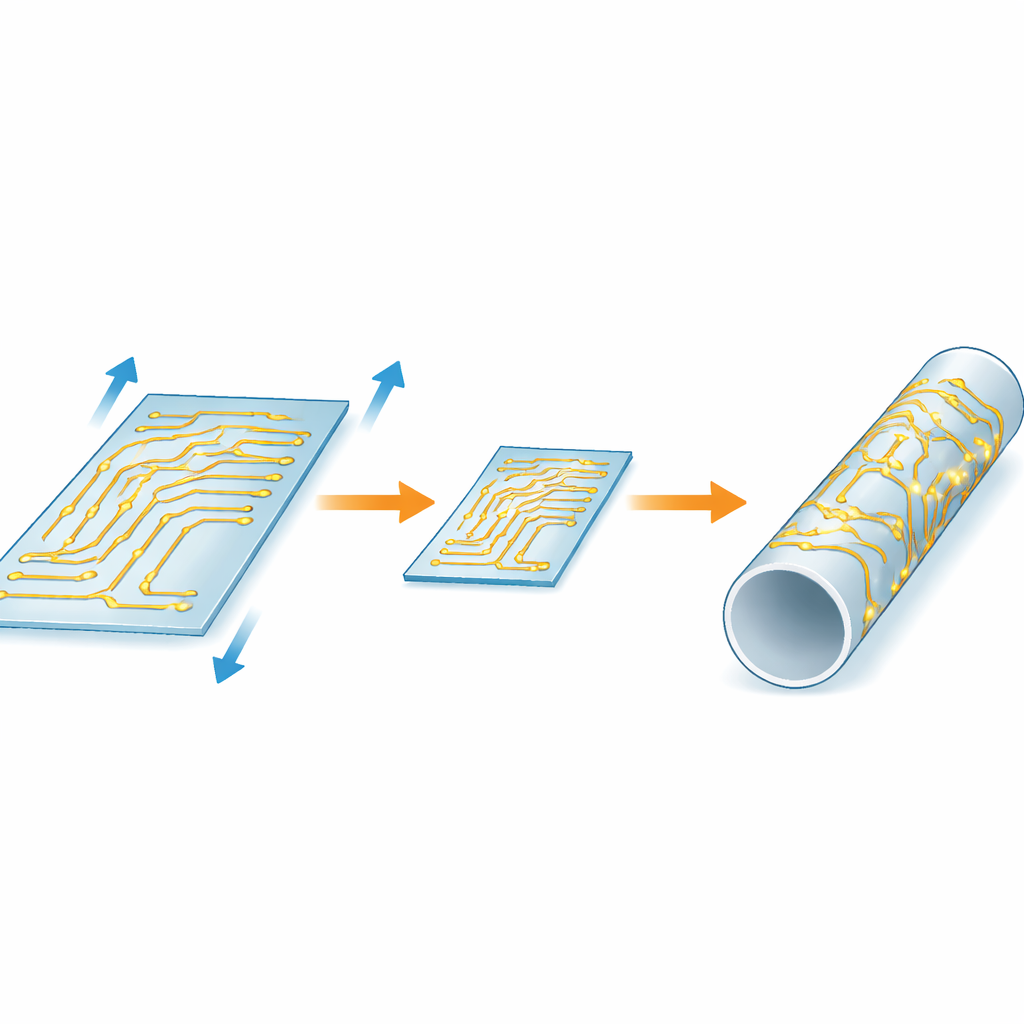
The researchers solve this shape mismatch with a two-step method they call shrinkage-transfer-assisted printing, or STAP. First, they print liquid-metal-based circuits onto a flat, stretchy silicone sheet using ordinary screen-printing equipment. The metal used is a gallium–indium alloy that is liquid near room temperature but can be handled as tiny particles stabilized in water by a silk protein called sericin. After printing, they relax the pre-stretched silicone so it contracts. As it shrinks, the patterned metal lines are pulled closer together, “miniaturizing” the circuit by up to 80% in area while keeping the pattern intact. During this shrinkage, the particles are squeezed until their outer shells break and merge into continuous conductive paths.
Gently moving circuits onto fibers
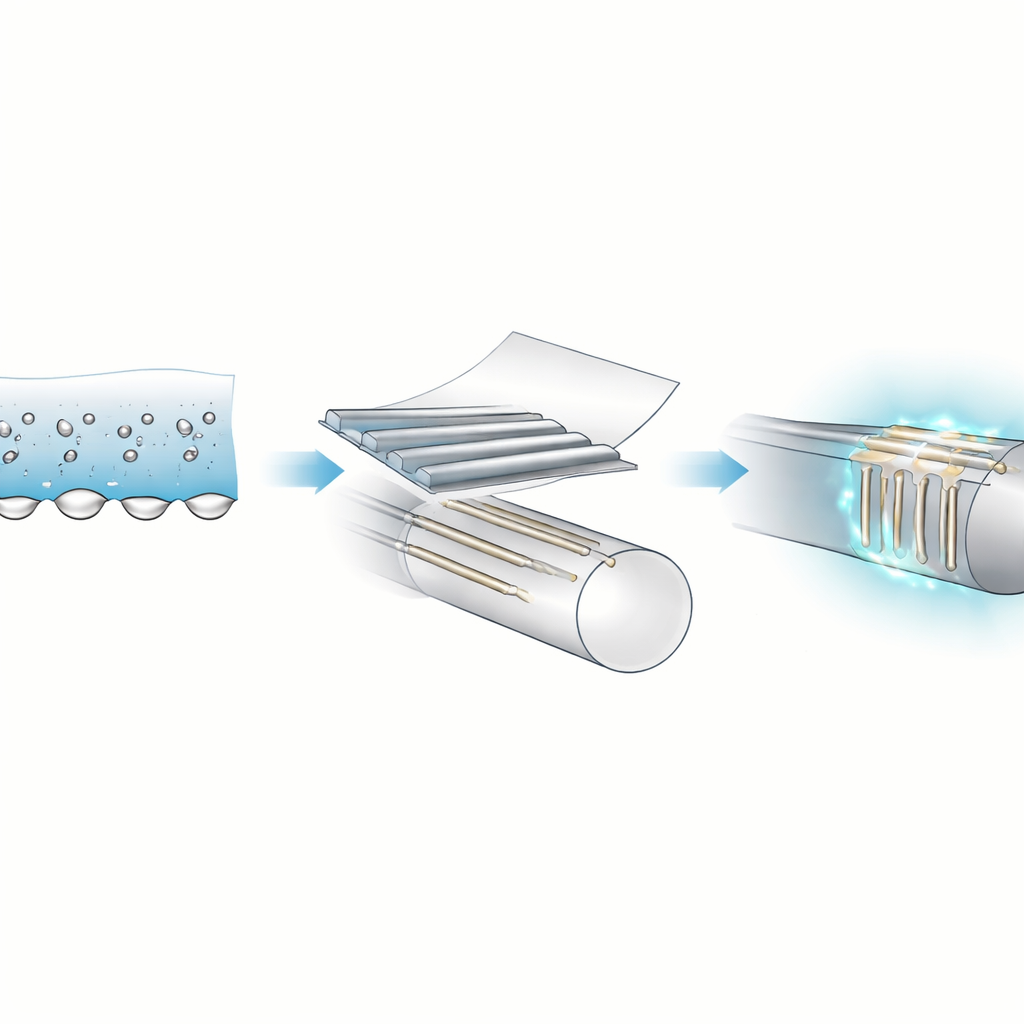
In the second step, these shrunken microcircuits are moved from the flat sheet onto a real fiber. The team uses an ultrathin film of polyvinyl alcohol (PVA) as a temporary carrier. The circuits are peeled from the silicone onto the PVA, then the PVA with its metal pattern is laid over an aramid fiber. When a small amount of water is added at the interface, capillary forces naturally pull the liquid around the fiber, softening the PVA and wrapping it snugly. As the PVA dissolves away, it leaves behind a continuous ring of metal lines that fully encircle the fiber, with variations in gap size of less than 5% around the 360° circumference.
Durable, high-resolution circuits in a single strand
This approach achieves circuit features as small as 60 micrometers wide, and electrode gaps down to 35 micrometers, surpassing typical limits of screen printing. Importantly, the resulting fiber devices are not fragile showpieces: they retain about 98.6% of their electrical conductivity even after 16,000 bending cycles around a radius of 1.6 centimeters, and can be bent down to a few millimeters before serious performance loss. The liquid nature of the gallium–indium alloy allows the metal pathways to flow slightly as the fiber bends, avoiding cracks that would plague solid wires.
From smart fiber to tiny display
To showcase what these fibers can do, the authors build a threadlike electroluminescent display. After forming the microcircuits on an aramid fiber, they spray on a light-emitting layer made from tiny zinc sulfide particles embedded in a soft polymer. When an alternating voltage is applied, strong electric fields appear between neighboring electrodes on the fiber, exciting the particles so they glow. By carefully tuning the spacing between electrodes, the team finds a sweet spot—around 50–60 micrometers—where the light is bright without electrical breakdown. A clever wiring scheme allows several individual light “pixels” along a single fiber to be controlled independently using only a handful of contact points.
What this means for future clothing
In simple terms, this work turns a flat, easy-to-print circuit into a tiny, tough, and flexible circuit wrapped around a hair-like thread. The STAP method combines familiar large-scale printing with controlled shrinking and a self-driven wrapping process to overcome long-standing geometric hurdles in electronic textiles. The resulting fibers can host dense, durable circuits and even multi-pixel displays, all within a single strand that can be woven like any other yarn. As the technique is refined and scaled up, it points toward everyday garments that quietly incorporate displays, sensors, and communication functions into their very weave.
Citation: Jin, J., Zou, M., Liu, D. et al. Shrinkage-transfer-assisted printing of microcircuits on fibers. Nat Commun 17, 2864 (2026). https://doi.org/10.1038/s41467-026-69640-5
Keywords: fiber electronics, wearable displays, liquid metal circuits, electronic textiles, flexible microcircuits