Clear Sky Science · en
Approaching theoretical polarization limit in HfZrO2/HfLaO2 multilayers
Making Tiny Memories Work Better
From smartphones to data centers, modern electronics are hungry for faster, smaller, and more energy‑efficient memory. One promising route uses a special class of materials called ferroelectrics, which can remember an electric state even when the power is off. This paper shows how a carefully engineered stack of ultrathin oxide layers pushes a well‑known ferroelectric, based on hafnium oxide, close to its theoretical performance limit—bringing practical, robust, next‑generation memory devices a step closer to reality.
Why Hafnium Films Matter for Future Chips
Hafnium‑based ferroelectrics are exciting because they can be made as extremely thin films and are compatible with standard silicon chip technology. In theory, the electric polarization—the measure of how strongly the material can hold an electric state—could reach very high values. Yet, most experiments have fallen short of these predictions. The difficulty stems from the material’s tendency to slip into less useful crystal structures and from limitations in the usual way its internal atoms switch between “on” and “off” states. Finding a practical way to stabilize the right crystal phase and to unlock the more powerful switching route has been a central challenge.
Building a Better Stack of Atomic Layers
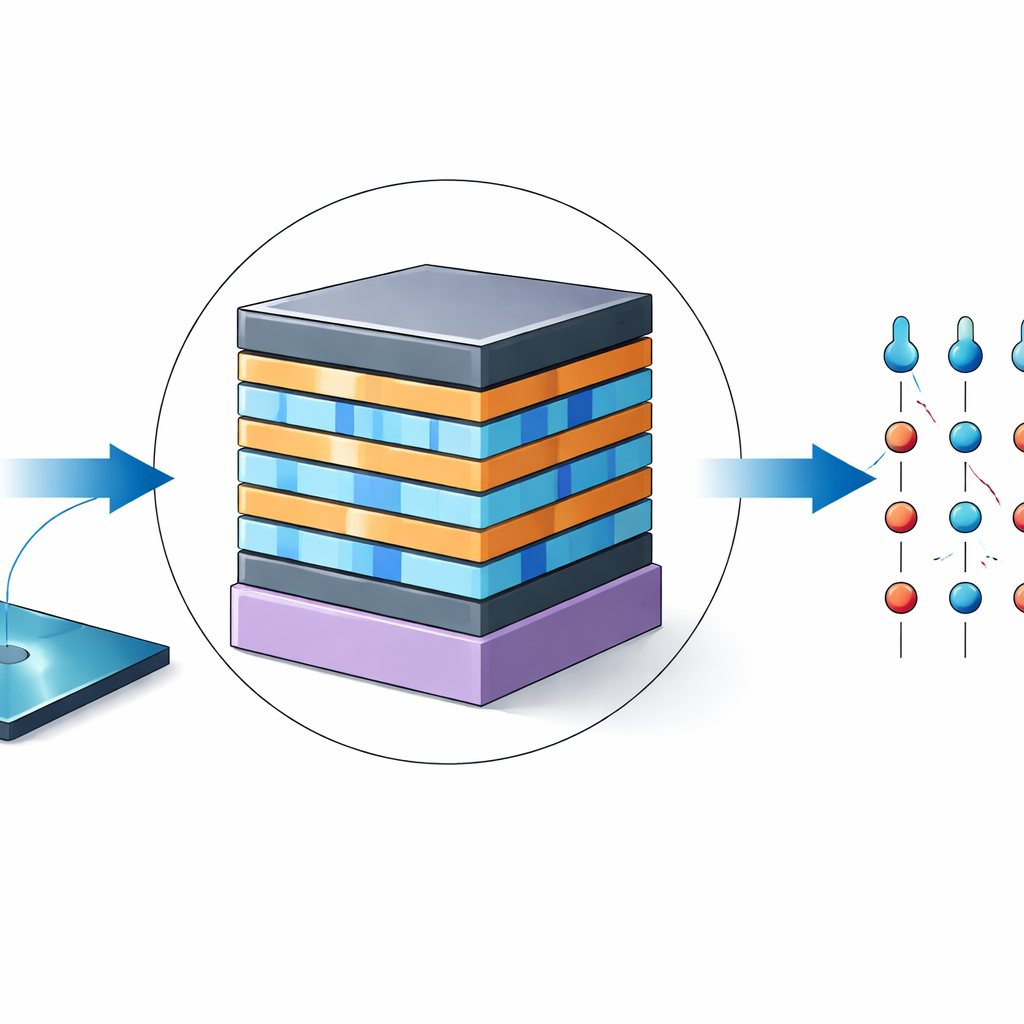
The authors tackle this by constructing a multilayer structure only about seven billionths of a meter thick. They alternate between two closely related materials: hafnium–zirconium oxide (HZO) and hafnium–lanthanum oxide (HLO), each layer less than a nanometer thick, all grown on a conductive base layer and a standard oxide substrate. Using advanced X‑ray diffraction and electron microscopy, they show that these alternating layers lock each other into a slightly distorted crystal arrangement. This distortion, created by in‑plane compressive strain as the larger lanthanum‑containing layers are squeezed by their neighbors, stabilizes the ferroelectric phase that devices need and suppresses unwanted secondary phases.
Record Polarization and Long‑Lasting Performance
Electrical tests on these tiny stacks reveal a record remnant polarization for such epitaxial hafnium‑based films. At room temperature, the multilayer shows about 56 microcoulombs per square centimeter, and when extrinsic effects are minimized by cooling to 10 kelvin, the intrinsic value remains around 40 microcoulombs per square centimeter. When translated to the main polarization direction of the crystal, this corresponds to roughly 69 microcoulombs per square centimeter—very close to the theoretical maximum. Importantly, the films endure up to three billion switching cycles with only minor degradation and very little “wake‑up” behavior, meaning they reach high performance without needing extensive pre‑conditioning.
How Doping and Strain Change the Atomic Dance
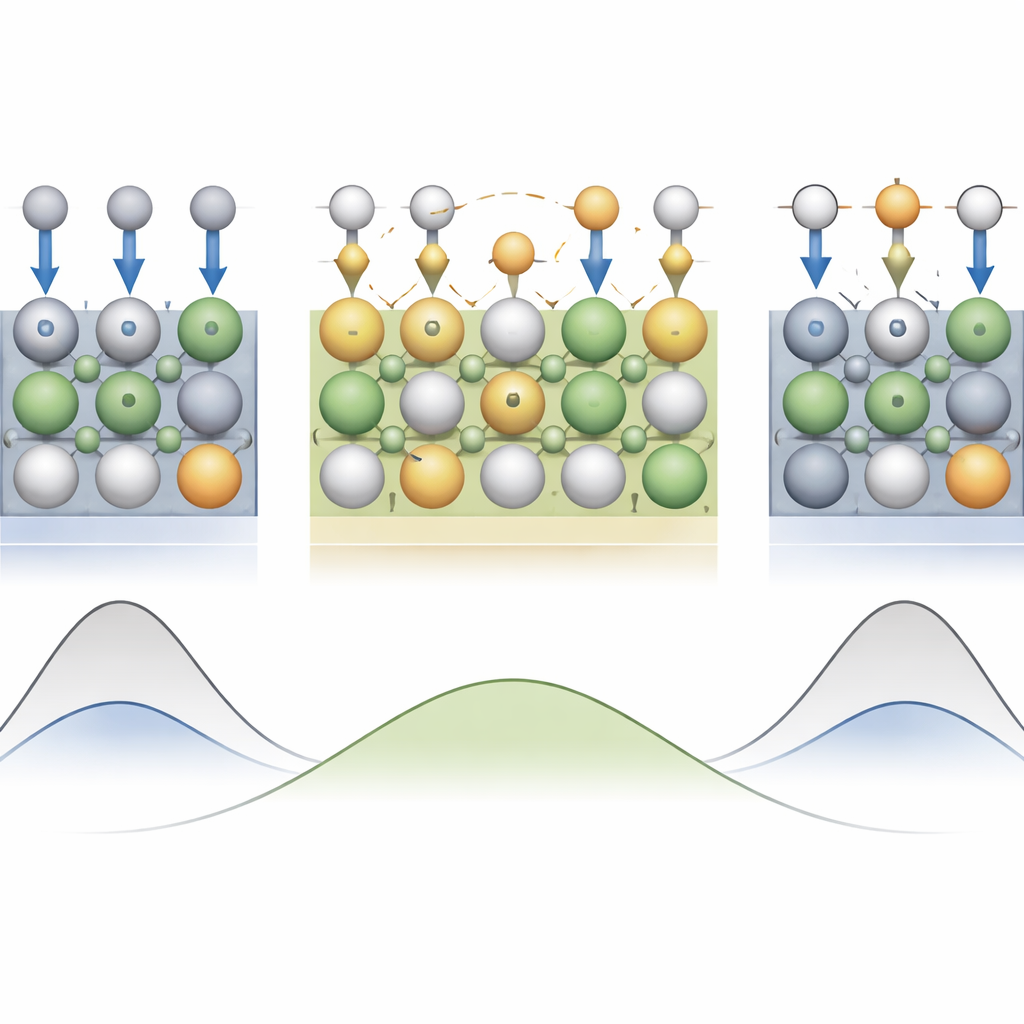
To understand why the polarization becomes so large, the researchers use quantum‑mechanical computer simulations. They compare two ways that the internal electric dipoles can flip. In the common route, certain oxygen atoms move without crossing key atomic planes, giving a moderate polarization. In the alternative “traversal” route, these oxygen atoms cross those planes, which in theory yields a much larger polarization but usually costs too much energy. The calculations show that lanthanum atoms in the lattice dramatically lower the energy barrier for this higher‑yield path, especially under the compressive strain produced by the multilayer design. The result is that the material naturally favors the more powerful switching mode, achieving near‑limit polarization while remaining structurally stable.
What This Means for Everyday Electronics
In simple terms, this work shows how stacking and gently straining ultrathin oxide layers, while adding a small amount of a carefully chosen element, can coax a material into behaving almost as well as theory allows. The hafnium‑based multilayers described here combine high, mostly intrinsic polarization with durability and compatibility with existing chip processes. Such advances may translate into denser, faster, and more energy‑efficient nonvolatile memories and logic components, helping future devices store more information in smaller, cooler, and more reliable packages.
Citation: Shi, S., Xi, H., Su, H. et al. Approaching theoretical polarization limit in HfZrO2/HfLaO2 multilayers. Nat Commun 17, 3103 (2026). https://doi.org/10.1038/s41467-026-69634-3
Keywords: hafnium oxide ferroelectrics, ultrathin multilayer films, high polarization memory, strain engineered oxides, La-doped HfZrO2