Clear Sky Science · en
Moiré superlattice-driven bionic hydrogel robot with programmable multifunctionality
Soft robots that squeeze where people cannot go
Many hidden parts of our technology, from power transformers to industrial pipelines, can overheat long before anyone notices. Inspecting these cramped, twisting spaces is difficult for rigid machines and impossible for humans. This study introduces a tiny, squishy robot made of water-rich gel that moves and senses using light, much like a cautious sea creature feeling its way through a reef. Such machines could one day patrol hard‑to‑reach places, quietly looking for dangerous hot spots before they turn into failures.
A sea anemone as a design blueprint
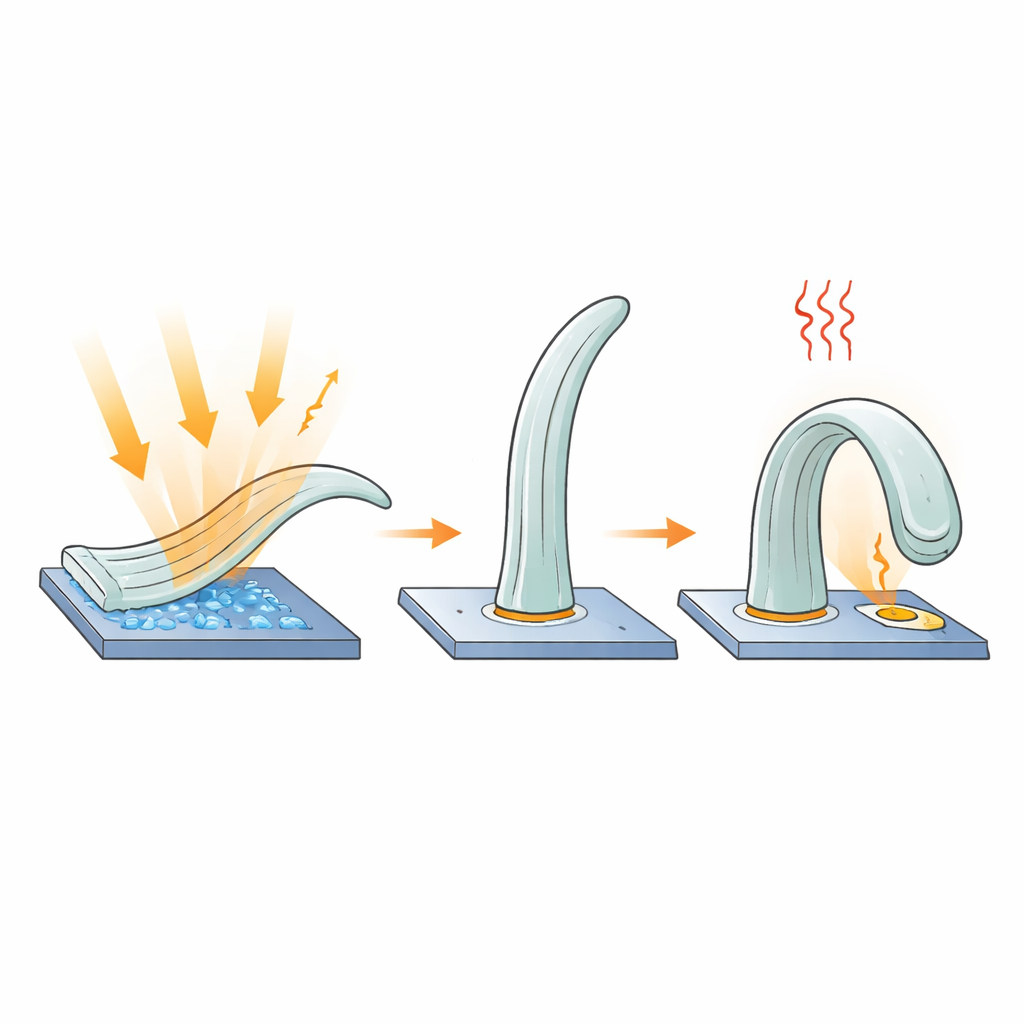
The researchers took inspiration from sea anemones, which anchor themselves and wave their tentacles to explore their surroundings. Their robot, called an anemone‑like light‑driven hydrogel robot, has a soft base and several upright tentacles. The entire body is made from a temperature‑sensitive hydrogel, a jellylike material that shrinks when warmed and swells again when cooled. By shining light of different colors on different parts of the robot, the team can make the base crawl and the tentacles bend, allowing the machine to both move and “feel” its environment without any rigid joints or traditional motors.
A smart material hidden inside the gel
At the heart of this robot lies a paper‑thin coating and fine particles of a special stacked material made from black phosphorus and tungsten disulfide. When these two ultra‑thin crystals are laid on top of each other with a slight mismatch, they form a repeating pattern known as a moiré superlattice. This pattern changes how electrons and vibrations behave inside the material, making it especially good at absorbing light in the near‑infrared range and turning that energy into both heat and electric current. Tests showed that this moiré material heats up quickly and efficiently under certain wavelengths and produces strong electrical signals when illuminated, outperforming each ingredient on its own.
Light‑powered motion and touch‑free heat sensing
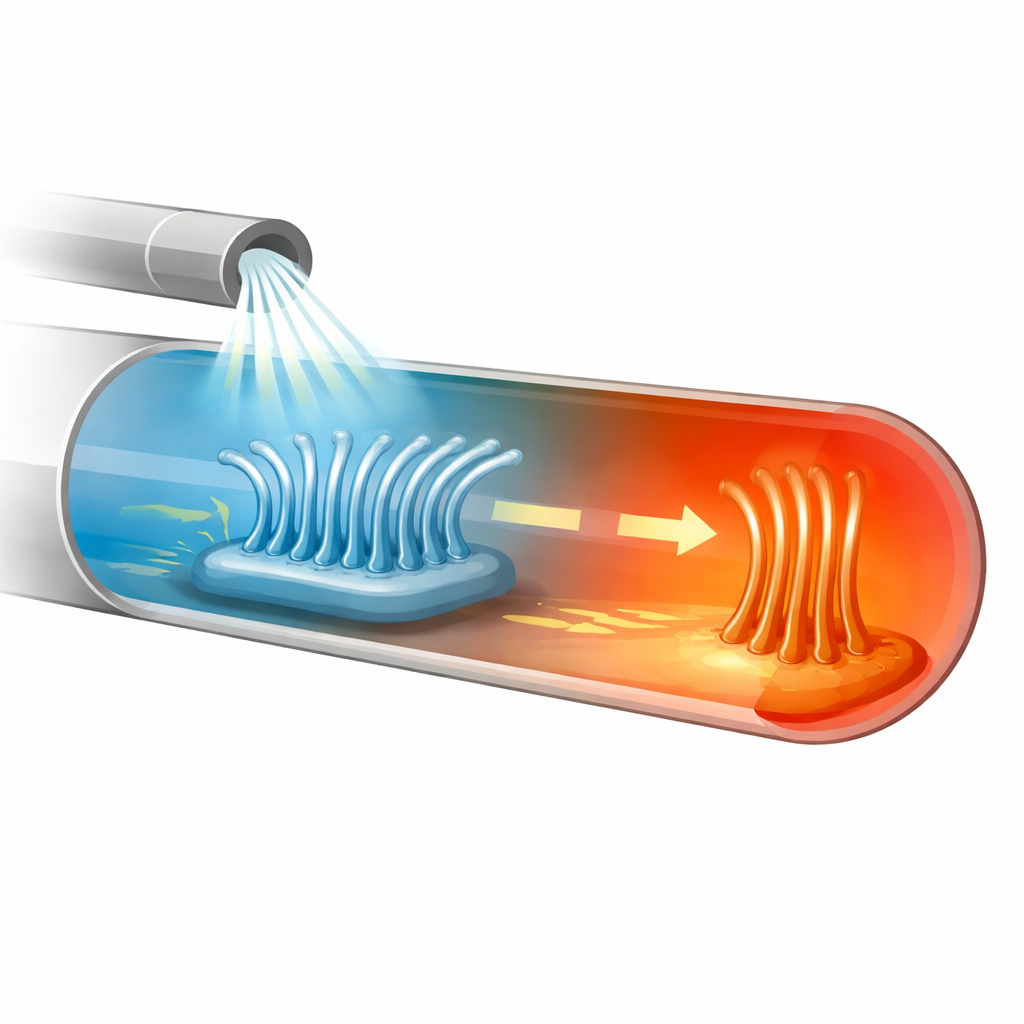
The team embedded this moiré material throughout the robot’s base and coated it on the surface of each tentacle. When red light shines on one side of the base, that region warms slightly, causing the gel there to shrink and bend. As the light is switched on and off, this bending and relaxing repeats, and friction with the surface beneath converts the cycle into a slow, inchworm‑like crawl. Different light intensities and flashing speeds tune how fast the robot moves. The tentacles behave differently: when they are exposed to near‑infrared light, similar to the heat given off by an overheated component, they contract downward. This motion brings the moiré‑coated tip into contact with a tiny metal electrode, closing an electrical path so that the light‑generated current can be measured outside the robot.
Hunting hot spots in cramped equipment
To show how this could matter in the real world, the researchers placed their soft robot inside a curved plastic tube standing in for an oil‑filled transformer pipe. By driving the base with harmless red light, they guided the robot along the tube. When a tentacle passed an artificial hot spot, near‑infrared radiation triggered it to bend and touch the electrode, sending a clear electrical pulse. The robot could distinguish normal and overheated regions over a useful distance, all while surviving repeated heating‑cooling cycles with only minor performance loss. Because it is soft, narrow, and highly flexible, it can slip through bends and tight passages that would block rigid inspection tools.
A general recipe for future soft machines
Beyond this single device, the authors outline a broader design strategy: treat a soft robot as a set of modules—a driving part that converts light into motion, a sensing part that converts light or heat into signals, and a flexible gel body that ties everything together. By choosing different layered two‑dimensional materials and tuning their moiré patterns, engineers could swap in modules that respond to other colors of light or other environmental cues, such as chemicals or biological markers. In simple terms, the study shows how to build soft, light‑controlled machines that can both move and feel using the same embedded material, opening a path toward gentle, intelligent robots that watch over hidden corners of our engineered world.
Citation: Zhang, L., Zhang, Y., Li, X. et al. Moiré superlattice-driven bionic hydrogel robot with programmable multifunctionality. Nat Commun 17, 2889 (2026). https://doi.org/10.1038/s41467-026-69611-w
Keywords: soft robotics, hydrogel robot, moiré materials, infrared sensing, overheating detection