Clear Sky Science · en
Computing-in-memory architecture for Kolmogorov-Arnold networks based on tunable Gaussian-like memory cells
Why this new computer chip idea matters
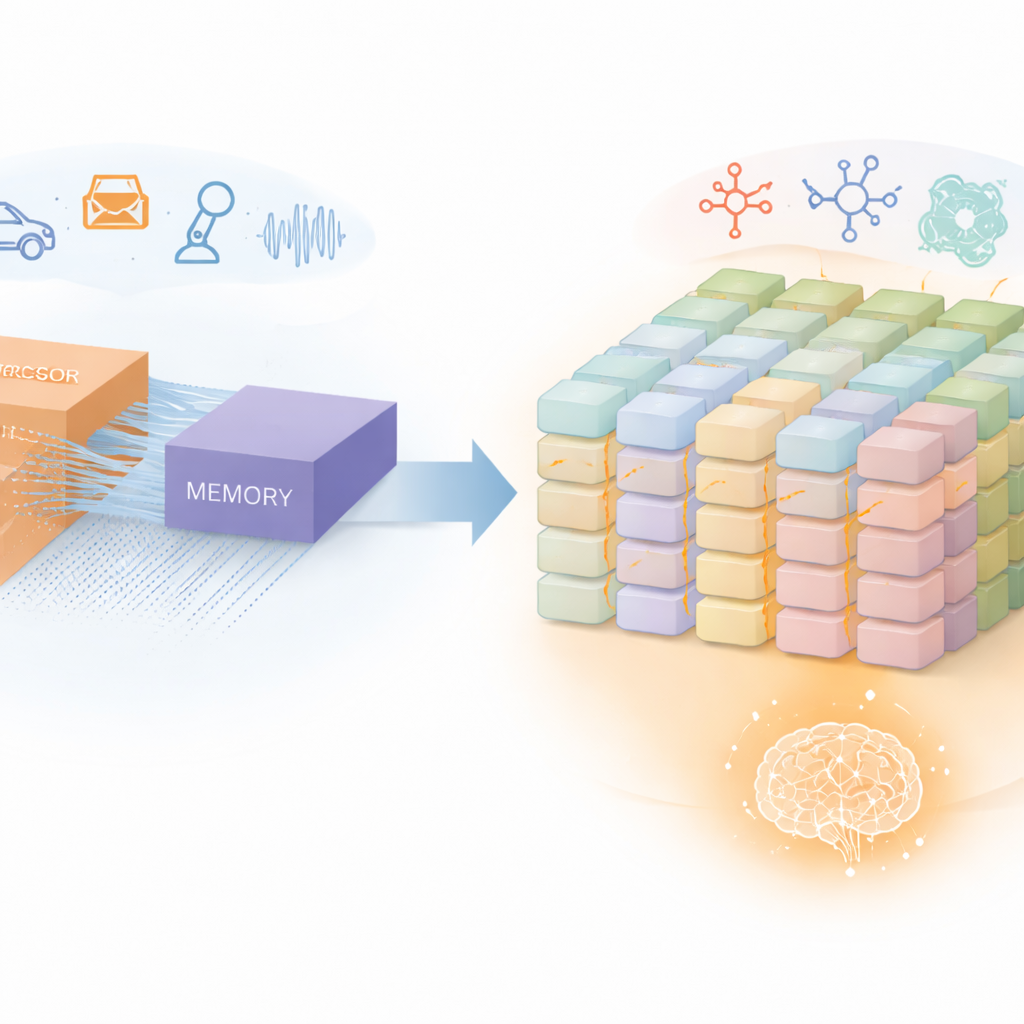
Today’s artificial intelligence systems, from game-playing programs to chatbots, rely on huge networks of simple math units that gulp energy and demand powerful graphics chips. This paper introduces a different kind of AI hardware that blends memory and computation in the same tiny elements and is tailored to a new class of neural networks called Kolmogorov–Arnold networks. The result is a chip concept that aims to learn more like a brain—flexibly and efficiently—while using far less power than today’s mainstream hardware.
A fresh way for neural networks to learn
Most neural networks in use today, such as multilayer perceptrons, rely on fixed mathematical recipes where learning happens mainly by adjusting the strength of connections between artificial neurons. Kolmogorov–Arnold networks take a different approach: instead of only tuning connection strengths, they learn the detailed shape of the functions that transform inputs into outputs. These learned curves act like customizable building blocks, letting the network adapt to complex data patterns and, importantly, remember old tasks while learning new ones. However, implementing these rich functions on ordinary chips is expensive in terms of circuitry and energy, because it requires many repeated and irregular calculations that standard processors and graphics chips do not handle efficiently.
A new kind of memory cell
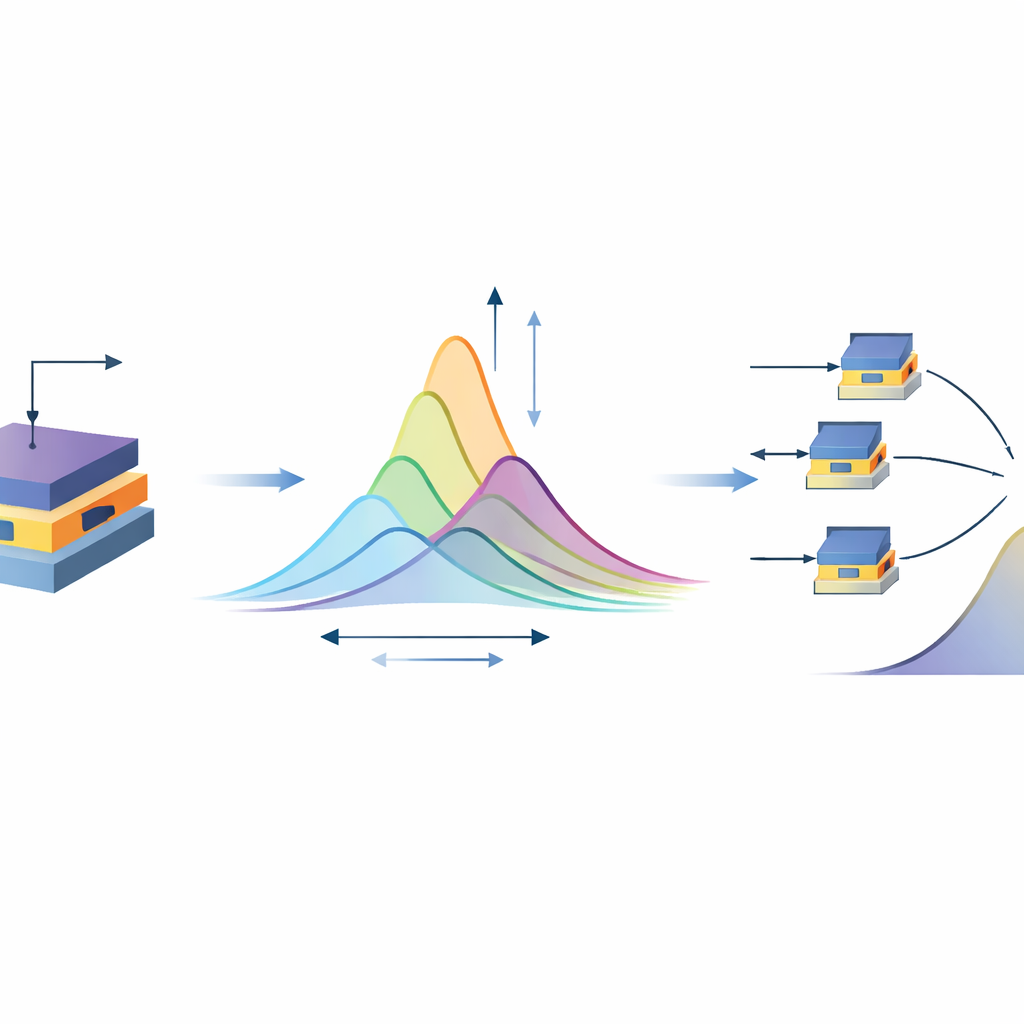
To bridge this gap between algorithm and hardware, the researchers designed a basic electronic building block they call a Gaussian-like memory cell. Each cell combines two nanoscale components in series: a special transistor whose electrical response rises and falls in a smooth bell-shaped curve, and a memristor, a device whose resistance can be permanently tuned by electrical pulses. By adjusting the memristor, the team can shift and scale the bell-shaped response of the transistor, effectively programming the height and width of a Gaussian-like curve directly in the hardware. Measurements show that these cells can be repeatedly reprogrammed, retain their state for long times, and behave uniformly across many cycles and devices, all of which are vital for building reliable large arrays.
Turning cells into an in-memory brain
The next step is arranging thousands of these memory cells into grid-like crossbar circuits. In this layout, rows and columns of wires intersect at each cell, and signals applied along the columns control the cells’ behavior while currents collected along the rows naturally add up according to basic electrical laws. This means the chip can perform the core operations of a Kolmogorov–Arnold network—adding together many Gaussian-like functions to form a flexible activation curve—directly where the information is stored, without shuttling data back and forth between separate processors and memory. Additional circuitry allows positive and negative contributions to be represented and summed, and optional residual paths enhance the stability of deep networks without replacing the core in-memory computation.
Putting the architecture to the test
Using detailed simulations tied to measured device behavior, the authors show that networks built from these memory-cell arrays can tackle a wide range of tasks. They successfully fit complicated one-dimensional functions without forgetting earlier ones, recognize handwritten digits and clothing items, solve partial differential equations, and forecast chaotic time series. Across these settings, the Gaussian-cell networks retain the key strengths of Kolmogorov–Arnold networks: strong performance with relatively few parameters and a marked ability to avoid catastrophic forgetting when trained on new tasks. When compared with conventional neural networks implemented using similar memristive hardware, the new architecture often achieves better accuracy and generalization while using smaller intermediate layers.
Energy savings and practical promise
Because computation occurs inside the same elements that store the learned parameters, the proposed architecture largely sidesteps the costly traffic between memory and processor that plagues today’s AI hardware. The authors estimate that their Gaussian-like memory cell system can perform the core operations of Kolmogorov–Arnold networks with roughly two orders of magnitude better energy efficiency than modern graphics chips running equivalent algorithms. In simple terms, the work outlines how to build chips where each tiny device can both remember and compute flexible bell-shaped responses, and where many such devices collaborate in parallel. This points toward future neuromorphic hardware that learns continuously, resists forgetting, and runs powerful AI models on far less energy than existing platforms.
Citation: Wen, Z., Zhang, Q., Chen, J. et al. Computing-in-memory architecture for Kolmogorov-Arnold networks based on tunable Gaussian-like memory cells. Nat Commun 17, 3496 (2026). https://doi.org/10.1038/s41467-026-69592-w
Keywords: neuromorphic computing, in-memory computing, Kolmogorov-Arnold networks, memristor devices, energy-efficient AI hardware